라 포르나리나 (La Fornarina)
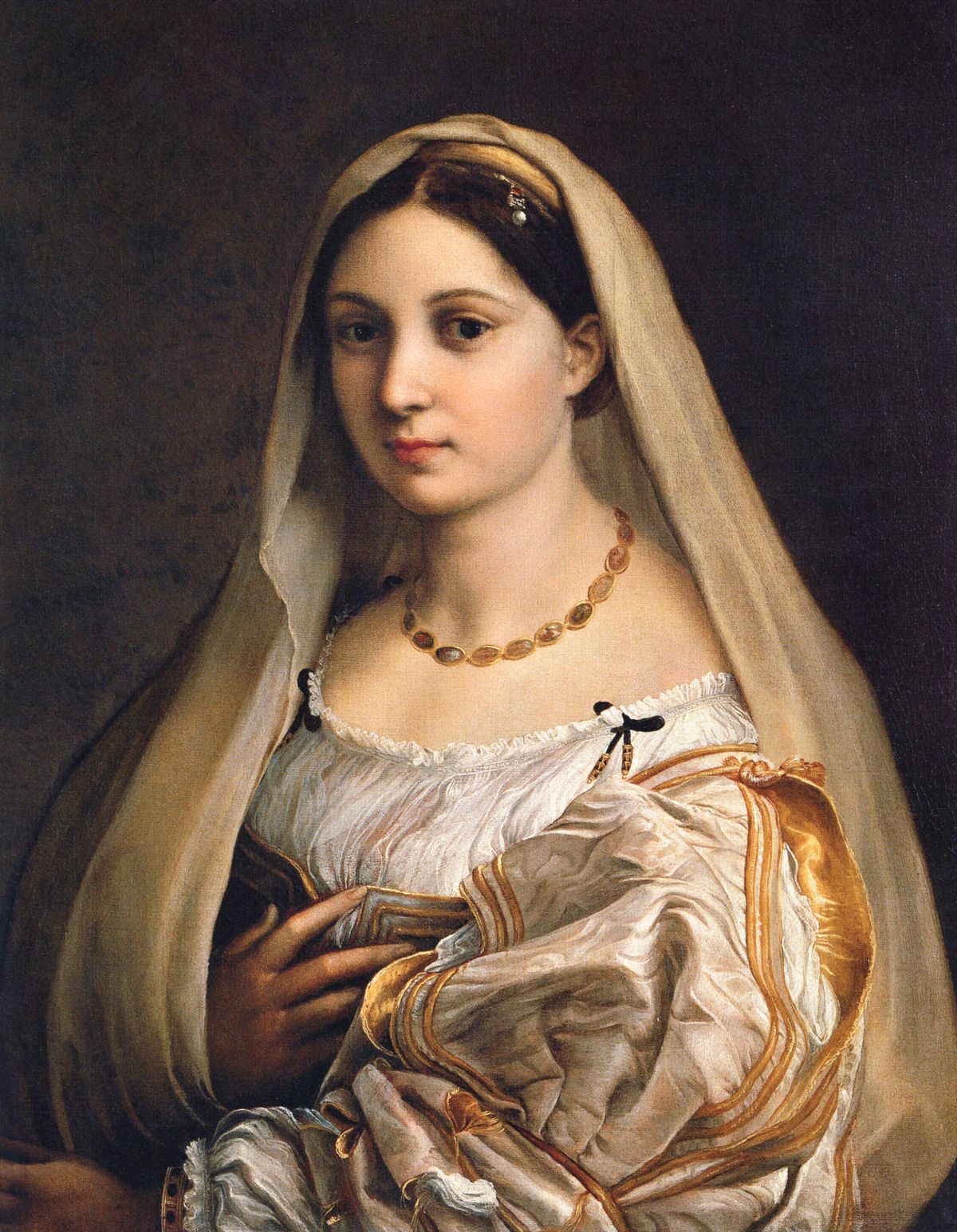
이 작품은 르네상스 전성기 거장 라파엘로 산치오(Raphael Sanzio, 1483–1520)가 1518–1519년경 완성한 대표적 명작 <라 포르나리나 (La Fornarina / 제빵사의 딸)>로, 현재 이탈리아 로마의 팔라초 바르베리니 국립고대미술관(Galleria Nazionale d'Arte Antica, Palazzo Barberini)에 소장되어 있습니다. 화면 상반신을 드러낸 채 자애롭고 비밀스러운 미소를 짓고 있는 여인을 통해 감성적이면서도 격조 높은 르네상스 여성미를 선명하게 보여주는 수작입니다.
미술사학계의 도상학적 분석에 따르면, 여인이 머리에 쓴 터번과 보석 핀, 그리고 왼쪽 팔에 착용한 진 푸른색 리본(Armband)은 매우 중요한 상징성을 지닙니다. 특히 팔에 착용된 리본에는 'RAPHAEL URBINAS(우르비노의 라파엘로)'라는 서명이 명확히 각인되어 있어, 이 화폭이 단순한 대상의 묘사를 넘어 작가 본인과의 깊은 결속을 뜻함을 증명합니다. 배경에 배치된 도금양(Myrtle)과 모란, 도화나무 잎사귀는 고대 신화에서 사랑과 풍요, 그리고 영원한 미덕을 상징하는 전통적인 알레고리입니다.
이 화폭에는 르네상스 미술사에서 가장 유명한 비하인드 스토리와 후대의 뜨거운 평가가 담겨 있습니다. '라 포르나리나'라는 명칭은 '제빵사(Fornaio)의 딸'이라는 뜻으로, 라파엘로가 죽기 직전까지 평생 비밀리에 사랑했던 운명의 연인 마르가리타 루티(Margarita Luti)를 모델로 그린 것입니다. 라파엘로는 1520년 갑작스럽게 세상을 떠날 때까지 이 그림을 자신의 스튜디오 깊은 곳에 간직하였으며, 그가 사망한 직후 수제자 줄리오 로마노에 의해 발견되었습니다. 후대 학자들은 이 작품을 라파엘로가 남긴 인물 초상화 중 가장 감성적이고 파격적인 에로티시즘과 고전적 품격이 완벽하게 결합된 거장의 마지막 유산으로 평가합니다.
이 그림을 가만히 들여다보고 있으면 보는 이의 무의식 속에서 은은한 시선 고정 기전이 자연스럽게 작동합니다. 여인의 그윽하면서도 살짝 비껴가는 눈빛에서 출발한 시선은 그녀의 왼팔에 적힌 서명 리본을 따라 아래로 내려갔다가, 가슴을 살포시 감싸쥔 우아한 손끝을 거쳐 다시 머리의 보석 핀과 배경의 도금양 잎사귀로 피어오릅니다. 이러한 부드러운 대각선 시선 유도는 대뇌 시각 인지 영역에서 찰나의 긴장감을 해쇄하고, 인물의 비밀스러운 아우라와 함께 가슴속 깊은 곳에서 밀려오는 평온함과 안식을 느끼게 해 줍니다.
This masterpiece, titled La Fornarina (The Baker's Daughter), was created around 1518–1519 by High Renaissance master Raphael Sanzio (1483–1520) and is currently preserved in the Galleria Nazionale d'Arte Antica (Palazzo Barberini) in Rome, Italy. Depicting a half-nude woman with a subtle, enigmatic smile, the portrait stands as a poignant embodiment of Renaissance sensuality and refined elegance.
Art historical scholarship highlights the profound personal iconography within her adornments, particularly the vibrant blue armband encircling her left arm inscribed with "RAPHAEL URBINAS" (Raphael of Urbino). This explicit signature seals a deeply personal bond between artist and subject. The background foliage, filled with myrtle and quince leaves, draws upon classical symbolism associated with Venus, representing eternal love, marital devotion, and fertility.
Fascinating historical backstories and profound art historical evaluations surround this iconic portrait. "La Fornarina," meaning "the baker's daughter," refers to Margarita Luti, the legendary mistress and enduring muse of Raphael's life. Kept privately in the master's studio until his tragic death in 1520, the panel was discovered shortly after by his primary assistant, Giulio Romano. Modern art historians celebrate this work as Raphael's final masterpiece of intimate portraiture, praising its soft chiaroscuro and poetic synthesis of human intimacy and High Renaissance classicism.
Engaging with this iconic narrative gently activates a subtle subconscious visual rhythm. The viewer's gaze originates at her intimate, luminous eyes, moves downward along the signed blue armband and the graceful hand resting against her chest, and reascends along the contours of her turband and background greenery. This soft circular visual loop dissolves cognitive friction, inviting the mind into a quiet sanctuary of serene reflection.
본 리뷰에서 작품을 제외한 컨텐츠의 저작권은 팔렛트제주에 있습니다.
"퍼블릭도메인 고전명화"를 제외한 모든 창작 콘텐츠는 저작권법 제4조 및 제10조에 의거하여 보호됩니다. 무단 도용시 저작권법 제136조(벌칙)에 의거, 당사의 사전 서면 승인 없는 저작권 침해 행위를 금지합니다.