세 미의 여신(Three Graces)
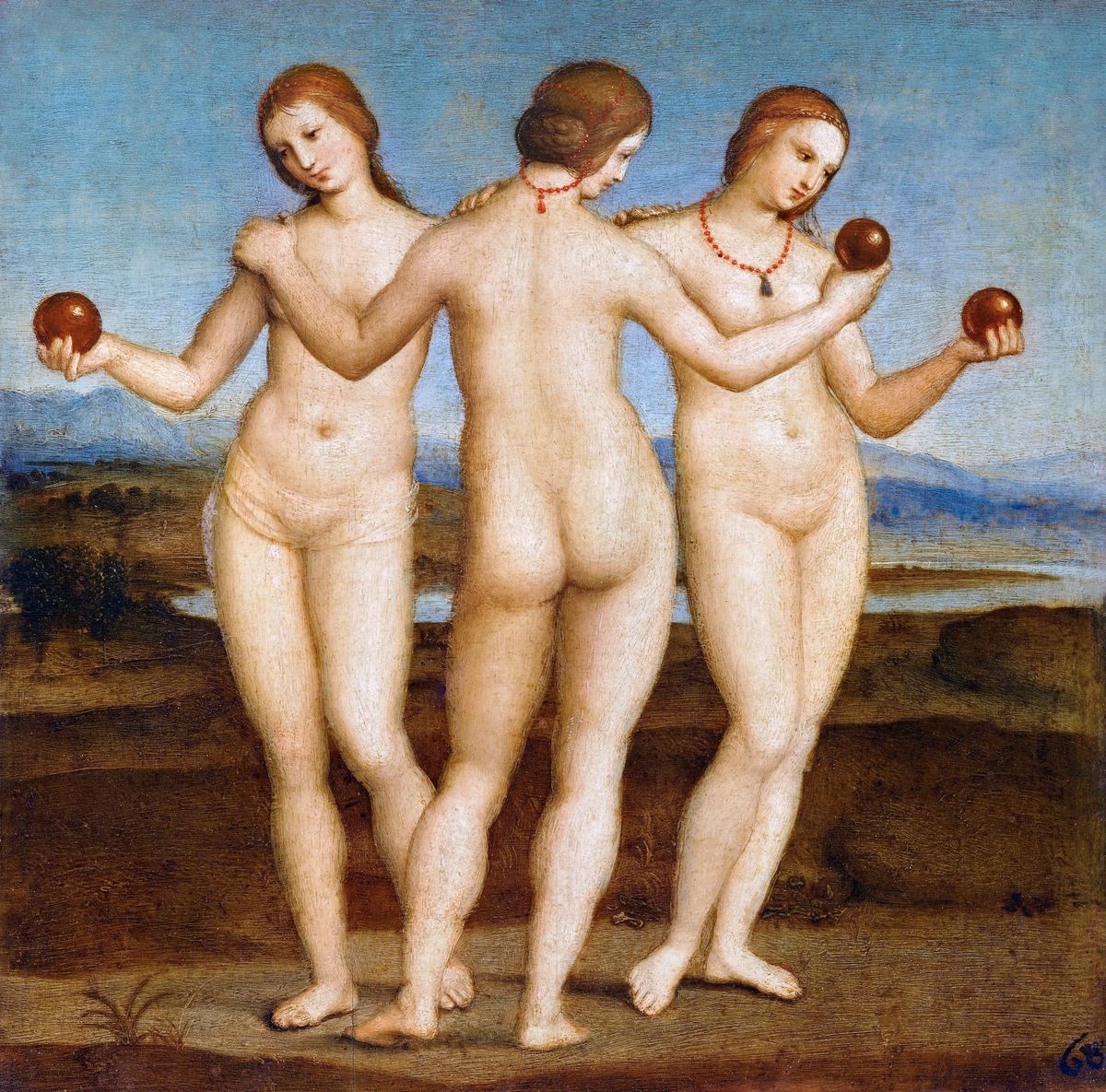
이 작품은 르네상스 전성기의 거장 라파엘로 산치오(Raphael Sanzio)가 1504–1505년경 완성하여 현재 프랑스 샹티이의 샹티이 미술관(Musée Condé, Chantilly)에 소장 중인 명작 <삼체 (The Three Graces, 삼미신)>입니다. 그리스 신화 속 아글라이아(Radiance), 탈리아(풍요), 에우프로시네(기쁨)를 화폭에 담아내어 고전적 미학의 정점인 완벽한 비율적 조화를 정교하게 구현해 낸 수작입니다.
미술사학계의 도상학적 분석에 따르면, 라파엘로는 보르게세 집안이 소장했던 시에나 대성당의 고대 로마 조각상을 직접 관찰하고 이를 이탈리아 르네상스의 유연한 인체 표현으로 재해석했습니다. 여신들이 들고 있는 황금 사과는 그리스 신화 속 헤스페리데스의 사과이자 영생과 미덕의 상징으로 해석됩니다. 이는 고대 로마 철학자 세네카(Seneca)의 철학서 《혜택에 대하여(De Beneficiis)》 및 신플라톤주의 학파에서 다루었던 베풂, 받음, 보답으로 이어지는 호혜적 미덕과 미적 에너지가 영원히 회전한다는 철학적 알레고리를 내포합니다.
감상자가 이 작품을 지각할 때, 인지 구조의 표면 아래 자리한 무의식적 시선 이동 패턴이 정밀하게 작동합니다. 중앙에 뒤돌아선 여신의 콘트라포스토(Contrapposto) 자태와 양옆 여신들이 이루는 미세한 시선 및 어깨 라인의 각도는 감상자의 시선을 시계 방향의 완벽한 원형 궤적으로 유도합니다. 이 시각적 닫힌 고리(Visual Closed Loop)는 뇌의 무의식적 인지 영역에서 원초적 불안 요소를 해쇄하고 극대화된 심리적 안정감을 유발합니다. 라파엘로 특유의 부드러운 스푸마토 조형과 피타고라스적 피보나치 황금비에 기반한 삼각 구도가 시각 경로를 통해 대뇌로 전달되며, 감상자는 정서적 편안함과 함께 내면의 깊은 사색 및 평정 상태로 진입하는 긍정적 심리 전이를 경험하게 됩니다.
This masterpiece, titled The Three Graces, is an iconic creation by High Renaissance master Raphael Sanzio, painted around 1504–1505 and currently housed in the Musée Condé in Chantilly, France. Personifying Aglaea (Radiance), Thalia (Abundance), and Euphrosyne (Joy) from classical mythology, the work stands as a quintessential realization of Renaissance balance, proportion, and aesthetic perfection.
The classical composition features the three maidens holding golden orbs while interlinking their arms in a harmonious embrace, transcending mere mythic narrative. Art historical scholarship indicates that Raphael drew direct inspiration from an antique Roman marble sculpture preserved in Siena, transforming classical antiquity into the fluid, ideal humanism of the High Renaissance. Rooted in Seneca’s moral treatise De Beneficiis and Neoplatonist philosophy, this tripartite configuration allegorizes the perpetual cycle of grace: the generous bestowal, gracious acceptance, and dutiful reciprocation of divine love and virtue, symbolized by the golden apples of immortality.
Upon encountering this iconographic arrangement, a subtle subconscious perceptual mechanism is activated within the viewer's psyche. The counterpoised posture of the central figure, juxtaposed with the gentle angles of her companions' shoulders and inclined gazes, establishes an unbroken circular movement for the eye. This unconscious visual loop dissolves cognitive friction, instilling a profound sense of inner composure. As the mind instinctively registers these ideal mathematical proportions and soft Renaissance chiaroscuro, the aesthetic experience transitions into an invigorating sanctuary of psychological tranquility.
본 리뷰에서 작품을 제외한 컨텐츠의 저작권은 팔렛트제주에 있습니다.
"퍼블릭도메인 고전명화"를 제외한 모든 창작 콘텐츠는 저작권법 제4조 및 제10조에 의거하여 보호됩니다. 무단 도용시 저작권법 제136조(벌칙)에 의거, 당사의 사전 서면 승인 없는 저작권 침해 행위를 금지합니다.