장미의 성모 (Madonna of the Rose)
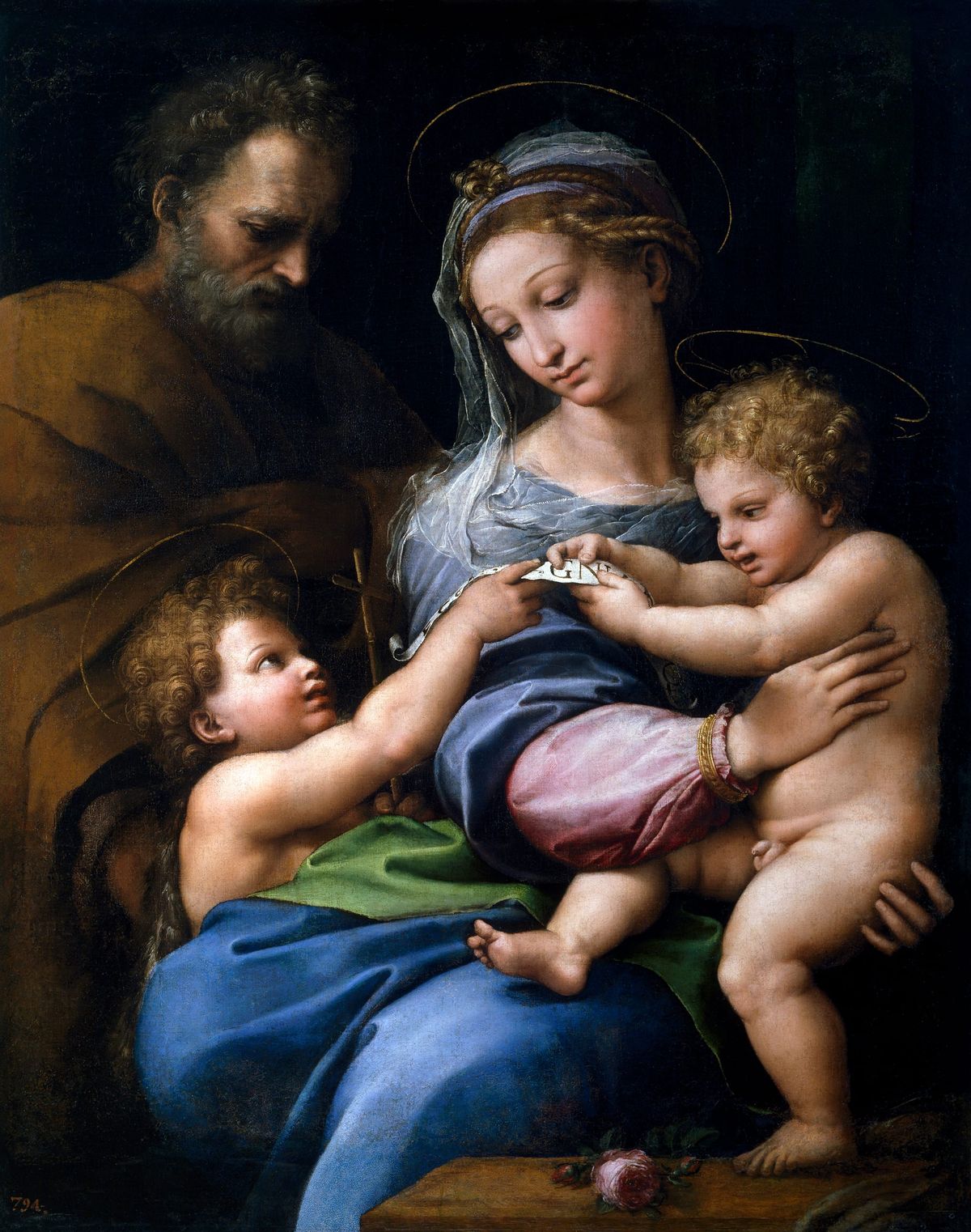
이 작품은 르네상스 전성기 거장 라파엘로 산치오(Raphael Sanzio, 1483–1520)와 그의 스튜디오가 1518–1520년경 완성한 명작 <장미의 성모 (Madonna of the Rose / Madonna della Rosa)>로, 현재 스페인 마드리드의 프라도 미술관(Museo del Prado, Madrid)에 소장되어 있습니다. 성모 마리아와 아기 예수, 어린 세례 요한, 그리고 뒤편의 성 요셉이 한자리에 모여 성가족의 은혜롭고 차분한 한때를 담아낸 수작입니다.
미술사학계의 도상학적 분석에 따르면, 어린 세례 요한이 아기 예수에게 전달하는 두루마리에는 'Agnus Dei(보라, 세상 죄를 지고 가는 하나님의 어린양이로다)'라는 문구가 적혀 있어 예수 그리스도의 구원자적 사명을 직접적으로 암시합니다. 성모 마리아가 두 아이를 따스하게 감싸며 내리까는 자애로운 시선은 어머니로서의 깊은 모성애와 천상의 순수함을 동시에 보여줍니다. 아래쪽 탁자 위에 놓인 한 송이 붉은 장망(Rose)은 성모 마리아의 순결함과 장차 예수가 흘릴 수난의 피를 상징하며, 어둡고 그윽한 배경 속 성 요셉의 엄숙한 모습은 화면에 영적인 깊이와 중후한 조화를 더해줍니다.
이 화폭에는 르네상스 미술사에서 손꼽히는 흥미로운 제작 비하인드와 현대 과학이 밝혀낸 역사적 평가가 담겨 있습니다. 이 작품은 라파엘로 생애 마지막 시기에 그의 디자인을 바탕으로 수제자 줄리오 로마노(Giulio Romano)와의 협업을 통해 제작된 것으로 알려져 있습니다. 특히 2020년대 최첨단 인공지능(AI) 및 과학적 분석 기법을 통한 연구에서 성모와 아기 예수, 장미가 그려진 핵심 부분은 라파엘로 본인의 손길이 명확하며, 성 요셉과 하단 구도는 스튜디오의 손길이 더해졌음이 밝혀져 큰 화제를 모았습니다. 후대 학자들은 이 작품을 라파엘로 특유의 명쾌한 구도와 스푸마토 명암법이 최절정에 달한 르네상스 성가족화의 명작으로 높이 평가합니다.
이 그림을 바라보고 있으면 보는 이의 무의식 속에서 완벽한 피라미드형 시선 순환 구조가 부드럽게 작동합니다. 성모 마리아의 우아한 시선에서 출발한 눈길은 두 아이가 함께 잡고 있는 성스러운 두루마리로 자연스럽게 모여들고, 아래쪽 탁자 위에 살포시 놓인 붉은 장미로 내려앉습니다. 이후 뒤편 성 요셉의 그윽한 시선을 거쳐 다시 성모의 온화한 얼굴로 돌아오는 유연한 곡선 흐름을 완성합니다. 이러한 안정적인 시선의 유도는 대뇌 시각 인지 영역에서 찰나의 피로와 긴장감을 가라앉히고, 가슴속 깊은 곳에서 밀려오는 포근한 온기와 고요한 내면의 안식을 선사합니다.
This masterpiece, titled Madonna of the Rose (Madonna della Rosa), was created around 1518–1520 by High Renaissance master Raphael Sanzio (1483–1520) in collaboration with his workshop, and is currently preserved in the Museo del Prado in Madrid, Spain. Depicting the Holy Family—the Virgin Mary, the Infant Christ, the young Saint John the Baptist, and Saint Joseph—the painting captures a moment of sacred intimacy and quiet grace.
Art historical scholarship highlights the rich theological symbolism woven into the composition. Young Saint John presents a parchment scroll to the Infant Jesus inscribed with "Agnus Dei," signifying Christ’s divine destiny as the Lamb of God. Mary's tender, downcast gaze reflects both maternal devotion and celestial purity. The single red rose resting upon the table in the foreground symbolizes both the Virgin's immaculate purity and the future Passion of Christ, while Saint Joseph’s contemplative presence in the shadowy background imparts spiritual depth and emotional balance to the narrative.
Fascinating historical backstories and groundbreaking modern evaluations surround this iconic panel. Long celebrated as a landmark of Raphael’s late Roman period, recent advanced AI and scientific analysis confirmed that while Raphael directly executed the central figures of Mary, Christ, and the rose, his primary assistant Giulio Romano contributed to Saint Joseph and the lower composition. Art historians revere this work as an extraordinary testament to Raphael's compositional brilliance, praising its seamless harmony of luminous chiaroscuro, soft sfumato, and classical humanism.
Engaging with this devotional composition gently awakens a harmonious subconscious visual rhythm. The viewer’s gaze originates at the Virgin’s serene countenance, descends along her arm toward the parchment scroll held between the two children, and settles briefly upon the red rose on the ledge below. The eye then ascends through the quiet presence of Saint Joseph back to Mary's face, completing a soft, triangular loop. This fluid visual movement dissolves internal cognitive friction, inviting the mind into a peaceful sanctuary of quiet reverence and enduring serenity.
본 리뷰에서 작품을 제외한 컨텐츠의 저작권은 팔렛트제주에 있습니다.
"퍼블릭도메인 고전명화"를 제외한 모든 창작 콘텐츠는 저작권법 제4조 및 제10조에 의거하여 보호됩니다. 무단 도용시 저작권법 제136조(벌칙)에 의거, 당사의 사전 서면 승인 없는 저작권 침해 행위를 금지합니다.