연안 파도 - Undertow
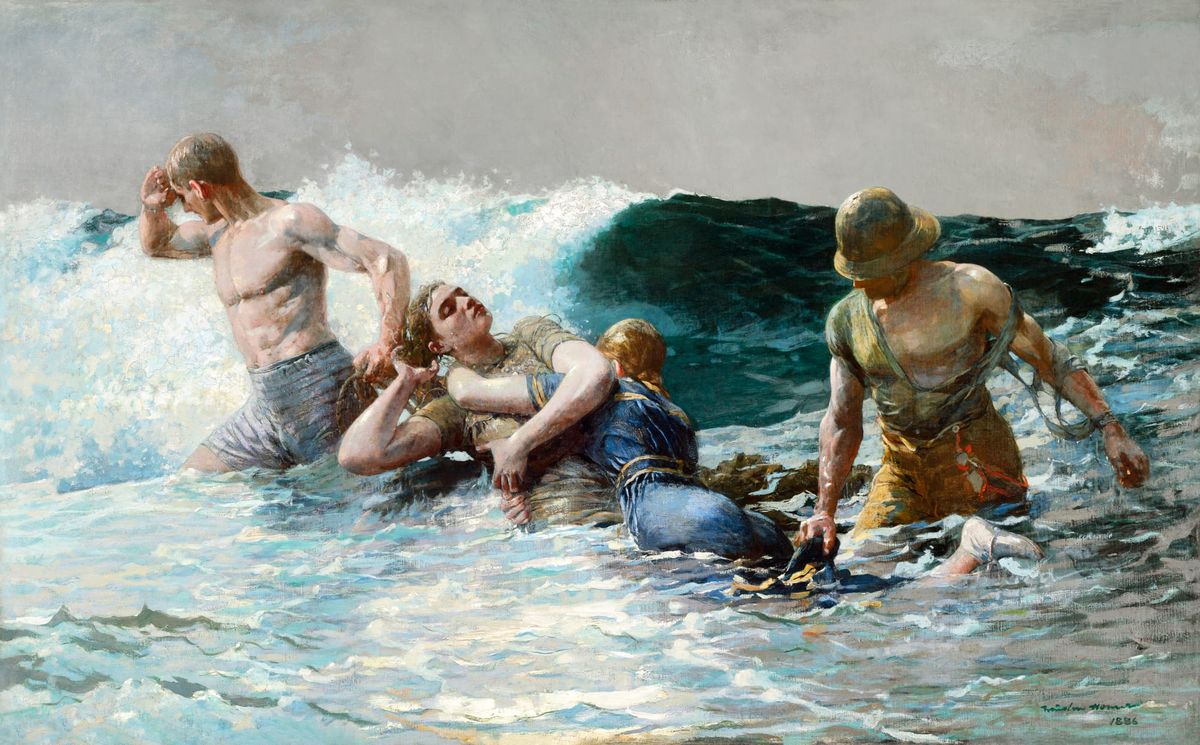
미국 사실주의와 해양 회화의 거장 윈슬로 호머(Winslow Homer, 1836–1910)가 1886년에 완성한 유화 대작입니다. 현재 미국 매사추세츠주에 위치한 클라크 미술관(Sterling and Francine Clark Art Institute)에 소장되어 있으며, 캔버스 위에 유채(Oil on canvas)로 제작된 실제 크기는 세로 76.8cm, 가로 127cm의 웅장한 가로형 규격입니다.
호머는 성난 바다의 역동적인 파도와 젖은 피부의 질감을 표현하기 위해 대담한 임파스토와 정교한 글레이징 기법을 결합했습니다. 등 뒤에서 거대하게 솟구쳐 오르는 파도의 에메랄드빛과 흰 포말은 묵직한 물감 층으로 입체감을 극대화했고, 물에 젖어 살갗에 달라붙은 수영복과 근육질 남성들의 탄탄한 신체는 햇빛을 받아 반짝이는 빛의 굴절 효과를 섬세하게 포착하여 현장감 넘치는 생생한 긴장감을 부여했습니다.
이 작품의 모티프는 1883년 여름 뉴저지주 애틀랜틱시티 해변에서 호머가 직접 목격한 극적인 인명 구조 사건에서 비롯되었습니다. 당시 바다의 강한 이안류(Undertow)에 휩쓸려 익사 위기에 처했던 두 명의 젊은 여성을 두 명의 용감한 해상 인명구조원이 거친 파도를 뚫고 헤엄쳐 들어가 안전하게 구조해 냈습니다.
비하인드 스토리로, 호머는 이 구조의 순간을 화폭에 생생히 재현하기 위해 메인주 프라우츠넥에 있는 자신의 작업실 옥상에 모델들을 세워두고 작업을 진행했습니다. 햇빛에 반사되는 젖은 인체의 질감을 사실적으로 관찰하기 위해 그는 조수에게 양동이에 물을 가득 담아와 포즈를 취하고 있는 남녀 모델들의 몸에 쉴 새 없이 끼얹게 했습니다. 쌀쌀한 북동부 바닷바람을 맞으며 떨던 모델들의 고투 끝에 완성된 이 그림은 1886년 발표 당시 "자연의 압도적인 위력 앞에 맞선 인간의 숭고한 용기와 육체미를 가장 현대적이고 고전적인 조형미로 담아낸 걸작"이라는 극찬을 받으며 미국 해양 미술의 기념비적인 성취로 기록되었습니다.
관람자의 무의식적 시선은 화면 중앙에서 정신을 잃고 구조원의 품에 안겨 있는 두 여성의 축 늘어진 신체로 가장 먼저 이끌립니다. 거친 파도 속에서 서로를 꼭 끌어안은 여성들의 모습은 보는 이에게 즉각적인 연민과 긴박한 정서적 몰입을 불러일으킵니다.
이어서 시선은 왼쪽에서 거대한 파도를 등지고 우람한 팔근육으로 밧줄을 움켜쥔 채 앞으로 나아가는 남성과, 우측에서 묵묵히 균형을 잡으며 물살을 버티는 헬멧 쓴 구조원의 단단한 자세로 자연스럽게 이동합니다. 거대한 에메랄드빛 파도의 위협적인 배경에도 불구하고 인물들의 유기적인 연결과 견고한 피라미드 구도는 무의식적인 시각적 안도감을 형성하며, 극단적인 위기 속에서도 서로를 구원해 내는 인간의 강인한 연대와 생명력을 통해 깊은 정서적 안정감과 카타르시스를 선사합니다.
Undertow
Completed in 1886 by Winslow Homer (1836–1910), a titan of American Realism and marine painting, this masterwork in oil is housed in the permanent collection of the Clark Art Institute in Williamstown, Massachusetts. Rendered in oil on canvas, the piece measures approximately 76.8 cm in height by 127 cm in width.
Homer masterfully captured the surging force of the Atlantic tide and the tactile quality of sunlit flesh by blending robust impasto with luminous glazes. The towering emerald wave cresting in the background is modeled with dense, textured paint to convey sheer physical mass, while the cling of sea-soaked woolen bathing suits and the strained anatomy of the lifesavers are articulated with dazzling light effects that heighten the dramatic immediacy of the rescue.
The genesis of this work stems from a real-life drama witnessed by Homer in the summer of 1883 at Atlantic City, New Jersey. Two young bathers were dragged out to sea by a treacherous undertow before two heroic lifeguards plunged into the turbulent surf to bring them back to shore.
A captivating studio anecdote reveals that Homer went to extraordinary lengths to ensure absolute realism in his Prouts Neck studio in Maine. He posed models on the studio roof under the open sky, instructing an assistant to repeatedly douse them with buckets of cold water so he could study the glistening patterns of wet skin and heavy, saturated fabric under direct sunlight. When debuted at the National Academy of Design in 1886, Undertow was universally lauded by critics as an artistic triumph, seamlessly fusing classical sculptural heroism with modern realism to portray humanity's noble resilience against the raw forces of nature.
The viewer's subconscious gaze immediately fastens upon the vulnerable, interlocking figures of the two women at the center, their limp forms and clasped arms evoking an immediate surge of empathy and dramatic tension.
The eye is then anchored by the muscular heroic rescuer on the left bracing against the roaring surf, before traveling to the steadfast, helmeted figure on the right wading with resolute determination through the foam. Despite the impending wall of dark ocean water, the solid compositional triangle and linked hands instill a profound sense of physical and emotional rescue, transforming instinctual panic into deep psychological relief and reaffirming the enduring power of human solidarity in times of peril.
본 리뷰에서 작품을 제외한 컨텐츠의 저작권은 팔렛트제주에 있습니다.
"퍼블릭도메인 고전명화"를 제외한 모든 창작 콘텐츠는 저작권법 제4조 및 제10조에 의거하여 보호됩니다. 무단 도용시 저작권법 제136조(벌칙)에 의거, 당사의 사전 서면 승인 없는 저작권 침해 행위를 금지합니다.