워싱턴 산의 승마객들 - The Bridle Path, White Mountains
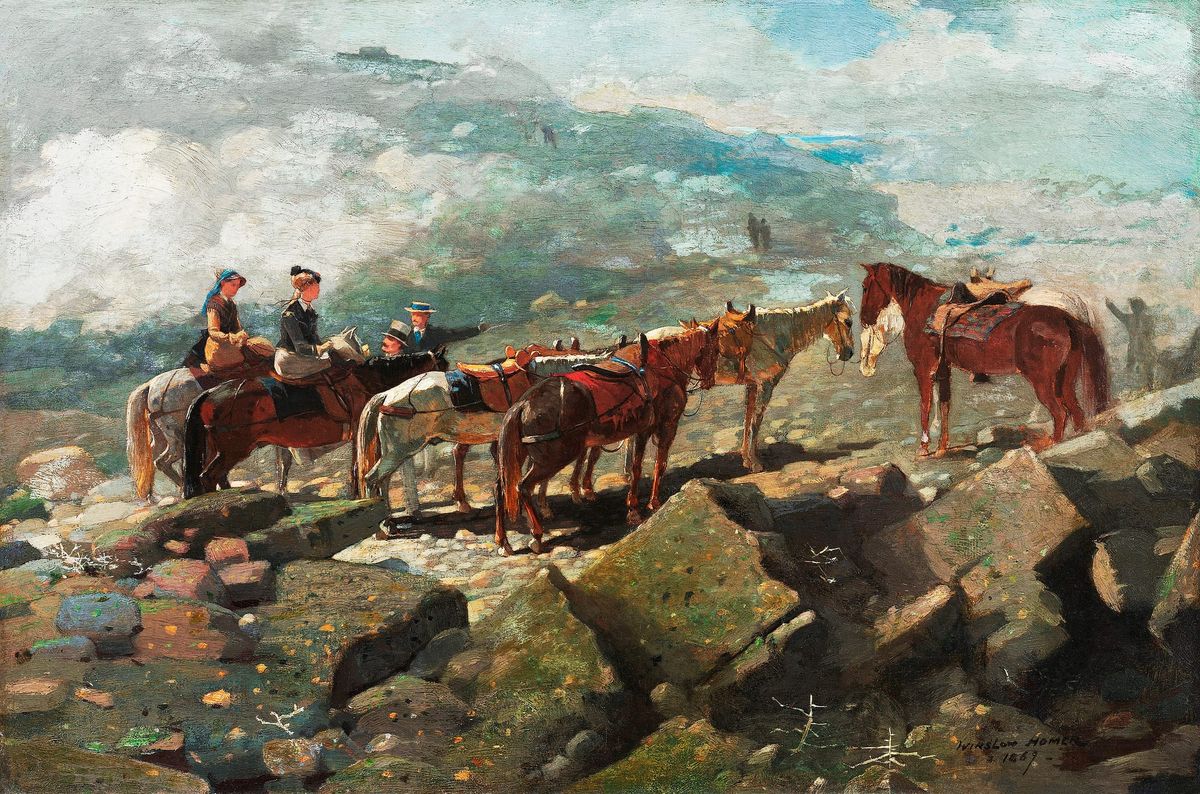
미국의 전설적인 사실주의 거장 윈슬로 호머(Winslow Homer, 1836–1910)가 1868년에 완성한 유화 명작 <워싱턴 산의 승마객들(The Bridle Path, White Mountains / Mount Washington)>은 웅장한 고산 지대의 운무와 험준한 바윗길을 오르는 당대 여행객들의 활기찬 여정을 탁월한 명암과 서정미로 포착해 낸 수작입니다.
이 작품은 가로 61.0cm, 세로 40.6cm 크기의 캔버스 위에 탄탄한 유화 기법으로 제작되었으며, 전경의 거친 화강암 암석과 이끼의 질감에는 도톰한 임파스토를 밀도 있게 얹고, 능선을 감싸며 피어오르는 안개와 맑은 고산의 대기감은 부드럽고 유연한 붓 터치로 살려냈습니다.
현재 미국 매사추세츠주 윌리엄스타운의 클라크 아트 인스티튜트(Clark Art Institute)에 소장되어 있는 이 그림은 뉴햄프셔주 화이트 마운틴의 최고봉인 워싱턴 산 정상 부근 브라이들 패스(승마 등산로)에서, 말을 타고 능선에 오른 세련된 여성 여행객들과 가이드, 그리고 안장을 얹은 말들이 잠시 멈추어 서서 구름 덮인 장관을 마주하는 극적인 순간을 담고 있습니다.
이 그림에는 남북전쟁 직후 미국의 새로운 여가 문화로 떠오른 산악 관광의 현장에 매료되었던 호머의 인간적인 애정과 유쾌한 비하인드가 깃들어 있습니다. 1860년대 후반 호머는 화이트 마운틴 일대를 여행하며 험준한 산악 지형을 드레스 차림으로 과감히 오르는 현대적인 여성 여행객들의 당당한 모습에 깊은 인상을 받았습니다.
호머는 구름이 발아래로 깔리는 정상 부근의 변화무쌍한 빛을 담기 위해 바위투성이 등산로에 이젤을 폈습니다. 당시 모델이자 실제 여행객이었던 여성들은 거친 산바람에 모자가 날아가고 말들이 가파른 바위 틈새에서 멈칫거리자 긴장과 웃음이 뒤섞인 비명을 지르곤 했습니다.
그때 뒤편에서 말을 몰던 산악 가이드가 먼 안개 속을 가리키며 저 멀리 또 다른 등산객들이 오고 있다고 소리치자, 호머는 "잠깐만 그대로 계시오! 바람에 흩날리는 저 푸른 리본과 말들의 호흡이야말로 이 거대한 산이 인간에게 건네는 가장 벅찬 환영사요!"라며 외치고는, 햇살이 바위와 말 잔등을 비추는 찰나를 놓칠세라 신나게 붓을 놀렸다는 훈훈한 일화가 전해집니다.
화면 전경에 거칠게 쪼개진 바위 표면의 황금빛 지의류와 말안장의 붉은 담요, 그리고 저 멀리 안개 속에서 손을 흔드는 작은 산악인의 실루엣은 호머가 현장의 생생한 현장감을 얼마나 정교하게 포찰했는지를 증명합니다.
미술사학자들은 이 작품을 남북전쟁 이후 상처 입은 미국 사회에 광활한 국토의 웅장함과 새로운 시대의 활력을 상기시켜 준 최고의 초기 걸작으로 평가합니다.
유럽의 이상주의적 풍경화 전통을 탈피하여 미국 고유의 험준한 자연환경과 이를 탐험하는 진취적인 인간 군상을 사실적이면서도 신선한 야외 자연광으로 구현해 냈다는 찬사를 받습니다.
작품을 마주할 때 관람자의 무의식적인 시선은 바윗길의 경사를 따라 매우 역동적이고 시원한 좌우 지그재그 궤적을 그리며 이동합니다. 관람객의 눈길은 가장 먼저 화면 좌측에서 말을 타고 당당하게 허리를 펴고 앉아 있는 두 여인의 단아한 실루엣과 푸른 머리띠 리본에 머뭅니다.
이어 시선은 여인들이 탄 말들의 다부진 다리와 안장을 타고 중앙으로 이동하여, 황갈색과 갈색 말들이 만들어내는 리드미컬한 등선과 먼 곳을 가리키는 중절모 신사의 역동적인 손짓으로 자연스럽게 이어집니다.
능선의 행렬을 훑은 시선은 화면 우측에서 고개를 돌려 관람자 쪽을 응시하는 갈색 말의 생생한 눈빛을 지나, 화면 앞쪽을 가득 채운 거칠고 묵직한 화강암 바위들의 견고한 질감으로 미끄러져 내려옵니다.
이후 시선은 바위틈을 돌아 화면 상단의 웅장한 산등성이와 그 위로 하얗게 굽이치며 솟아오르는 신비로운 뭉게구름, 그리고 맑은 푸른 하늘로 상승하며 탁 트인 고산의 개방감을 만끽하게 됩니다.
이러한 유려한 시선의 순환은 관람자의 내면에 깊은 심리적 해방감과 청량한 안식을 선사합니다. 눈앞에 펼쳐진 거대한 산악 지대의 신선한 공기와 구름 위를 걷는 듯한 공간감은, 복잡한 일상의 답답함과 스트레스에 지친 현대인의 무의식에 마치 시원한 산꼭대기에서 바람을 깊게 들이마시는 듯한 깊은 이완과 감각적 정화를 제공합니다.
험준한 대자연의 품속에서도 두려움 없이 새로운 길을 열어가며 호흡하는 여행자들의 건강한 자태는, 보는 이에게 번잡한 걱정을 내려놓고 삶의 새로운 지평을 향해 나아갈 수 있는 내면의 굳센 용기와 맑은 평정을 되찾아 주는 든든한 치유의 위로를 건넵니다.
The Bridle Path, White Mountains
Completed in 1868 by the celebrated American realist master Winslow Homer (1836–1910), the oil masterpiece The Bridle Path, White Mountains (also known as Mount Washington) stands as an extraordinary tour de force capturing the alpine exhilaration, dramatic cloudscapes, and fashionable spirit of nineteenth-century American mountain tourism.
Measuring 61.0 cm wide by 40.6 cm high on canvas, the work showcases Homer's robust plein-air oil technique, applying thick, tactile impasto to the rugged granite boulders and lichens of the foreground path while articulating the swirling, luminous mountain mists and clear sky with fluid, atmospheric brushwork.
Preserved in the prestigious permanent collection of the Clark Art Institute in Williamstown, Massachusetts, this painting portrays a spirited party of equestrians navigating the rugged bridle path near the summit of Mount Washington in New Hampshire, pausing as horses and riders take in the panoramic vista of shifting clouds and peaks.
Behind this captivating canvas lies Homer's keen interest in the emergence of outdoor recreational culture in post-Civil War America. Visiting the White Mountains in the late 1860s, Homer was fascinated by the modern, independent women who boldly undertook the arduous ascent along rocky bridal paths in full riding attire.
Setting up his easel directly amidst the treacherous scree to capture the fleeting shifts of alpine light, Homer observed the party as sudden mountain gusts tugged at bonnets and caused the horses to tread cautiously over the rocky ledges.
When a guide pointed out distant hikers emerging through the vaporous clouds and the lead riders steadied their mounts with laughter, Homer called out in admiration, declaring that the wind-tossed blue ribbons and the steely footing of the mountain horses were nature's grandest welcome to the summit, rapidly recording the incandescent sunlight breaking across the horses' flanks.
The weathered fissures of the foreground rocks encrusted with golden lichen, the bright red saddle blankets, and the minute silhouette of a distant mountaineer signaling through the fog serve as authentic testaments to Homer's vivid firsthand engagement with the terrain.
Art historians celebrate this painting as a pivotal milestone of Homer's early career, extolling its rejection of romanticized European landscapes in favor of a crisp, direct American realism. By harmonizing the unyielding physical mass of ancient stone with the fleeting, buoyant energy of modern travelers, Homer elevated a mountain excursion into a timeless visual anthem of exploration, resilience, and optimism.
When engaging with the painting, the viewer's unconscious gaze undertakes an inherently refreshing and expansive visual journey. The eye is initially welcomed by the graceful silhouettes of the two women riding on the left, lingering upon the crisp blue ribbons fluttering against the alpine breeze.
The gaze then travels along the rhythmic row of pack horses and saddles toward the center, meeting the dynamic gesture of the gentleman pointing out across the misty valley.
Sweeping across the handsome brown horse turned toward the viewer on the right, the eye descends into the textured mass of dark granite boulders dominating the foreground, absorbing the rugged stability of the mountain path.
Finally, ascending naturally through the swirling white vapor rising behind the ridge, the viewer's attention expands into the vast blue sky and sunlit peaks, embracing the boundless clarity of the high mountain air.
This rhythmic visual journey fosters profound psychological reassurance, mental lightness, and deep emotional stillness within the observer. The sensory immersion in bracing mountain breezes and towering peaks acts as an intuitive emotional balm, dispelling ambient modern fatigue and inner tension.
By presenting a world embraced by adventurous courage, natural majesty, and incandescent daylight, Homer offers the observer a comforting sanctuary of mindfulness, inspiring a deep sense of renewal, sweet contentment, and enduring inner peace.
본 리뷰에서 작품을 제외한 컨텐츠의 저작권은 팔렛트제주에 있습니다.
"퍼블릭도메인 고전명화"를 제외한 모든 창작 콘텐츠는 저작권법 제4조 및 제10조에 의거하여 보호됩니다. 무단 도용시 저작권법 제136조(벌칙)에 의거, 당사의 사전 서면 승인 없는 저작권 침해 행위를 금지합니다.