순풍을 탄 슬루프 (안개 낀 바다를 가르는 돛단배) - Sloop, Nassau / Sloop, Bermuda
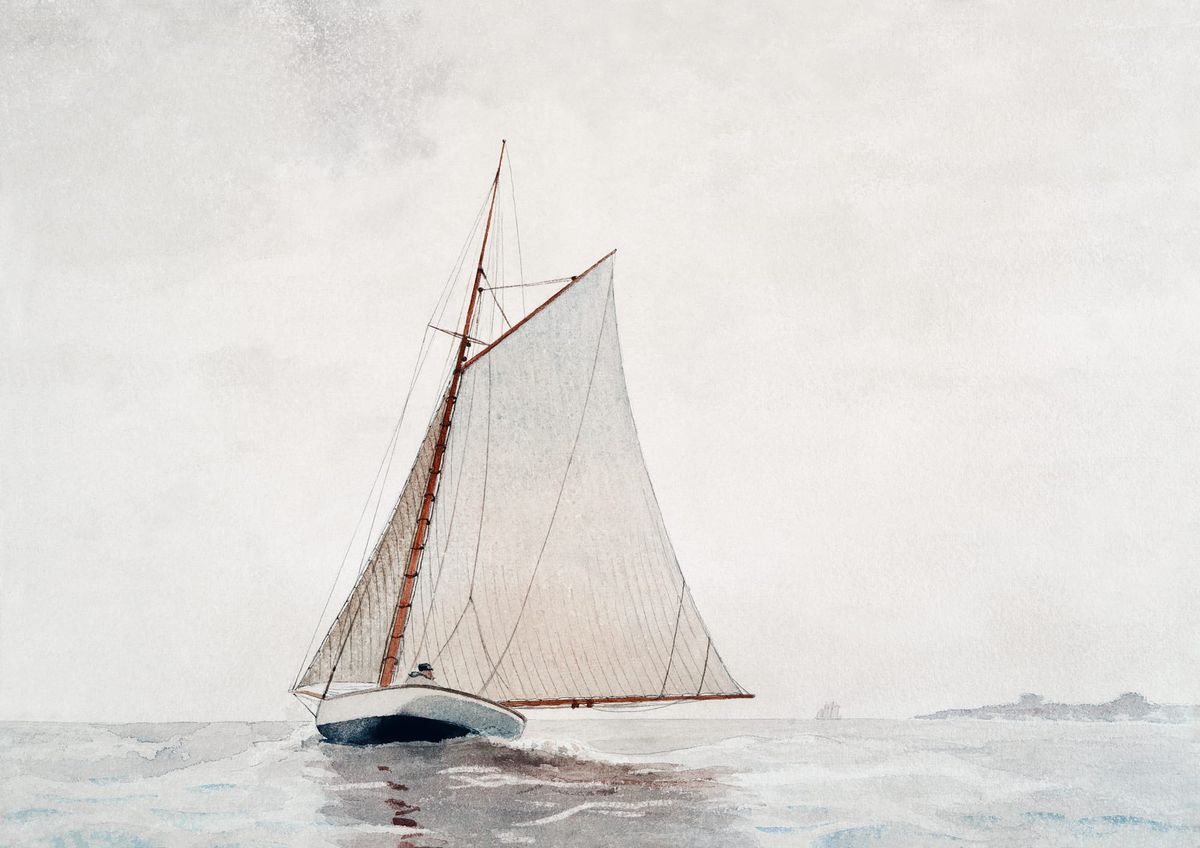
미국의 전설적인 사실주의 거장 윈슬로 호머(Winslow Homer, 1836–1910)가 1899년에 완성한 수채화 명작 <순풍을 탄 슬루프(Sloop, Nassau / Sloop, Bermuda)>는 은은한 바다 안개가 감도는 광활한 대서양 수면 위에서 바람을 가득 품은 거대한 백색 돛을 펼치고 파도를 가르며 힘차게 미끄러져 나아가는 단층 돛단배의 우아하고 당당한 항해를 가장 절제되고 서정적인 필치로 포착해 낸 수작입니다.
이 작품은 가로 약 54.6cm, 세로 약 38.1cm 크기의 고급 워브 종이 위에 흑연 연필로 범선의 날렵한 돛대와 선체의 유려한 비례를 정교하게 잡은 후, 투명 수채 물감의 극도로 맑고 섬세한 번짐으로 엷은 은회색 대기와 찰랑이는 바닷물을 칠하고, 종이 본연의 밝고 눈부신 흰 여백을 대담하게 살려 팽팽하게 부풀어 오른 돛의 질감과 뱃머리에서 부서지는 은빛 포말을 극대화한 미니멀리즘적 혼합 수채 기법으로 제작되었습니다.
현재 미국 주요 미술관 및 유수 프라이빗 컬렉션에서 높이 평가받는 이 그림은 바하마 나소 또는 버뮤다의 열대 해역에서, 챙 달린 모자를 쓴 사공이 키를 잡고 조용히 전방을 응시하는 가운데 은빛 햇살을 머금은 거대한 삼각 돛이 순풍을 안고 잔잔한 파도를 가르며 망망대해로 나아가는 고요하면서도 웅장한 순간을 담고 있습니다.
이 그림 뒤에는 매서운 북부의 겨울을 피해 대서양의 남쪽 섬들을 찾았던 호머가 바다와 바람, 그리고 돛단배의 순수한 조형미에 깊이 매료되었던 치열한 예술혼과 흥미진진한 비하인드가 깃들어 있습니다. 당시 60대에 접어든 노거장 호머는 화려하고 복잡한 장식을 모두 덜어내고, 오직 배 한 척과 바람의 숨결만으로 바다의 영혼을 화폭에 담는 작업에 깊이 몰두했습니다.
호머는 바람을 머금고 팽팽하게 솟아오른 돛의 유려한 곡선과 물살을 가르는 속도감을 포착하기 위해 해안가 바위턱에 이젤을 세우고 몇 시간이고 지나가는 배들을 관찰했습니다. 슬루프선을 몰고 지나가던 사공이 뱃머리를 돌리다 해안가에서 붓을 든 호머를 발견하고는, 배를 기우뚱 기울여 바람을 더 태우며 "화가 선생님, 우리 배가 너무 빨라서 돛에 닿기도 전에 그림 밖으로 날아가 버리는 건 아닙니까!"라며 호쾌하게 손을 흔드는 유쾌한 소동이 벌어졌습니다.
물보라를 맞으며 사공의 손 인사를 본 호머는 껄껄 웃음을 터뜨리며 "염려 말게나! 자네의 그 팽팽한 돛과 은빛 바다야말로 오늘 아침 바람이 내 종이 위에 불어넣어 준 가장 찬란한 생명의 날개라네!"라며 환호했습니다. 호머는 돛의 완벽한 각도와 뱃머리가 일으키는 부드러운 물결을 놓칠세라 신나게 붓을 놀려 단숨에 바다의 숨결을 새겨 넣었다는 훈훈한 일화가 전해집니다.
화면 우측 먼 수평선 너머로 아스라이 솟아오른 섬의 고즈넉한 실루엣과 그 곁을 유유히 지나가는 작은 원경 범선의 아련한 자태, 그리고 뱃머리 아래로 투명하게 비치는 차가운 그림자의 깊이감은 호머가 대양의 생생한 현장감을 얼마나 진솔하고 세심한 애정으로 관찰했는지를 증명합니다.
미술사학자들은 이 작품을 호머가 만년에 도달한 수채화 미학의 절대적인 정수이자, 동양의 수묵화에 필적하는 고도의 여백의 미를 구현한 근대 해양 회화의 기념비적 걸작으로 평가합니다.
프랑스 인상주의의 빛 연구를 뛰어넘어 불필요한 색채를 극도로 절제하고 종이 자체의 백색 광채와 맑은 물 번짐만으로 대기감과 운동감을 완벽히 형상화했으며, 고독한 항해를 인간의 자유로운 영혼과 대자연의 조화가 깃든 시각적 안식처로 승화시켰다는 극찬을 받습니다.
작품을 마주할 때 관람자의 무의식적인 시선은 돛의 웅장한 수직 대각선 축을 따라 매우 시원하고 안정적인 상하 및 좌우 순환 궤적을 그리며 이동합니다. 관람객의 눈길은 가장 먼저 화면 중앙을 압도하며 눈부신 은백색으로 부풀어 오른 거대한 메인 돛의 유려한 삼각형 형태와 팽팽한 돛줄에 사로잡힙니다.
이어 시선은 하늘 높이 솟아오른 얇고 붉은 갈색 돛대의 날렵한 직선을 타고 화면 상단으로 올라가, 맑고 투명한 바다 안개와 엷은 빛이 감도는 은회색 하늘의 광활한 대기감을 만끽합니다.
대기의 청량함을 확인한 시선은 돛의 매끄러운 바깥 능선을 타고 화면 아래로 미끄러져 내려와, 배의 키를 잡고 묵묵히 앉아 있는 사공의 작은 실루엣과 파도를 헤치고 나아가는 짙푸른 선체의 단단한 양감으로 자연스럽게 흘러갑니다.
이후 시선은 뱃머리 아래로 하얗게 부서지며 뒤로 길게 퍼져나가는 은빛 물결의 포말과 화면 우측 먼 수평선에 아스라이 떠 있는 섬과 돛단배의 고즈넉한 실루엣을 지나, 다시 순풍을 타고 질주하는 돛의 중심부로 돌아와 깊고 아늑한 시각적 안착을 이룹니다.
이러한 유려한 시선의 순환은 관람자의 내면에 깊은 심리적 정화와 가슴 뻥 뚫리는 시원한 해방감을 선물합니다. 화면 가득 쏟아지는 맑은 바람과 끝없이 펼쳐진 수평선의 여백이 자아내는 공간감은, 복잡한 일상의 번잡함과 피로에 지친 현대인의 무의식에 묵은 스트레스와 답답함을 단숨에 날려 보내는 깊은 이완과 감각적 휴식을 선사합니다.
거친 파도와 넓은 바다 앞에서도 흔들림 없이 돛을 활짝 펴고 순풍을 타며 당당하게 나아가는 배의 의연한 자태는, 보는 이에게 일상의 번뇌를 내려놓고 삶의 어떤 망망대해 앞에서도 당당하게 자신의 항로를 향해 나아갈 수 있는 내면의 맑은 용기와 충만한 평정을 되찾아 주는 든든한 치유의 위로를 건냅니다.
Sloop, Nassau / Sloop, Bermuda
Completed in 1899 by the celebrated American realist master Winslow Homer (1836–1910), the watercolor masterpiece Sloop, Nassau (also known as Sloop, Bermuda) stands as an extraordinary tour de force capturing the crystalline expanse, silent aerodynamic grace, and profound maritime solitude of the open Atlantic with peerless minimalist economy.
Measuring approximately 54.6 cm wide by 38.1 cm high on fine wove paper, the work showcases Homer's absolute mastery of transparent watercolor in his late mature period, laying down whisper-thin wet-on-wet washes of pale pewter, slate, and translucent cerulean across the vaporous sky and rolling swells, while utilizing vast, untouched reserves of white paper to articulate the towering canvas mainsail filled with ocean wind.
Preserved and celebrated across prominent public and private American art collections, this painting portrays a serene morning off the coast of Nassau or Bermuda, where a solitary helmsman in a straw hat steers a graceful wooden sloop, its massive triangular sail billowing tautly as the sharp bow cuts through the pale turquoise swells beneath an expansive, misty sky.
Behind this restorative watercolor lies Homer's winter retreat to the southern seas during the late 1890s, where the master sought respite from northern blizzards and became enchanted by the pure, unadorned geometry of sailing vessels in perfect communion with the offshore trade winds.
Setting up his field easel along the shore to study the tension of wind-filled canvas and the subtle architecture of the wake, Homer observed the sloops gliding across the horizon.
When a passing boatman caught sight of the painter working upon the rocks and hauled his sheet tight, tilting the craft to catch the full draft of wind while calling across the water with a cheerful shout that his sloop was moving too fast to be caught on paper, the coast echoed with lively mirth.
Delighted by the sailor's spirited maneuver, Homer laughed heartily in return, remarking across the water that the swelling white sail and the clear ocean wake were the purest wings of natural poetry that the trade winds could ever grant an artist's brush. Homer worked with swift, electric precision to record the elegant taper of the wooden mast and the soft ripples trailing behind the hull, capturing the living breath of the sea before the breeze could alter its course.
The faint silhouette of a distant spit of land resting on the far right horizon, the ghostlike form of a secondary sail drifting in the distance, and the delicate reflections cast across the foreground shallows serve as authentic testaments to Homer's deeply observant eye for the humble majesty of maritime life.
Art historians celebrate this watercolor as a defining summit of Homer's late career, extolling its radical compositional daring and breathtaking economy of means that rivals the finest East Asian ink traditions. By stripping away nonessential detail to focus entirely on the sacred dialogue between wind, water, and white sail, Homer created an enduring visual sanctuary of atmospheric purity, existential freedom, and contemplative peace.
When engaging with the painting, the viewer's unconscious gaze undertakes an intensely refreshing and stabilizing visual journey. The eye is initially welcomed by the luminous, soaring expanse of the white mainsail dominating the composition, lingering upon the taut curve of the canvas and the delicate rigging catching the morning light.
The gaze then ascends along the slender vertical mast toward the heavens, exploring the pale, vaporous wash of the breezy oceanic sky above.
Cascading smoothly downward past the leaning boom, the viewer's attention meets the compact, steady figure of the helmsman seated at the tiller and the dark, buoyant shape of the hull slicing through the water.
Finally, tracing the frothing white wake churning beneath the bow and sweeping across the open sea horizon to the distant landform on the right, the eye settles comfortably back into the balanced, anchored equilibrium of the sailing vessel.
This rhythmic visual journey fosters profound psychological reassurance, sensory clarity, and deep emotional stillness within the observer. The tactile immersion in cool ocean mist, fresh salt air, and unhurried sailing rhythms acts as an intuitive emotional balm, dispelling ambient modern fatigue and soothing inner tension.
By presenting an idyllic world where purposeful direction exists in pure harmony with the rhythm of the eternal tides, Homer offers the observer a comforting sanctuary of mindfulness, inspiring a deep sense of renewal, sweet contentment, and enduring inner peace.
본 리뷰에서 작품을 제외한 컨텐츠의 저작권은 팔렛트제주에 있습니다.
"퍼블릭도메인 고전명화"를 제외한 모든 창작 콘텐츠는 저작권법 제4조 및 제10조에 의거하여 보호됩니다. 무단 도용시 저작권법 제136조(벌칙)에 의거, 당사의 사전 서면 승인 없는 저작권 침해 행위를 금지합니다.