수박 먹는 소년들 - The Watermelon Boys
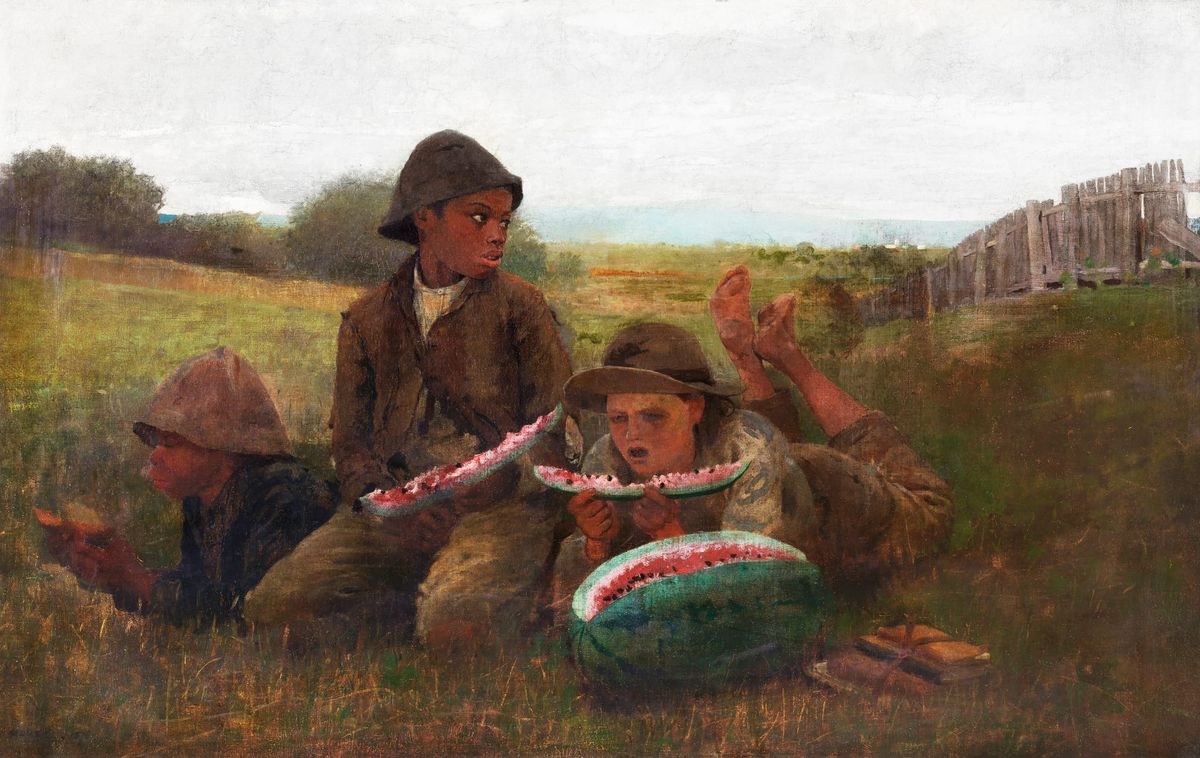
미국 사실주의 미술의 거장 윈슬로 호머(Winslow Homer, 1836–1910)가 1876년에 완성한 유화 명작입니다. 현재 미국 뉴욕에 위치한 쿠퍼 휴잇 스미스소니언 디자인 박물관(Cooper Hewitt, Smithsonian Design Museum)에 소장되어 있으며, 캔버스 위에 유채(Oil on canvas)로 제작된 실제 크기는 세로 61.3cm, 가로 97.5cm의 가로형 규격입니다.
호머는 한여름의 나른한 공기와 따스한 온기를 표현하기 위해 절제된 톤과 정교한 명암법을 구사했습니다. 풀밭의 마른 잔디와 흙바닥은 황갈색과 올리브 톤의 차분한 색조로 펴 발랐으며, 화면 앞쪽에 쪼개진 수박의 붉은 과육과 검은 씨앗은 짙은 원색의 유화 물감을 두텁게 얹어 강렬한 시각적 대비를 주었습니다. 낡은 펠트 모자와 소년들의 흙 묻은 옷자락, 맨발의 질감은 빠른 붓놀림과 섬세한 빛의 반사를 통해 생생하고 투박한 현장감을 드러냅니다.
이 작품이 탄생한 1870년대 중반은 미국 남북전쟁이 끝난 후 사회적 재건과 치유가 절실했던 시기였습니다. 호머는 버지니아주 피터즈버그 인근을 방문하여 흑인과 백인 아이들이 신분이나 인종의 장벽 없이 들판에 모여 수박을 나눠 먹는 평화로운 일상을 관찰했습니다.
비하인드 스토리로, 당시 미국 사회에서 흑인과 수박이라는 소재는 주로 대중잡지나 연극에서 흑인을 희화화하고 조롱하는 악의적인 캐리커처로 소비되곤 했습니다. 하지만 호머는 이러한 인종적 편견과 고정관념을 단호히 거부하고, 잘 익은 수박 한 덩이를 가운데 두고 서리라도 한 듯 눈치를 보며 수박을 베어 무는 아이들의 천진난만한 장난기와 순수한 동심을 진솔하게 화면에 담았습니다. 엎드려서 발을 까딱이며 수박을 먹는 소년의 익살스러운 표정과 곁에서 조심스레 주변을 살피는 소년의 시선은 현장의 활기를 그대로 전해줍니다. 평단과 후대 미술사학자들은 이 작품을 두고 "남북전쟁 이후 상처 입은 미국 사회에서 인종을 초월한 화해와 유년 시절의 무구함을 가장 솔직하고 품격 있게 포착한 역사적 명작"이라 평가했습니다.
관람자의 무의식적 시선은 화면 하단 중앙에서 붉은 속살을 드러내며 쪼개져 있는 싱싱한 수박에 가장 먼저 닿습니다. 선명한 붉은색과 초록색 껍질의 대비는 즉각적인 시각적 미각을 자극하며 유쾌한 생동감을 일으킵니다.
이어서 시선은 수박 조각을 양손에 들고 베어 무는 엎드린 소년의 익살스러운 표정을 지나, 앉아서 경계하듯 고개를 돌린 중앙 소년의 진지한 옆모습과 발을 까딱이는 맨발의 리듬을 타고 부드럽게 상승합니다. 이후 풀밭 너머의 나무 울타리와 은은한 여름 하늘로 시선이 편안하게 확장됩니다. 햇살 가득한 들판에서 친구들과 비밀스러운 간식을 나누던 어린 시절의 추억을 환기하는 이 정겨운 구도는 뇌파를 편안한 이완 상태로 유도하며, 일상의 피로를 잊게 만드는 깊은 심리적 안도감과 따스한 정서적 위로를 선사합니다.
The Watermelon Boys
Completed in 1876 by Winslow Homer (1836–1910), a monumental figure in American Realism, this historic oil painting is preserved in the permanent collection of the Cooper Hewitt, Smithsonian Design Museum in New York. Rendered in oil on canvas, the piece measures approximately 61.3 cm in height by 97.5 cm in width.
Homer skillfully captured the lazy, humid atmosphere of midsummer by employing a warm, earthy tonal palette and nuanced lighting. The dry summer grasses and soil are rendered with subtle washes of ochre, olive, and raw umber, creating a quiet backdrop that accentuates the brilliant crimson flesh and glistening dark seeds of the freshly split melon in the foreground. The tattered felt hats, sun-faded work clothes, and dusty bare feet are modeled with decisive impasto touches that breathe tangible authenticity into the pastoral setting.
Created during the post-Civil War Reconstruction era, the painting reflects Homer’s observations near Petersburg, Virginia, where he witnessed Black and white rural youths coexisting and sharing moments of unadorned summer leisure.
A compelling historical narrative surrounds this composition: in nineteenth-century popular media, the depiction of African Americans with watermelons was routinely exploited through derogatory caricatures and minstrel tropes. Homer completely dismantled these racist stereotypes, presenting the children with profound human dignity, candid humor, and honest camaraderie. The spontaneous moment—boys covertly feasting on a stolen or scavenged melon in a secluded field—captures the universal mischief and innocence of youth. Modern art historians universally celebrate this canvas as a breakthrough work of American social realism, praising Homer's quiet courage in depicting interracial harmony and pastoral truth during a fractured era.
The viewer's subconscious gaze immediately drops to the vibrant, split watermelon resting in the foreground. Its rich crimson tones and glossy seeds provide an instant visual anchor, awakening a joyful and nostalgic sensory connection.
The gaze then travels upward to the reclining boy eagerly taking a bite, tracing his upturned bare feet before moving toward the seated boy casting a cautious glance over his shoulder. The eye smoothly follows the gentle slope of the sun-drenched pasture into the weathered wooden fence and pale summer sky beyond. This warm, nostalgic narrative evokes fond memories of childhood freedom and simple pleasures, gently dissolving mental tension and bestowing an enduring sense of emotional comfort and peaceful solace.
본 리뷰에서 작품을 제외한 컨텐츠의 저작권은 팔렛트제주에 있습니다.
"퍼블릭도메인 고전명화"를 제외한 모든 창작 콘텐츠는 저작권법 제4조 및 제10조에 의거하여 보호됩니다. 무단 도용시 저작권법 제136조(벌칙)에 의거, 당사의 사전 서면 승인 없는 저작권 침해 행위를 금지합니다.