솟구치는 배스 (플로리다의 낚시) - Jumping Trout / Bass, Homosassa River
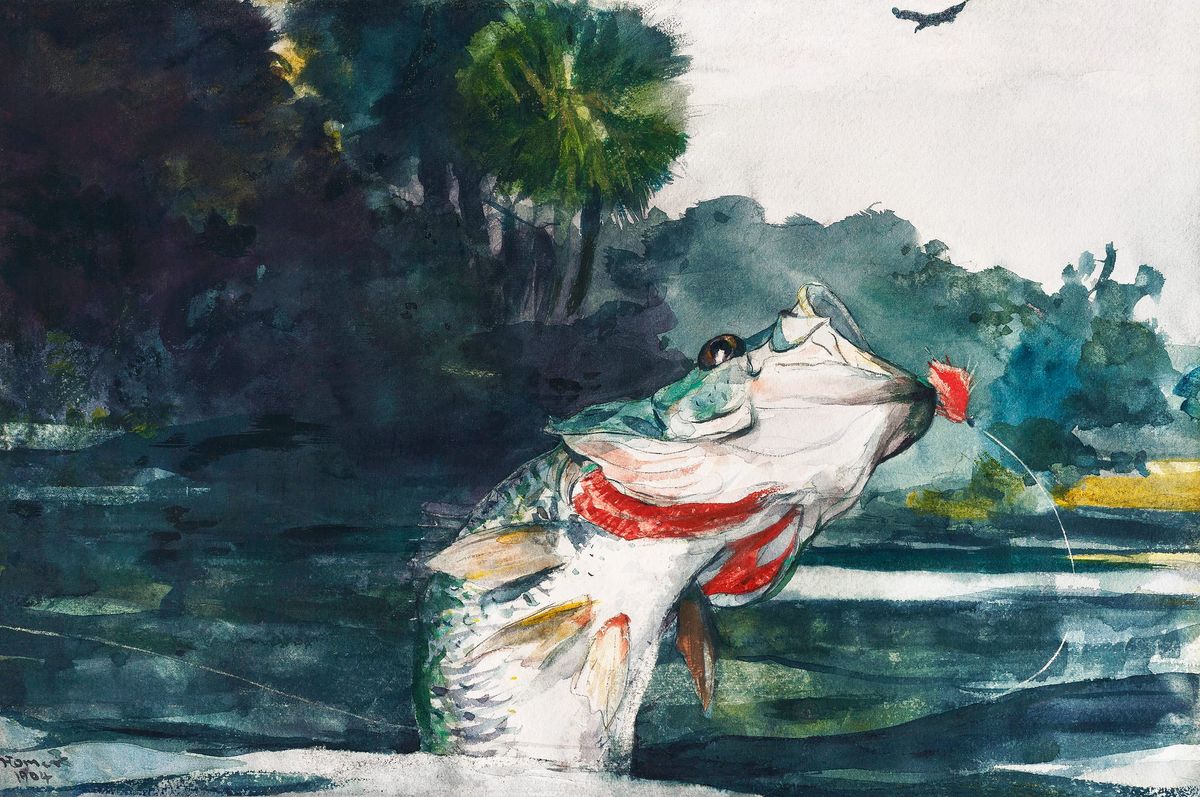
미국의 전설적인 사실주의 거장 윈슬로 호머(Winslow Homer, 1836–1910)가 1904년에 완성한 수채화 명작 <솟구치는 배스(Bass, Homosassa River / Jumping Trout)>는 맑은 강물 위로 솟구쳐 오르는 물고기의 역동적인 생명력과 낚싯줄에 팽팽하게 걸린 찰나의 긴장감을 압도적인 필치로 포착해 낸 수작입니다.
이 작품은 가로 약 50.8cm, 세로 약 35.6cm 크기의 고급 워브 종이 위에 제작되었으며, 물 밖으로 튀어 오르는 물고기의 아가미와 비늘에 선명한 붉은색과 에메랄드빛 수채 물감을 촉촉하게 입히고, 종이의 백색 여백을 그대로 살려 수면의 거품과 물고기 턱 밑의 투명한 하이라이트를 극대화하는 혼합 수채 기법으로 완성했습니다.
현재 미국 주요 미술관 및 유수 프라이빗 컬렉션에서 소중히 다루어지는 이 그림은 미국 플로리다주 호모사사 강(Homosassa River)의 아열대 숲을 배경으로, 붉은 인조 파리 미끼를 문 거대한 배스가 수면 위로 솟구쳐 오르며 온몸을 뒤트는 야생의 긴박하고 원초적인 순간을 포착하고 있습니다.
이 그림 뒤에는 노년의 나이에도 열정적인 낚시광이자 자연 탐험가로 살았던 호머의 유쾌한 인간미와 흥미진진한 비하인드가 깃들어 있습니다. 1904년 겨울, 호머는 추운 북부를 떠나 플로리다의 호모사사 강가에 머물며 플라이낚시와 수채화 작업에 깊이 몰입했습니다.
호머는 물속에 낚싯줄을 드리우고 배가 낚싯바늘을 무는 순간의 폭발적인 힘에 매료되었습니다. 그는 낚싯대를 쥐고 물고기와 힘겨루기를 하다가도 거대한 배스가 수면 위로 높이 뛰어오르는 광경을 목격하면, 낚싯대를 한 손에 쥔 채 다른 손으로 화구 상자에서 붓을 꺼내 스케치북에 그 찰나의 형상을 기록하곤 했습니다.
동행했던 낚시 가이드가 "선생님, 그림을 그리다간 대어를 놓치겠습니다!"라며 소리치자, 호머는 "고기를 잡는 것보다 저 녀석이 허공을 가르며 뿜어내는 생명의 붉은 빛깔을 캔버스에 낚아채는 것이 내게는 백배나 더 짜릿한 월척이라네!"라며 호탕하게 웃어넘겼다는 유쾌한 일화가 전해집니다.
화면 우측 상단 하늘 높이 원을 그리며 날아가는 맹금류의 실루엣과, 팽팽하게 휘어진 투명한 낚싯줄, 그리고 좌측 하단의 'HOMER 1904' 서명은 호머가 야생의 드라마를 얼마나 치밀하고 생생하게 관찰했는지를 증명합니다.
미술사학자들은 이 작품을 호머가 평생에 걸쳐 완성한 수채화 기법 중에서도 공간감과 운동성이 가장 완벽하게 조화된 말년의 대표 걸작으로 평가합니다.
원경의 짙푸른 야자수 숲과 근경의 거대한 물고기를 극적인 명암으로 대비시키고, 순식간에 지나가는 야생의 찰나를 단 몇 번의 대담한 붓질로 영원한 생명의 기념비로 승화시켰다는 극찬을 받습니다.
작품을 마주할 때 관람자의 무의식적인 시선은 매우 역동적이고 경쾌한 포물선 궤적을 그리며 이동합니다. 관람객의 눈길은 가장 먼저 화면 중앙에서 물살을 뚫고 솟구쳐 오른 배스의 붉고 선명한 아가미와 반짝이는 검은 눈망울, 그리고 입에 물린 붉은색 깃털 미끼에 사로잡힙니다.
이어 시선은 미끼에서 뻗어 나가 허공에서 부드러운 호를 그리며 수면으로 이어지는 하얀 낚싯줄의 유려한 곡선을 타고 화면 우측으로 미끄러져 내려옵니다.
수면의 투명한 파문을 확인한 시선은 화면 좌측과 상단을 짙푸르게 뒤덮고 있는 야자수와 무성한 아열대 숲의 신비로운 그늘을 훑은 뒤, 하늘 높이 유유히 선회하는 독수리의 실루엣을 지나 다시 튀어 오르는 물고기의 힘찬 비늘로 돌아와 완벽한 시각적 안착을 이룹니다.
이러한 유려한 시선의 순환은 관람자의 내면에 깊은 심리적 해방감과 짜릿한 생명력을 불어넣어 줍니다. 맑은 강물과 햇살을 머금은 숲이 빚어내는 야생의 생생한 공기감은, 복잡한 일상의 긴장과 피로에 젖어 있던 현대인의 무의식에 번갯불처럼 선명한 카타르시스와 마음의 정화를 선사합니다.
생의 에너지를 다해 물 밖으로 솟구쳐 오르는 야생 생명체의 굳센 자태는, 보는 이에게 번잡한 걱정을 내려놓고 삶의 순수한 열정과 내면의 맑은 활력을 되찾아 주는 든든한 치유의 위로를 건넵니다.
Bass, Homosassa River / Jumping Trout
Completed in 1904 by the celebrated American realist master Winslow Homer (1836–1910), the watercolor masterpiece Bass, Homosassa River (also celebrated as Jumping Trout) stands as an extraordinary tour de force capturing the primeval kinetic energy, sudden tension, and wild beauty of the American sporting life.
Measuring approximately 50.8 cm wide by 35.6 cm high on fine wove paper, the work showcases Homer's consummate watercolor technique, employing transparent emerald washes, vibrant vermilion touches along the gills and lure, and brilliant reserves of unpainted white paper to articulate the glistening belly and frothing wake of the airborne fish.
Preserved and celebrated across prominent public and private American art collections, this painting portrays a dramatic encounter along the subtropical Homosassa River in Florida, where a massive black bass leaps high above the river surface, thrashing violently against the tension of a fly line hooked to a red feather lure.
Behind this electrifying composition lies Homer's lifelong passion for angling and a delightful array of personal anecdotes. During the winter of 1904, seeking refuge from northern winters, Homer traveled to the wild waterways of Florida to indulge in his dual passions of fly-fishing and plein-air painting.
Transfixed by the acrobatic leaps of the native river bass, Homer often held his rod in one hand while steadying his watercolor pad with the other, determined to record the instantaneous arc of the leaping fish before the ripples settled.
When his local boat guide shouted in alarm that the master was risking the loss of a trophy catch by reaching for his brush instead of the net, Homer laughed heartily, replying that landing the fish in a creel was nothing compared to capturing the incandescent flash of living red and silver upon clean paper.
The distant silhouette of a hunting bird circling overhead in the upper right, the taut curve of the gossamer line, and the bold signature 'HOMER 1904' in the lower left stand as authentic testaments to Homer's visceral immersion in the rhythms of the untamed wilderness.
Art historians celebrate this painting as a defining pinnacle of Homer's late watercolor oeuvre, praising its audacious spatial compression and fluid modernism. By juxtaposing the shadowed density of the palm hammocks against the radiant, explosive emergence of the creature, Homer elevated a sporting study into a timeless visual monument of natural vigor and instinct.
When engaging with the painting, the viewer's unconscious gaze undertakes an intensely thrilling yet stabilizing visual journey. The eye is initially seized by the gaping maw and brilliant scarlet gills of the leaping bass in the center, lingering upon the vivid red fly firmly lodged in its jaw.
The gaze then traces the delicate, sweeping curve of the white line arcing through the open air toward the lower right, before descending into the translucent turquoise ripples and foam breaking across the foreground.
Ascending naturally into the lush, dark canopy of subtropical palms and dense riverbank foliage on the left, the viewer's attention discovers the minute raptor soaring against the pale sky, finally returning to the muscular, glistening flank of the fish.
This rhythmic visual journey fosters profound psychological reassurance, sensory awakening, and deep emotional clarity within the observer. The tactile immersion in crystal-clear river waters and untamed wild greenery acts as an intuitive emotional tonic, sweeping away ambient modern stress and accumulated inner fatigue.
By presenting a world defined by pure kinetic vitality, natural harmony, and incandescent southern light, Homer offers the observer a comforting sanctuary of mindfulness, inspiring a deep sense of renewal, sweet contentment, and enduring inner peace.
본 리뷰에서 작품을 제외한 컨텐츠의 저작권은 팔렛트제주에 있습니다.
"퍼블릭도메인 고전명화"를 제외한 모든 창작 콘텐츠는 저작권법 제4조 및 제10조에 의거하여 보호됩니다. 무단 도용시 저작권법 제136조(벌칙)에 의거, 당사의 사전 서면 승인 없는 저작권 침해 행위를 금지합니다.