스냅 더 휩 (채찍 놀이하는 아이들) - Snap the Whip
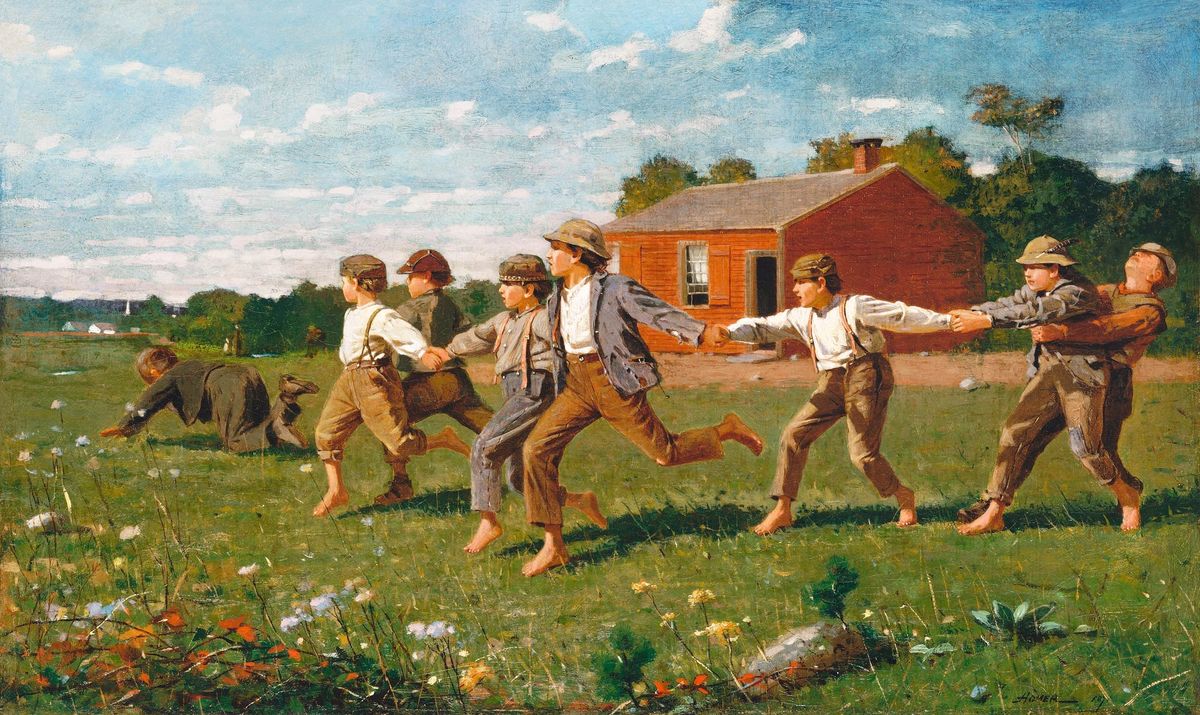
미국의 전설적인 사실주의 거장 윈슬로 호머(Winslow Homer, 1836–1910)가 1872년에 완성한 유화 걸작 <스냅 더 휩(Snap the Whip)>은 붉은 시골 학교 앞 푸른 들판에서 맨발의 소년들이 손을 맞잡고 온 힘을 다해 달리는 채찍 놀이의 역동적인 순간과 순수한 유년의 생명력을 가장 찬란하고 서정적인 필치로 포착해 낸 수작입니다.
이 작품은 가로 약 91.4cm, 세로 약 55.9cm 크기의 캔버스 위에 정교한 유화 기법으로 제작되었으며, 들꽃이 만발한 풀밭과 흙바닥, 붉은 목조 교사의 질감에는 도톰한 임파스토를 밀도 있게 얹고, 눈부신 여름 햇살을 받아 빛나는 소년들의 흰 셔츠와 푸른 하늘에 떠가는 뭉게구름의 대기감을 섬세한 명암 대비와 생동감 넘치는 붓 터치로 구현해 냈습니다.
현재 미국 뉴욕 메트로폴리탄 미술관(The Metropolitan Museum of Art) 및 버틀러 미국 미술관에 소장되어 있는 이 그림은 뉴욕주 헐리스빌의 시골 학교 마당에서, 모자를 쓴 소년들이 둥글게 줄을 지어 서로의 손을 굳게 잡고 회전하다 원심력에 의해 맨 끝의 아이들이 풀밭으로 뒹구는 활기차고 평화로운 쉬는 시간의 한때를 담고 있습니다.
이 그림 뒤에는 남북전쟁의 깊은 상흔을 치유하고 미국 고유의 순수한 이상과 희망을 되찾고자 했던 호머의 따뜻한 시선과 흥미진진한 비하인드가 깃들어 있습니다. 당시 호머는 전후 급격한 산업화 속에서 사라져가는 시골 마을의 건강한 공동체 의식과 티 없이 맑은 아이들의 동심에서 조국의 새로운 미래를 발견했습니다.
호머는 아이들의 생동감 넘치는 달리기 동작과 햇살 아래 휘날리는 옷자락을 화폭에 담기 위해 학교 운동장 풀밭에 이젤을 세웠습니다. 소년들이 온 힘을 다해 손을 잡고 달리다 급격히 방향을 틀자, 줄의 맨 끝에 매달려 있던 아이 둘이 원심력을 이기지 못하고 풀밭 위로 데굴데굴 굴러떨어지며 흙먼지를 뒤집어쓰는 유쾌한 소동이 벌어졌습니다.
풀밭에 넘어진 아이들이 서로를 바라보며 배를 잡고 까르르 웃음을 터뜨리자, 호머는 껄껄 웃으며 "잠깐, 그대로 있게! 흙바닥에 뒹굴면서도 터져 나오는 자네들의 그 해맑은 웃음소리야말로 오늘 햇살이 이 대지 위에 내린 가장 찬란한 축복이라네!"라며 환호했습니다. 호머는 아이들의 역동적인 질주와 풀밭에 핀 야생화의 조화를 놓칠세라 신나게 붓을 놀렸고, 화면 우측 하단 풀밭 위에 'HOMER 1872' 서명을 힘차게 새겨 넣었다는 훈훈한 일화가 전해집니다.
화면 뒤편에 다정하게 자리 잡은 단층짜리 붉은 목조 학교 건물과 저 멀리 완만한 능선을 이루는 푸른 구릉 지대, 그리고 전경 풀밭에 앙증맞게 피어난 흰색과 붉은색 야생화들은 호머가 북미 시골의 여름 정취를 얼마나 진솔하고 세심한 애정으로 관찰했는지를 증명합니다.
미술사학자들은 이 작품을 호머의 초기 대표 걸작이자 19세기 미국 미술사에서 유년의 순수함과 민주주의적 연대감을 가장 완벽하게 시각화한 국민 회화로 평가합니다.
전쟁의 비극을 딛고 일어서는 미국의 새로운 희망을 상징하며, 인물들의 유기적인 동작 연결과 탁월한 공간 구성을 통해 전원적 사실주의의 정점을 이룩했다는 극찬을 받습니다.
작품을 마주할 때 관람자의 무의식적인 시선은 아이들이 손을 맞잡은 수평 곡선을 따라 매우 경쾌하고 시원한 좌우 순환 궤적을 그리며 이동합니다. 관람객의 눈길은 가장 먼저 화면 중앙에서 모자를 쓰고 다리를 힘차게 뻗으며 앞으로 질주하는 중심 소년의 역동적인 도약과 펄럭이는 재킷에 사로잡힙니다.
이어 시선은 맞잡은 손들의 팽팽한 리듬을 타고 화면 우측으로 이동하여, 중심을 잡으려 뒤로 버티며 힘을 쏟는 소년들의 굳센 맨발과 집중된 얼굴 표정으로 자연스럽게 흘러갑니다.
줄을 지탱하는 아이들의 든든한 힘을 확인한 시선은 다시 반대편인 화면 좌측으로 빠르게 미끄러져 내려가, 원심력에 의해 풀밭 위로 뒹굴며 쓰러진 아이의 장난기 어린 실루엣과 바닥의 싱그러운 들풀에 가닿습니다.
이후 시선은 배경의 따스한 붉은 학교 건물과 부드러운 산 능선을 지나, 맑고 투명한 여름 하늘에 흩어지는 뭉게구름으로 상승한 뒤, 전경의 향긋한 야생화 군락을 타고 다시 달리는 소년들의 힘찬 발걸음으로 돌아와 깊고 아늑한 시각적 안착을 이룹니다.
이러한 유려한 시선의 순환은 관람자의 내면에 깊은 심리적 안정감과 포근한 유년의 향수를 선물합니다. 푸른 풀밭의 싱그러움과 눈부신 햇살이 자아내는 광활한 공간감은, 복잡한 일상의 긴장과 피로에 지친 현대인의 무의식에 마치 어린 시절 친구들과 맨발로 들판을 내달리던 깊은 이완과 감각적 해방감을 선사합니다.
서로의 손을 굳게 잡고 함께 달리며 넘어짐조차 웃음으로 넘기는 소년들의 건강하고 순수한 자태는, 보는 이에게 일상의 번뇌를 내려놓고 삶의 가장 소박하고 맑은 행복과 내면의 깊은 평정을 되찾아 주는 든든한 치유의 위로를 건냅니다.
Snap the Whip
Completed in 1872 by the celebrated American realist master Winslow Homer (1836–1910), the monumental oil masterpiece Snap the Whip stands as an extraordinary tour de force capturing the kinetic exhilaration, rustic innocence, and golden optimism of nineteenth-century American youth.
Measuring approximately 91.4 cm wide by 55.9 cm high on canvas, the work showcases Homer's consummate mastery of plein-air oil technique, applying rich, tactile impasto to the wildflower-strewn pasture and red clapboard schoolhouse, while modulating the bright sunlight striking the boys' homespun shirts and the breezy blue sky with crisp tonal clarity.
Preserved in the prestigious permanent collections of The Metropolitan Museum of Art in New York and the Butler Institute of American Art, this iconic painting portrays a recess game behind a one-room red schoolhouse in Hurley, New York, where barefoot country boys join hands in a spirited line, running full tilt across the meadow until the centrifugal force at the tail snaps and sends the end boys tumbling into the clover.
Behind this restorative canvas lies Homer's desire to capture the resilient innocence and democratic fellowship of post-Civil War America, finding in the uninhibited play of rural children an enduring metaphor for national healing and renewed vitality.
Setting up his easel directly in the open pasture to record the shifting anatomy of movement and sunlight, Homer observed the schoolboys play.
When the chain of runners made a sharp pivot and the two boys on the far end were flung into the grass, rolling over each other with breathless bursts of laughter, the whole meadow echoed with merriment.
Delighted by their spirited tumble, Homer laughed heartily, reassuring the boys that their dusty knees and joyous laughter were the finest blessings the sun could cast upon an artist's canvas. Homer swiftly applied vibrant strokes of viridian, ochre, and vermilion to capture the unposed momentum of the race, proudly signing 'HOMER 1872' in the lower right foreground.
The humble red schoolhouse standing warmly against the trees, the soft blue contours of the rolling hills in the distance, and the delicate scatter of white and red blossoms in the foreground serve as authentic testaments to Homer's deeply observant eye for the pastoral poetry of American country life.
Art historians celebrate Snap the Whip as a defining summit of Homer's early mature career and an enduring landmark of American genre painting, praising its exceptional dynamic rhythm and tender humanism. By celebrating youthful solidarity and innocent freedom, Homer elevated a schoolyard pastime into a timeless visual monument of communal harmony, boundless hope, and natural joy.
When engaging with the painting, the viewer's unconscious gaze undertakes an intensely invigorating and stabilizing visual journey. The eye is initially welcomed by the sun-drenched form of the central boy in the lead, lingering upon his determined profile, outstretched barefoot stride, and fluttering jacket.
The gaze then travels along the rhythmic chain of interlocked hands toward the right, meeting the braced, muscular postures of the anchor boys leaning backward against the pull of the whip.
Sweeping swiftly across the canvas to the left, the viewer's attention follows the kinetic release of the line, discovering the playful forms of the boys tumbling into the soft green turf.
Finally, ascending past the warm red geometry of the schoolhouse into the airy expanse of the cloud-dappled summer sky, the eye embraces the boundless spatial freedom of the countryside before settling comfortably back into the spirited chain of children.
This rhythmic visual journey fosters profound psychological reassurance, gentle nostalgia, and deep emotional stillness within the observer. The tactile immersion in warm sunshine, fragrant summer grass, and unhurried mountain breezes acts as an intuitive emotional balm, dispelling ambient modern fatigue and soothing inner tension.
By presenting an idyllic world where trust and joy interlock in pure harmony with the rhythm of nature, Homer offers the observer a comforting sanctuary of mindfulness, inspiring a deep sense of renewal, sweet contentment, and enduring inner peace.
본 리뷰에서 작품을 제외한 컨텐츠의 저작권은 팔렛트제주에 있습니다.
"퍼블릭도메인 고전명화"를 제외한 모든 창작 콘텐츠는 저작권법 제4조 및 제10조에 의거하여 보호됩니다. 무단 도용시 저작권법 제136조(벌칙)에 의거, 당사의 사전 서면 승인 없는 저작권 침해 행위를 금지합니다.