풍하측으로 기운 배 - On the Lee Shore (Sailing a Catboat)
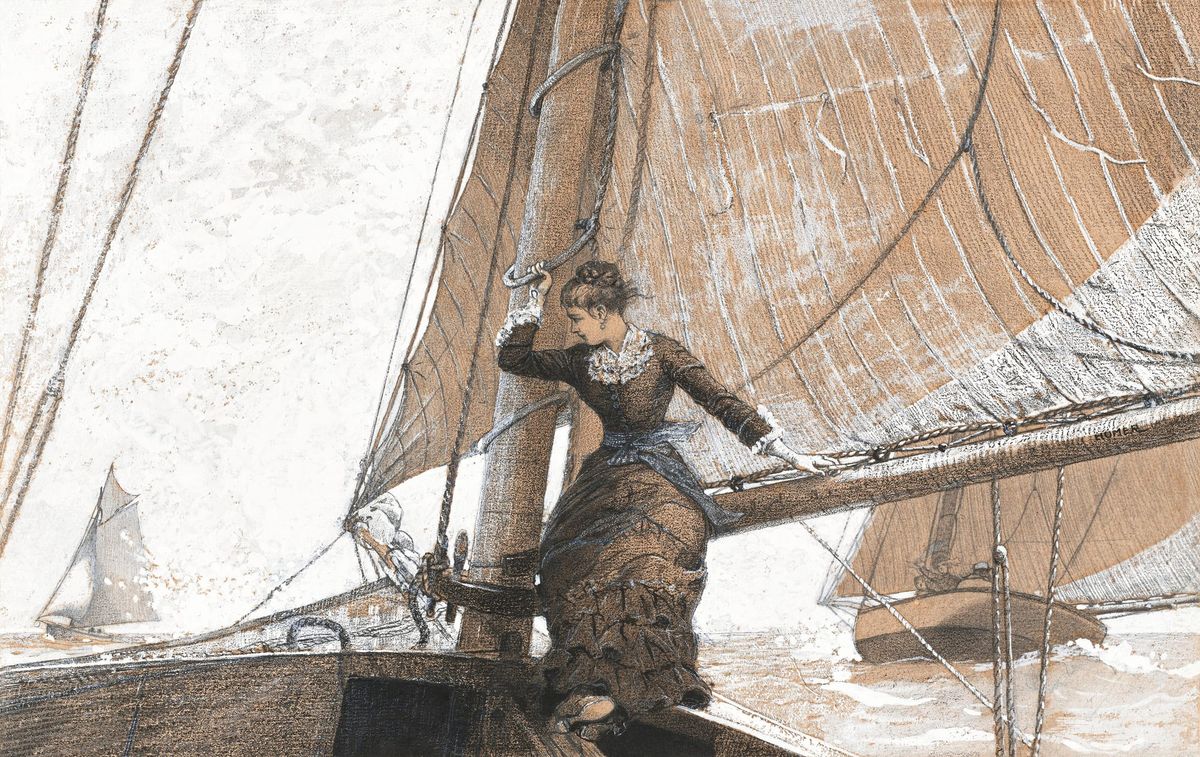
미국 사실주의 미술의 독보적인 거장 윈슬로 호머(Winslow Homer, 1836–1910)가 1880년에 제작한 탁월한 드로잉 명작입니다. 현재 미국 보스턴 미술관(Museum of Fine Arts, Boston)에 소장되어 있으며, 따뜻한 톤이 감도는 직조 종이 위에 흑연 연필, 검은색 잉크, 그리고 불투명한 흰색 과슈(Graphite, ink, and white gouache on wove paper)를 혼합하여 완성한 세로 30.2cm, 가로 49.5cm 크기의 작품입니다.
호머는 정교한 흑연 드로잉과 펜 터치로 거친 돛천의 질감과 복잡한 선박의 밧줄 구조를 날카롭게 구축했습니다. 여기에 흰색 불투명 과슈를 과감하게 덧발라 바람을 가득 안고 팽팽해진 돛의 밝은 면과 거세게 튀어 오르는 파도의 포말, 그리고 여인의 레이스 깃을 입체적으로 강조했습니다. 바탕 종이의 따뜻한 베이지색 톤을 중간색으로 활용하는 세련된 기법을 통해 거센 바닷바람이 몰아치는 순간의 빛과 공기를 생동감 넘치게 구현했습니다.
이 작품의 배경은 1870년대 후반에서 1880년 사이 호머가 자주 찾았던 매사추세츠주의 항구도시 글로스터(Gloucester)입니다. 당시 호머는 항구의 분주한 어촌 풍경과 함께 도시 피서객들의 세련된 요트 항해 문화에 깊은 관심을 기울였습니다.
비하인드 스토리로, 당시 19세기 빅토리아 시대 여성들은 부피가 큰 페티코트와 버슬 드레스를 입고 있었기에 요트처럼 급격히 기울어지는 배 위에서는 균형을 잡기 매우 어려웠습니다. 하지만 호머는 나약하거나 두려워하는 여성의 전형을 거부하고, 돛대와 붐대를 단단히 붙잡은 채 몸을 과감히 내맡기며 바다의 속도감을 온몸으로 즐기는 당차고 진취적인 신여성의 면모를 화면에 담아냈습니다. 당시 평단과 후대 미술사학자들은 이 작품을 두고 "바다의 거친 물리적 에너지와 인간의 당당한 기개를 흑백의 절제된 톤 속에 가장 현대적이고 파격적인 구도로 담아낸 기념비적 드로잉"이라 극찬했습니다.
관람자의 무의식적 시선은 화면 정중앙에서 바람에 치맛자락을 휘날리며 단단하게 균형을 잡고 있는 여인의 역동적인 실루엣에 먼저 착지합니다. 돛대를 꽉 쥐고 시선을 바다 쪽으로 돌린 여인의 당당한 옆모습은 보는 이에게 즉각적인 생동감과 시각적 긴장감을 전달합니다.
이어서 시선은 바람을 가득 품어 활처럼 둥글게 부풀어 오른 거대한 돛의 대각선 곡선을 타고 상단으로 시원하게 상승했다가, 좌우 수평선 너머로 함께 파도를 가르는 다른 쾌속선들과 부서지는 흰 물보라로 확장됩니다. 거세게 기울어진 선체의 불안정한 운동성 속에서도 돛대를 지탱하는 팽팽한 로프와 여인의 안정된 자세가 강력한 균형을 이루며, 관람객의 뇌는 '도전 속에서도 통제되고 있다'는 깊은 심리적 안정감과 전율 섞인 카타르시스를 경험하게 됩니다.
On the Lee Shore (Sailing a Catboat)
Created in 1880 by Winslow Homer (1836–1910), the titan of American Realism, this masterful graphic work is preserved in the permanent collection of the Museum of Fine Arts, Boston. Executed on warm-toned wove paper using graphite pencil, ink wash, and opaque white gouache, the work measures approximately 30.2 cm in height by 49.5 cm in width.
Homer skillfully utilized precise linear drafting in graphite and ink to articulate the intricate rigging, weathered wooden mast, and strained cordage of the catboat. He then applied decisive highlights of white gouache to capture the brilliant Atlantic light reflecting off the churning sea spray, the fluttering lace collar, and the wind-taut curve of the mainsail. By utilizing the underlying paper's natural tone as a mid-value foundation, Homer summoned the palpable rush of salty sea breeze and raw atmospheric illumination.
The piece originated during Homer’s productive visits around 1880 to the historic fishing and sailing port of Gloucester, Massachusetts. Captivated by both the maritime industry and the burgeoning recreation of open-water pleasure cruising, Homer frequently observed local sailors testing the winds in nimble single-masted vessels.
A compelling narrative surrounds the portrayal of the female protagonist. In Victorian America, women navigating high-speed sailing vessels were encumbered by elaborate bustles and heavy skirts, making sudden heeling maneuvers challenging. Yet Homer deliberately rejected decorative passivity, portraying a bold, modern woman bracing herself against the rolling mast and boom while reveling in the exhilaration of the wind. Later critics and historians universally celebrated this work as an extraordinary demonstration of modern dynamic design, seamlessly fusing human resilience with the untamed forces of nature.
The spectator's subconscious gaze immediately fastens onto the central female figure, anchored firmly against the tilting deck with her skirts swept back by the gale. Her resolute grasp on the stays and focused profile instantly generate a pulse of visual excitement and emotional immersion.
The eye is then swept upward along the soaring, billowed diagonal of the great sail before traveling down to the foam-flecked wake and tracing the companion vessels racing along the horizon. This bold contrast between precarious nautical tilt and steady physical equilibrium creates a satisfying state of psychological focus, instilling a profound sense of courage, inner stability, and invigorating liberation against the tempestuous currents of existence.
본 리뷰에서 작품을 제외한 컨텐츠의 저작권은 팔렛트제주에 있습니다.
"퍼블릭도메인 고전명화"를 제외한 모든 창작 콘텐츠는 저작권법 제4조 및 제10조에 의거하여 보호됩니다. 무단 도용시 저작권법 제136조(벌칙)에 의거, 당사의 사전 서면 승인 없는 저작권 침해 행위를 금지합니다.