플램버러 곶 - Flamborough Head
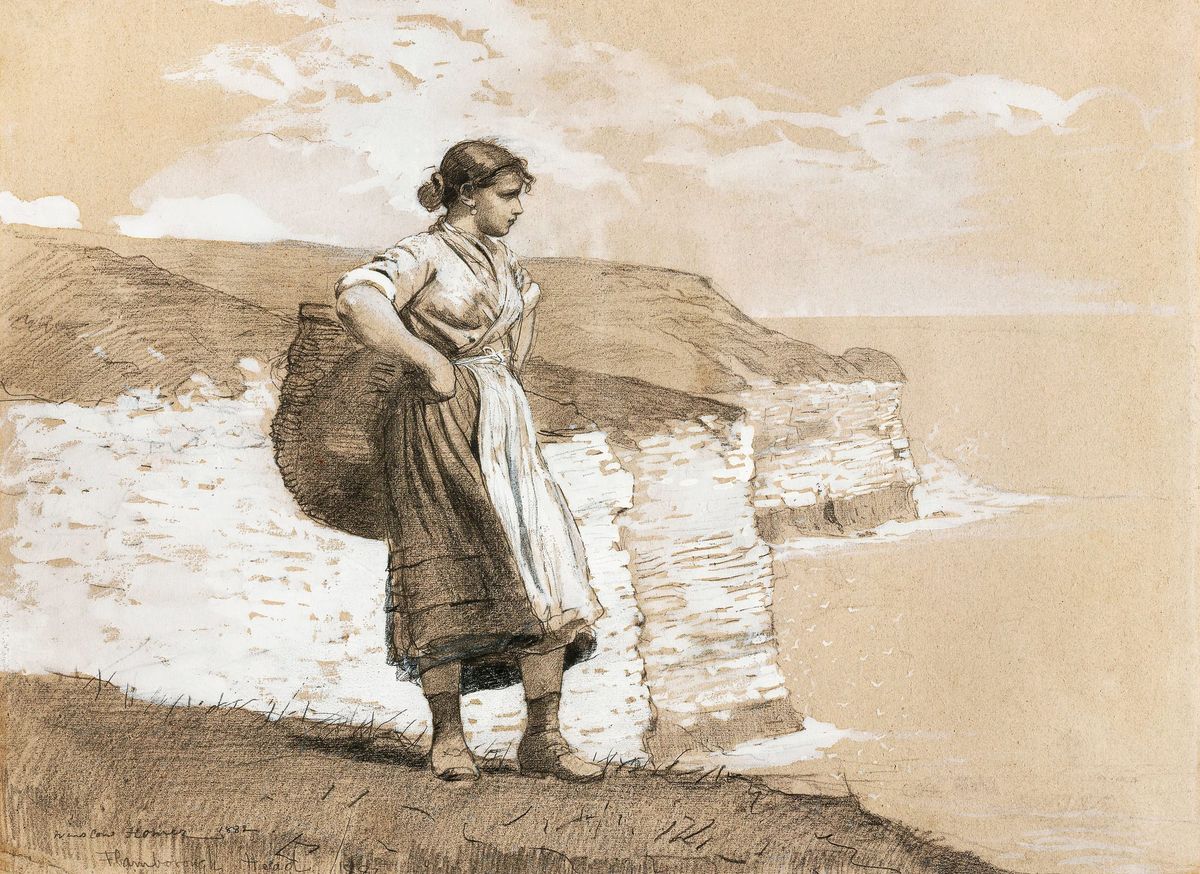
미국의 대표적인 사실주의 화가 윈슬로 호머(Winslow Homer, 1836–1910)가 1882년에 제작한 드로잉 작품 <플램버러 곶(Flamborough Head)>은 그의 예술 여정에서 가장 중대한 전환점으로 꼽히는 영국 체류 시기의 정수를 담고 있는 수작입니다.
이 작품은 가로 60.8cm, 세로 44.5cm 크기의 따뜻한 베이지 톤 우브 종이 위에 차콜과 흑연으로 섬세하고 단단한 소묘 선을 구축한 뒤, 불투명한 흰색 과슈(구아슈)를 정교하게 덧발라 입체감과 눈부신 채광을 극대화한 혼합 기법 드로잉입니다.
현재 미국 시카고 미술관(The Art Institute of Chicago)에 소장되어 있는 이 그림은 깎아지른 듯한 하얀 백악질 절벽 끝에 서서 거친 바다를 응시하는 강인한 어촌 여인의 모습을 기념비적인 조형미로 담아내고 있습니다.
1881년 봄, 상업적 성공과 뉴욕 사교계의 번잡함에 깊은 피로를 느낀 호머는 돌연 짐을 싸서 영국 북동부 요크셔 해안의 외딴 어촌 마을인 컬러코츠(Cullercoats)로 떠나 약 20개월 동안 은둔 생활을 시작했습니다.
그곳에서 호머는 생선을 나르고 그물을 손질하며 거친 바다로부터 가족의 생계를 지탱하는 어촌 여인들의 건강하고 당당한 모습에 깊은 매료를 느꼈습니다. 그는 매일같이 짙은 바다 안개와 세찬 바닷바람을 맞으며 절벽과 해변을 누볐고, 마을 사람들과 격의 없이 어울리며 현지 어부들의 투박한 삶에 진심으로 동화되었습니다.
당시 마을 주민들은 낯선 미국인 화가가 값비싼 실크 드레스를 입은 귀부인 대신 무거운 생선 바구니를 짊어진 자신들의 억척스러운 일상을 주인공으로 화폭에 담는 것을 보고 무척 신기해하면서도 깊은 자부심을 느꼈다고 전해집니다.
호머는 거센 해풍 속에서도 이젤이 쓰러지지 않도록 무거운 바위로 받쳐가며 현장에서 직접 스케치를 진행하는 열정을 보였습니다. 훗날 미술사학자들은 호머가 영국 어촌에서 보낸 이 시기를 기점으로 기존의 밝고 목가적인 삽화풍 스타일에서 벗어나, 인간의 실존적 존엄성과 자연의 숭고한 힘을 다루는 위대한 거장의 반열에 오르게 되었다고 평가합니다.
절벽 아래로 부서지는 파도와 새하얀 석회암 암벽 위에 홀로 우뚝 선 여인의 자태는 단순한 노동자를 넘어 대자연의 풍파를 견뎌내는 영웅적인 인류의 표상으로 승화되었습니다.
작품을 감상할 때 관람자의 무의식적인 시선은 매우 안정적이고 치유적인 상승 곡선을 그리며 이동합니다. 관람객의 눈길은 가장 먼저 화면 중앙에서 흰색 과슈로 환하게 빛나는 여인의 앞치마와 블라우스, 그리고 그녀의 다부진 허리손 자세에 머뭅니다.
이어 시선은 묵묵하고 단단하게 다져진 그녀의 옆얼굴과 바람에 흩날리는 머리칼을 따라 올라간 뒤, 뒤편으로 아득하게 펼쳐진 플램버러 백악 절벽의 하얀 지층과 수평선 너머의 바다로 자연스럽게 확장됩니다.
거대한 자연의 공간을 천천히 훑은 시선은 다시 여인의 어깨에 든든하게 얹힌 커다란 수확 바구니와 굳건히 땅을 딛고 선 발끝으로 내려와 완벽한 시각적 균형을 이룹니다.
이러한 시선의 흐름은 관람자의 내면에 깊은 심리적 안정감과 단단한 정서적 지지력을 형성합니다. 위태로워 보일 수 있는 벼랑 끝 풍경임에도 불구하고, 화면을 지배하는 인물의 흔들림 없는 당당한 자세와 차분한 눈빛은 관람객의 무의식 속에 내재된 일상의 불안과 조급함을 평온하게 잠재워 줍니다.
거센 비바람과 삶의 거친 파도를 정면으로 마주하면서도 한 치의 흐트러짐 없이 삶의 터전을 지켜내는 여인의 굳센 에너지는, 현대인들에게 복잡한 번민을 내려놓게 하고 내면의 중심을 곧게 세워주는 숭고한 위로와 묵직한 내적 용기를 선사합니다.
Flamborough Head
Executed in 1882 by the eminent American realist master Winslow Homer (1836–1910), Flamborough Head stands as an exquisite masterpiece capturing the vital turning point of his artistic career during his transformative residency in England.
Measuring 60.8 cm wide by 44.5 cm high on warm beige wove paper, the work combines charcoal and graphite underdrawing with delicately layered opaque white gouache, creating an extraordinary interplay of sculptural volume and natural luminosity.
Preserved in the permanent collection of The Art Institute of Chicago, this drawing monumentalizes a resilient fisherwoman standing poised atop sheer chalk cliffs, gazing out over the expansive, turbulent sea.
In the spring of 1881, weary of the commercial pressures and social whirl of New York, Homer retreated to the remote fishing village of Cullercoats on the rugged northeastern coast of Yorkshire, England, where he remained for nearly twenty months.
There, he became utterly captivated by the formidable strength, dignity, and grace of the local women who hauled heavy fish baskets, mended nets, and sustained their families against the perilous sea. Braving relentless coastal gales and dense sea mist, Homer walked the bluffs daily, developing a deep, respectful camaraderie with the hardworking community.
The local villagers were initially amused and later deeply honored that this quiet American gentleman chose to immortalize their daily labors rather than depicting fashionable ladies in opulent drawing rooms. Homer often anchored his easel with heavy seaside stones against the howling North Sea winds to sketch outdoors directly from life.
Art historians universally regard this English period as the crucible that elevated Homer from a gifted genre illustrator into a profound master of the sublime, shifting his focus toward existential human perseverance and the monumental forces of nature. The solitary figure standing steadfast against the stark white cliffs transcends ordinary labor, emerging as a timeless emblem of heroic fortitude.
When engaging with the drawing, the viewer's unconscious gaze follows an inherently grounding and restorative pathway. The eye is immediately drawn to the vibrant highlights of white gouache illuminating the woman's apron and blouse, accentuating her confident posture with hands braced firmly on her hips.
The gaze then ascends to her calm, resolute profile and wind-tousled hair, before drifting across the layered chalk strata of Flamborough Head and the vast marine horizon. After traversing the breathtaking coastal expanse, the viewer's attention returns downward, guided by the substantial creel basket slung across her shoulders to her grounded stance upon the cliff edge.
This visual rhythm instills an enduring sense of composure and inner clarity within the viewer. Although positioned at the precipice of a dramatic cliff, the protagonist's steadfast balance and untroubled demeanor act as a psychological anchor, gently dispelling the ambient stresses and anxieties of daily life.
By confronting the boundless elements with quiet courage and grounded grace, the figure imparts a reassuring sense of resilience, inviting the observer to discover profound stillness, fortitude, and emotional equilibrium amidst life's unforeseen storms.
본 리뷰에서 작품을 제외한 컨텐츠의 저작권은 팔렛트제주에 있습니다.
"퍼블릭도메인 고전명화"를 제외한 모든 창작 콘텐츠는 저작권법 제4조 및 제10조에 의거하여 보호됩니다. 무단 도용시 저작권법 제136조(벌칙)에 의거, 당사의 사전 서면 승인 없는 저작권 침해 행위를 금지합니다.