나비와 물고기 (옐로 퍼치) - Butterflies and Perch
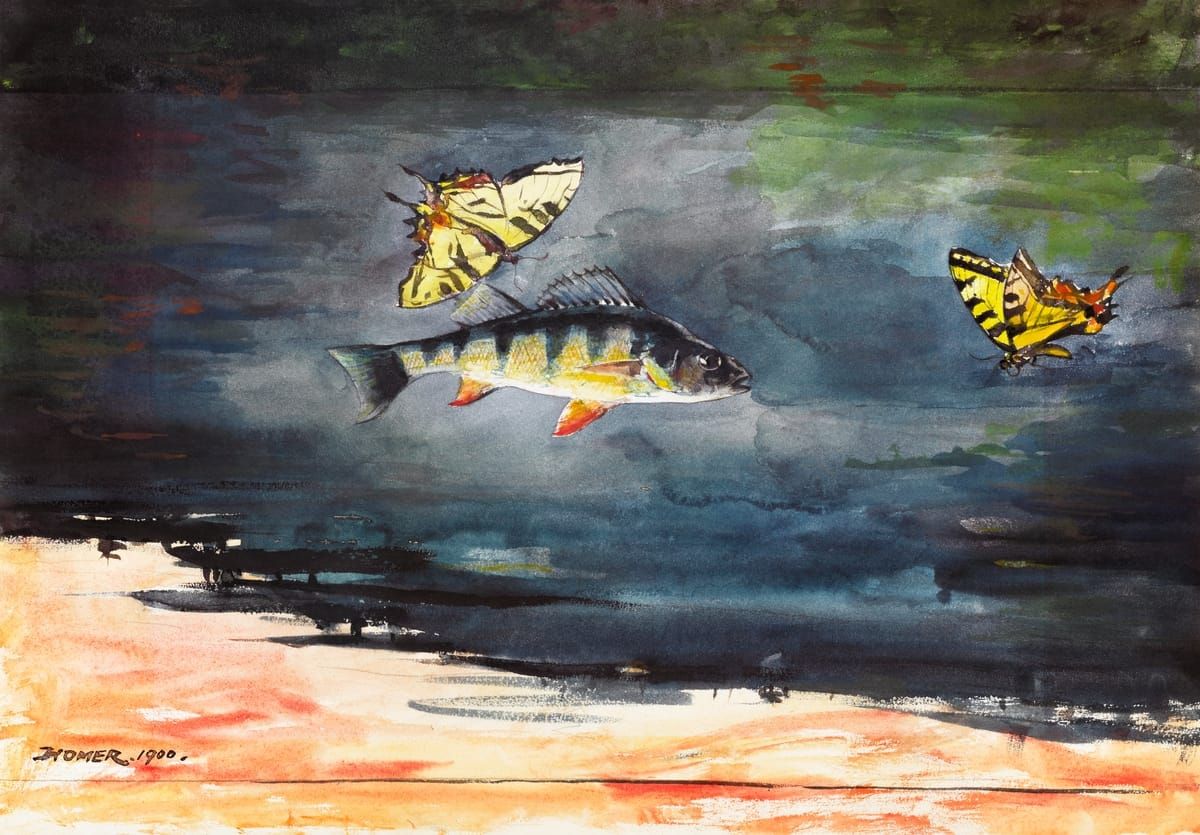
미국의 전설적인 사실주의 거장 윈슬로 호머(Winslow Homer, 1836–1910)가 1900년에 완성한 수채화 명작 <나비와 물고기(Butterflies and Perch / Fish and Butterflies)>는 북미 야생 숲속 호숫가의 투명한 물빛과 그 수면 위를 나풀거리는 호랑나비, 그리고 물속에서 유영하는 민물고기 옐로 퍼치의 찰나를 가장 독창적이고 환상적인 필치로 포착해 낸 수작입니다.
이 작품은 가로 약 51.0cm, 세로 약 35.5cm 크기의 고급 워브 종이 위에 흑연 연필로 윤곽을 섬세하게 구축한 후, 깊고 맑은 호숫물의 짙은 청록빛을 촉촉하게 스며들게 하는 웨트 온 웨트(wet-on-wet) 기법과 물감을 날카롭게 긁어내어 물고기 등지느러미와 비늘의 섬세한 선을 살려내는 스크래칭, 닦아내기 기법을 자유자재로 구사하여 제작되었습니다.
현재 미국 주요 미술관 및 유수 프라이빗 컬렉션에서 높이 평가받는 이 그림은 뉴욕주 북부 애디론댁(Adirondacks) 또는 캐나다 퀘벡의 한적한 호숫가 얕은 여울에서 노란 날개를 활짝 펴고 수면 위를 날아다니는 두 마리의 호랑나비와, 붉은 지느러미와 황금빛 줄무늬를 뽐내며 먹이를 노리듯 수면 가까이 솟아오른 옐로 퍼치(Yellow Perch)의 생생한 순간을 담고 있습니다.
이 그림에는 평생을 열렬한 플라이낚시꾼으로 살아가며 숲과 호수의 미세한 생태적 신비에 매료되었던 호머의 깊은 관찰력과 유쾌한 인간적 에피소드가 깃들어 있습니다. 만년에 호머는 낚시 여행을 떠날 때마다 단순히 물고기를 낚는 행위에 그치지 않고, 수면 위로 떨어지는 곤충과 이를 낚아채려는 물고기 사이의 보이지 않는 교감을 집요하게 관찰했습니다.
어느 여름날 호숫가 바위에 앉아 낚싯대를 드리우던 호머는 수면 위를 스치듯 날아가던 노란 호랑나비 한 마리가 물에 살짝 닿는 순간, 물속에서 번개처럼 솟구쳐 오른 퍼치가 나비를 향해 입을 뻐끔거리는 경이로운 광경을 목격했습니다.
호머는 그 자리에서 낚싯대를 내려놓고 무릎 위에 화구 상자를 펼친 뒤, 물속의 어류와 공중의 나비가 하나의 평면에서 공존하는 마법 같은 구도를 번개처럼 스케치하기 시작했습니다.
함께 동행했던 산림 가이드가 낚시는 안 하고 왜 날아다니는 나비 따위를 그리고 있느냐고 묻자, 호머는 "저 나비는 지금 물고기와 목숨을 건 춤을 추고 있는 중이라네! 낚싯바늘의 가짜 털미끼보다 저 노란 날갯짓이야말로 자연이 만든 가장 완벽한 유혹이지!"라며 껄껄 웃었다는 유쾌하고 생생한 일화가 전해집니다.
화면 상단의 짙은 숲 그늘과 하단의 밝은 모래톱은 호머가 수면의 굴절과 깊이감을 얼마나 치밀하게 계산하며 투명 수채 물감을 겹쳐 발랐는지를 여실히 증명합니다.
미술사학자들은 이 작품을 호머의 후기 수채화 중에서도 일본 우키요에(동양 판화)의 평면적 공간 미학과 서양의 철저한 사실주의가 가장 세련되게 결합된 독창적 걸작으로 평가합니다. 수면 위와 아래의 경계를 과감하게 허물고 공중의 곤충과 수중의 어류를 한 화면에 대등하게 병치한 대담한 조형성은 20세기 현대 자연주의 미술의 새로운 시각적 가능성을 열었다는 극찬을 받습니다.
작품을 마주할 때 관람자의 무의식적인 시선은 매우 경쾌하고 유연한 수평 나선형 궤적을 그리며 이동합니다. 관람객의 눈길은 가장 먼저 화면 중앙에서 정교한 흑색 줄무늬와 선명한 다홍빛 지느러미를 뽐내며 헤엄치는 옐로 퍼치의 다부진 몸체에 가닿습니다.
이어 시선은 물고기의 바로 위쪽에서 노란 날개를 펄럭이며 수면에 닿을 듯 날아가는 호랑나비의 화사한 색감으로 가볍게 솟아오른 뒤, 화면 우측에서 또 다른 율동감을 만들어내는 두 번째 나비의 역동적인 날갯짓으로 자연스럽게 미끄러져 갑니다.
공중의 날갯짓을 훑은 시선은 수면 아래 짙은 남색과 청록색으로 번져 나가는 깊은 호수의 묵직한 물그림자를 지나, 화면 하단에서 따뜻한 주황빛과 모랫빛으로 빛나는 얕은 강변의 여울로 내려와 포근하고 안정적인 시각적 안착을 이룹니다.
이러한 유려한 시선의 순환은 관람자의 내면에 깊은 심리적 정화와 맑은 생동감을 불어넣어 줍니다. 짙푸른 호숫물의 서늘함과 화사한 노란 나비의 날갯짓이 만들어내는 선명한 색채 대비는, 복잡한 일상의 소음과 답답한 긴장감에 지친 현대인의 무의식에 마치 시원한 숲속 옹달샘을 들여다보는 듯한 상쾌한 카타르시스와 마음의 정화를 선사합니다.
생명의 긴장감마저 한 폭의 우아한 춤처럼 승화시킨 자연의 순수한 조화는, 보는 이에게 번잡한 잡념을 씻어내고 자신의 내면에 잠재된 유연한 생명력과 맑고 평온한 쉼을 되찾아 주는 따뜻한 치유의 선물을 건넵니다.
Butterflies and Perch
Completed in 1900 by the celebrated American realist master Winslow Homer (1836–1910), the watercolor masterpiece Butterflies and Perch (also known as Fish and Butterflies) stands as an extraordinary tour de force capturing the luminous transparency of fresh inland waters and the fleeting, poetic encounter between aquatic life and the aerial world.
Measuring approximately 51.0 cm wide by 35.5 cm high on fine wove paper, the work showcases Homer's consummate watercolor technique, employing rich wet-on-wet washes of deep Prussian blue and forest greens, sharp surface scratching to delineate the bristling dorsal fin and shimmering scales of the fish, and delicate lifting that conveys the translucent glow of water.
Preserved and celebrated across prominent public and private American art collections, this painting dramatically portrays a yellow perch rising near the surface of a secluded Adirondack or Quebec stream, its sharp red fins poised beneath a pair of vibrant tiger swallowtail butterflies fluttering above the dark, reflective pool.
Behind this captivating natural composition lies Homer's lifelong passion for fly-fishing and an enchanting array of personal anecdotes. In his mature years, Homer approached angling not merely as a sport, but as an intimate study of the subtle ecological rhythms connecting forest insects, river currents, and underwater predators.
While resting along a quiet shoreline, Homer observed a swallowtail butterfly skimming the water's surface, triggering an immediate, lightning-fast ascent from a lurking perch eager for a natural strike.
Electrified by the visual harmony of air and water colliding in a single instant, Homer laid aside his fishing tackle, opened his traveling paint kit upon his knees, and rapidly laid down fluid washes to capture the exquisite suspended drama.
When his rustic wilderness guide asked with amusement why he was sketching fragile bugs instead of hauling in trophies for dinner, Homer laughed heartily, replying that the fluttering yellow wings were dancing a magnificent dance of life with the fish, far surpassing any artificial fly crafted by human hands.
The contrast between the cool, shadowed depths of the pool and the warm ochre shoal in the foreground serves as an authentic testament to Homer's extraordinary mastery of aquatic optics and natural light.
Art historians celebrate this painting as a definitive jewel of Homer's late period, praising its audacious structural synthesis of Western realism and the flat, decorative elegance of Japanese woodblock prints. By seamlessly collapsing the boundary between water and atmosphere to present fish and insects in dynamic equilibrium, Homer established an intensely modern visual language that prefigured twentieth-century wildlife art.
When engaging with the painting, the viewer's unconscious gaze undertakes an inherently refreshing and centering visual journey. The eye is initially captured by the crisp, horizontal form of the yellow perch poised gracefully in the center, lingering upon its warm gold belly, dark vertical banding, and radiant scarlet fins.
The gaze then leaps upward into the delicate, fluttering contours of the swallowtail hovering directly above its spine, before drifting toward the second butterfly poised energetically on the right margin.
Sweeping down through the deep, velvety indigo washes that evoke the mysterious depths of the pool, the viewer's attention settles comfortably along the luminous band of warm sand and amber shallows anchoring the lower edge.
This rhythmic visual journey fosters profound psychological reassurance, mental lightness, and deep emotional clarity within the observer. The pristine aquatic palette and vibrant chromatic sparks act as an intuitive emotional balm, dispelling ambient modern fatigue and cooling inner tension.
By presenting a world where danger and beauty dissolve into a graceful ballet of pure natural instinct, Homer offers the observer a comforting sanctuary of mindfulness, inspiring a deep sense of renewal, inner equilibrium, and enduring peace.
본 리뷰에서 작품을 제외한 컨텐츠의 저작권은 팔렛트제주에 있습니다.
"퍼블릭도메인 고전명화"를 제외한 모든 창작 콘텐츠는 저작권법 제4조 및 제10조에 의거하여 보호됩니다. 무단 도용시 저작권법 제136조(벌칙)에 의거, 당사의 사전 서면 승인 없는 저작권 침해 행위를 금지합니다.