물수리의 둥지 (카누와 물수리) - The Osprey's Nest
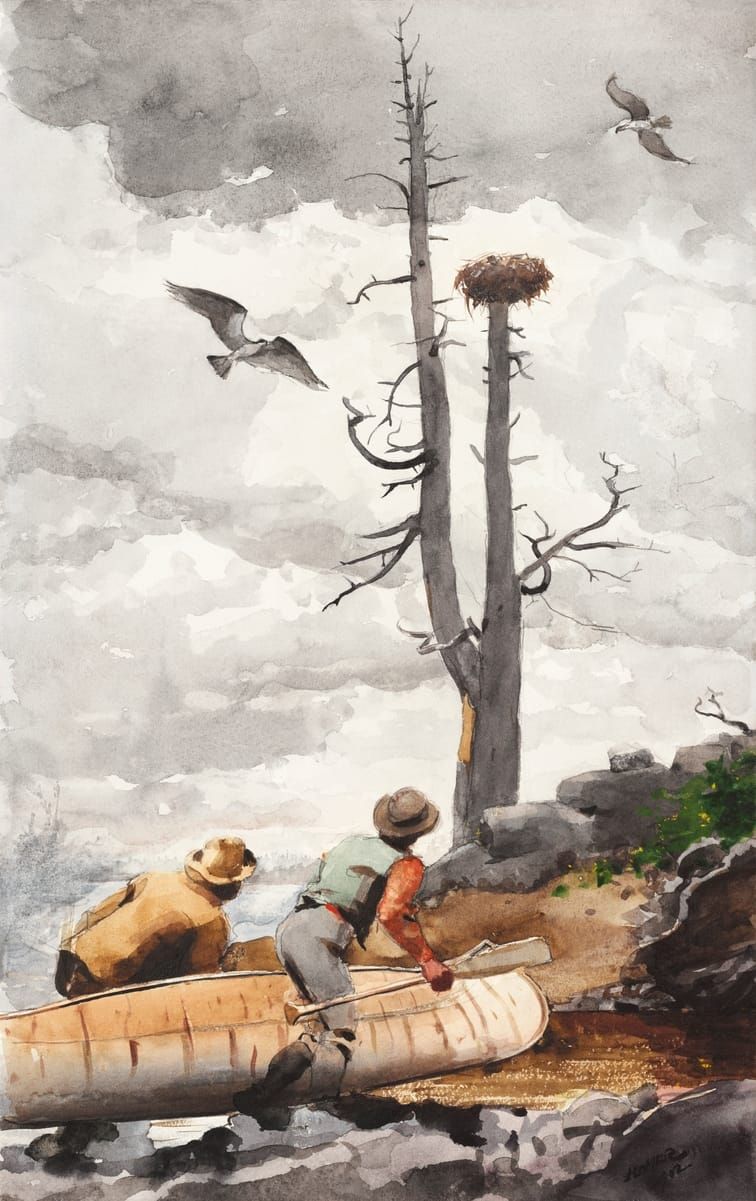
미국의 전설적인 사실주의 거장 윈슬로 호머(Winslow Homer, 1836–1910)가 1902년에 완성한 수채화 명작 <물수리의 둥지(The Osprey's Nest)>는 북미 야생의 적막한 강변에서 카누를 몰며 고목 꼭대기에 자리한 거대한 새 둥지와 허공을 선회하는 물수리들을 올려다보는 탐험가들의 경이로운 순간을 가장 청량하고 대담한 필치로 포착해 낸 수작입니다.
이 작품은 가로 약 34.3cm, 세로 약 54.6cm의 세로형 구도를 지닌 고급 워브 종이 위에 흑연 연필로 고목의 마른 가지와 인물들의 윤곽을 날렵하게 잡은 후, 투명 수채 물감의 촉촉한 번짐과 스며듦으로 먹구름 낀 하늘과 호숫가를 칠하고, 종이 본연의 밝은 흰 여백과 날카로운 긁어내기 기법을 활용해 껍질을 벗겨낸 자작나무 카누의 질감과 물수리의 날갯짓을 조형해 낸 혼합 수채 기법으로 제작되었습니다.
현재 미국 주요 미술관 및 유수 프라이빗 컬렉션에서 높이 평가받는 이 그림은 캐나다 퀘벡주 또는 뉴욕주 애디론댁의 깊은 야생 강변에서, 자작나무 껍질로 만든 카누를 끌어올리던 사공과 낚시꾼이 메마른 고목 상단에 얽혀 있는 거대한 물수리 둥지와 그 주변을 맴돌며 날카롭게 지저귀는 새들을 호기심 어린 눈빛으로 응시하는 생생한 찰나를 담고 있습니다.
이 그림 뒤에는 매년 여름과 가을이면 문명세계를 떠나 북미 원시림의 야생 동식물을 관찰하며 플라이 낚시를 즐겼던 호머의 깊은 자연애와 흥미진진한 비하인드가 깃들어 있습니다. 1900년대 초반 호머는 인간의 발길이 닿지 않는 깊은 숲속에서 맹금류가 터를 잡고 살아가는 원초적인 생태의 질서에 완전히 매료되어 있었습니다.
호머는 마른 고목의 드라마틱한 수직선과 하늘을 가르는 물수리의 역동적인 비행을 포착하기 위해 가이드와 함께 강변 자갈밭에 자리를 잡았습니다. 카누를 끌어당기던 가이드가 머리 위를 가로질러 낮게 활공하는 물수리의 날개 소리에 깜짝 놀라 모자를 움켜쥐며 "화가 선생님, 저 녀석들이 둥지를 침범한 줄 알고 우리를 공격하려는 것 같습니다!"라며 엉겁결에 몸을 웅크리는 유쾌한 소동이 벌어졌습니다.
그 모습을 본 호머는 껄껄 웃음을 터뜨리며 "놀라지 말게! 저 거대한 날갯짓과 의연한 둥지야말로 이 원시림이 우리에게 보여주는 가장 위대한 환영 인사라네!"라고 외쳤습니다. 호머는 사공의 긴장된 뒷모습과 하늘 높이 솟은 둥지를 향해 날아드는 물수리의 날렵한 실루엣을 번개처럼 종이 위에 포착해 냈고, 화면 우측 하단 짙은 바위 위에 'HOMER 1902' 서명을 힘차게 새겨 넣었다는 다정한 일화가 전해집니다.
메마른 고목 줄기에 남겨진 껍질 벗겨진 흔적과 잿빛 먹구름 사이로 날아오르는 두 마리 물수리의 유려한 비행, 그리고 맑고 차가운 강변의 자갈과 자작나무 카누의 디테일은 호머가 북미 야생의 숭고한 현장감을 얼마나 진솔하고 세심한 애정으로 관찰했는지를 증명합니다.
미술사학자들은 이 작품을 호머가 1900년대 초 만년에 도달한 수채화 조형미와 야생 생태 관찰의 절대적인 정점으로 평가합니다.
장대한 수직 구도를 통해 자연의 원초적인 위엄과 생명력을 극대화했으며, 투명 수채화의 유연한 흐름 속에서 인간과 야생 동물이 대등한 존재로 마주하는 평화로운 긴장감을 완벽한 현대적 시각 언어로 승화시켰다는 극찬을 받습니다.
작품을 마주할 때 관람자의 무의식적인 시선은 고목의 수직선을 따라 매우 장엄하고 시원한 수직 상승 및 하강 순환 궤적을 그리며 이동합니다. 관람객의 눈길은 가장 먼저 화면 중앙 하단에서 카누를 잡고 허리를 세워 높은 하늘을 우러러보는 붉은 셔츠 사공의 역동적인 뒷모습과 밀짚모자에 머뭅니다.
이어 시선은 사공의 시선이 향하는 중앙의 높고 메마른 두 그루의 고목 기둥을 타고 단숨에 화면 상단으로 솟구쳐 올라, 나뭇가지 끝에 둥글고 묵직하게 얹혀 있는 짙은 갈색 물수리 둥지와 그 위를 날갯짓하는 새들의 날렵한 실루엣에 도달합니다.
하늘을 가르는 물수리의 시원한 날갯짓을 확인한 시선은 화면 상단을 덮은 웅장하고 서늘한 회백색 먹구름의 대기감을 훑고 내려와, 화면 좌측에서 둥지를 향해 하강하는 또 한 마리의 물수리가 그리는 유려한 비행 궤적을 타고 좌측 하단으로 부드럽게 미끄러져 갑니다.
이후 시선은 은은한 황금빛으로 빛나는 자작나무 카누의 매끄러운 선체와 강변의 둥근 자갈 바위들을 거쳐, 다시 고목 아래 굳건하게 발을 디딘 사공들의 생생한 호기심으로 돌아와 완전하고 아늑한 시각적 안착을 이룹니다.
이러한 유려한 시선의 순환은 관람자의 내면에 깊은 심리적 정화와 가슴 벅찬 해방감을 선물합니다. 차가운 야생의 바람과 웅장한 원시림의 고목이 뿜어내는 깊은 침묵의 공간감은, 복잡한 일상의 번잡함과 피로에 지친 현대인의 무의식에 마치 깊은 숲속 호숫가에 서서 맑은 숲 공기를 깊게 들이마시는 듯한 깊은 이완과 감각적 휴식을 선사합니다.
대자연의 장엄한 질서 속에서 야생의 섭리를 경외하며 바라보는 인간들의 순수한 모습은, 보는 이에게 일상의 번뇌를 내려놓고 삶의 어떤 막막함 앞에서도 시선을 높이 들어 새로운 희망을 발견할 수 있는 내면의 굳센 용기와 맑은 평정을 되찾아 주는 든든한 치유의 위로를 건냅니다.
The Osprey's Nest
Completed in 1902 by the celebrated American realist master Winslow Homer (1836–1910), the watercolor masterpiece The Osprey's Nest stands as an extraordinary tour de force capturing the primeval stillness, ecological wonder, and vertical majesty of the North American wilderness with peerless atmospheric brilliance.
Measuring approximately 34.3 cm wide by 54.6 cm high on fine wove paper, the work showcases Homer's consummate mastery of transparent watercolor within an elongated vertical format, laying down fluid wet-on-wet washes of charcoal and slate across the billowing overcast sky, while utilizing crisp paper reserves and sharp scraping to articulate the peeled golden birchbark canoe and the soaring silhouettes of the ospreys.
Preserved and celebrated across prominent public and private American art collections, this painting portrays a quiet wilderness landing along a rushing river in Quebec or the Adirondacks, where a woodsman in a red shirt and his companion steady their birchbark canoe along the rocky shore, pausing to gaze upward in awe at a massive raptor nest balanced upon the crest of a weathered pine snag.
Behind this captivating watercolor lies Homer's lifelong passion for northern waterways and his acute eye for untamed fauna during his autumn angling expeditions. Venturing deep into remote territories where wild birds nested undisturbed by modern civilization, Homer was enchanted by the primal balance between the ancient forest and its winged inhabitants.
Setting up his field stool along the gravelly bank to capture the dramatic upward thrust of the barren timber, Homer watched his guide maneuver the canoe toward the shore.
When one of the circling ospreys swooped low over the water with a piercing whistle, the startled woodsman instinctively grabbed his hat and ducked, thinking the great bird was defending its domain.
Amused by the guide's sudden scramble, Homer laughed heartily, reassuring him that the magnificent raptors were merely offering the finest wilderness greeting nature could provide. Homer swiftly applied fluid washes of ochre, indigo, and umber to record the unposed wonder of the woodsmen and the soaring flight of the birds, proudly signing 'HOMER 1902' upon the dark boulder in the lower right margin.
The stripped bark blaze on the lower trunk, the intricate silhouette of dry twigs forming the aerial nest, and the pale ripples reflecting along the river stones stand as authentic testaments to Homer's deeply observant eye for the humble poetry of wilderness exploration.
Art historians celebrate this painting as a defining highlight of Homer's late mature watercolor period, praising its radical vertical rhythm and modern compositional daring. By elevating an everyday outdoor encounter into a sublime dialogue between man and primeval nature, Homer created an enduring visual sanctuary of ecological harmony, quiet courage, and timeless peace.
When engaging with the painting, the viewer's unconscious gaze undertakes an intensely uplifting and grounding visual journey. The eye is initially welcomed by the sun-warmed figure of the woodsman standing beside the canoe in the lower center, lingering upon his red sleeve, broad hat, and his focused upward gaze.
The gaze then travels along the sheer vertical ascent of the twin dead pine trunks, soaring into the upper register to discover the dense, tangled form of the osprey nest perched against the gray sky.
Sweeping into the vast, atmospheric expanse of rolling storm clouds, the viewer's attention follows the sweeping wings of the airborne ospreys wheeling above before descending along the graceful curve of the left-hand bird gliding downward.
Finally, cascading through the warm ochre tones of the birchbark canoe and the shaded river rocks in the foreground, the eye settles comfortably back into the anchored fortitude of the explorers.
This rhythmic visual journey fosters profound psychological reassurance, sensory awakening, and deep emotional stillness within the observer. The tactile immersion in cool mountain air and resinous forest quietude acts as an intuitive emotional balm, dispelling ambient modern fatigue and soothing inner tension.
By presenting an idyllic world where human wonder exists in pure harmony with the rhythm of the wild, Homer offers the observer a comforting sanctuary of mindfulness, inspiring a deep sense of renewal, sweet contentment, and enduring inner peace.
본 리뷰에서 작품을 제외한 컨텐츠의 저작권은 팔렛트제주에 있습니다.
"퍼블릭도메인 고전명화"를 제외한 모든 창작 콘텐츠는 저작권법 제4조 및 제10조에 의거하여 보호됩니다. 무단 도용시 저작권법 제136조(벌칙)에 의거, 당사의 사전 서면 승인 없는 저작권 침해 행위를 금지합니다.