물결의 노래 (메인 해안의 파도) - A Light on the Sea / On a Lee Shore (Waves crashing at Prout's Neck)
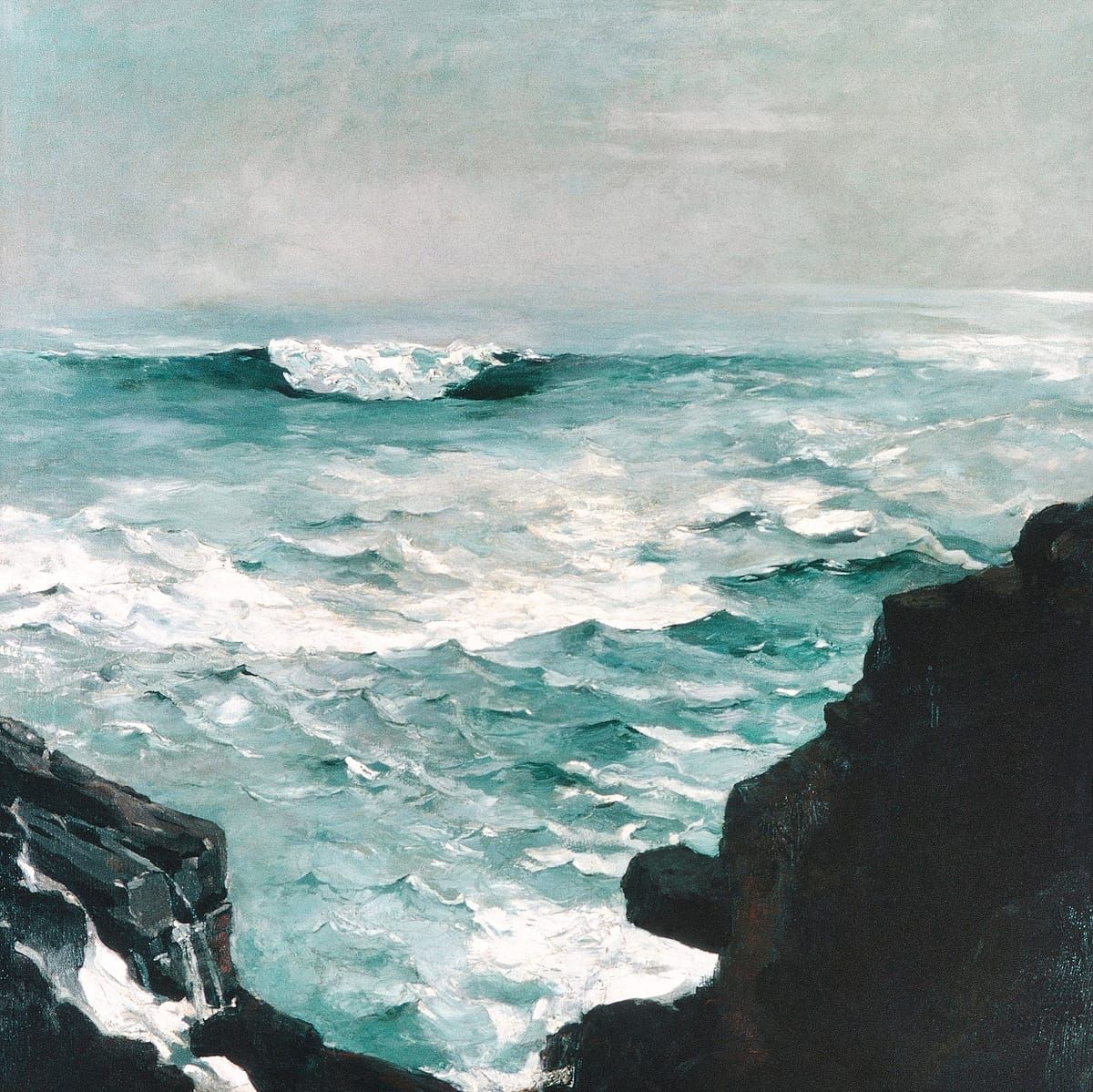
미국의 전설적인 사실주의 거장 윈슬로 호머(Winslow Homer, 1836–1910)가 1895년경에 완성한 기념비적 유화 걸작 <물결의 노래(Waves crashing at Prout's Neck / Maine Coast)>는 북대서양의 서늘한 청록빛 파도와 해안 바위 절벽 틈새로 부서져 내리는 은백색 포말의 장엄한 조형미를 압도적인 깊이감으로 포착해 낸 수작입니다.
이 작품은 가로 약 76.2cm, 세로 약 76.2cm 크기의 정방형에 가까운 캔버스 위에 제작되었으며, 수면 위로 굽이치는 에메랄드빛과 청록빛 물결에 두터운 유화 임파스토를 밀도 있게 얹고, 암벽 틈새로 쏟아져 내리는 하얀 파도의 포말과 전경 양쪽에 버티고 선 흑갈색 화강암 절벽의 묵직한 질감을 과감한 팔레트 나이프와 정교한 붓질로 구현해 냈습니다.
현재 미국 주요 미술관 및 유수 프라이빗 컬렉션 연구 아카이브에서 중요하게 다루어지는 이 그림은 메인주 프라우츠 넥(Prouts Neck)의 험준한 해안가에서, 안개가 옅게 깔린 은빛 하늘 아래 거대한 파도가 암벽 사이 협곡으로 밀려들며 바다 전체가 살아 숨 쉬듯 요동치는 원초적 순간을 담고 있습니다.
이 그림 뒤에는 세상의 모든 소음을 뒤로하고 오직 파도와 바위의 대화에만 몰두했던 호머의 치열한 예술혼과 인간적인 비하인드가 깃들어 있습니다. 1890년대 호머는 메인주 절벽 위에 직접 지은 이동식 화실을 두고, 거센 바닷바람과 파도가 몰아치는 날이면 방수 외투를 걸친 채 몇 시간이고 벼랑 끝에 서서 바다를 관찰하곤 했습니다.
호머는 파도가 바위 절벽 사이에 갇혀 소용돌이치며 뿜어내는 독특한 청록빛 광채를 포착하기 위해 물보라가 튀어 오르는 절벽 틈새 바로 위에 이젤을 세웠습니다. 바닷물이 튀어 물감이 묻은 팔레트 위로 바닷물이 고이자, 동생 아서가 위험하다고 만류했습니다.
하지만 호머는 "아서, 저기 먼 수평선에서부터 달려와 바위 틈새로 쏟아져 내리는 파도의 리듬을 보게! 저건 단순한 바닷물이 아니라 수천 년 동안 이 땅을 깎아온 거대한 시간의 숨결일세!"라며 감탄을 터뜨렸고, 차가운 바닷바람 속에서도 얼굴 가득 미소를 띤 채 신들린 듯 붓을 놀렸다는 생생한 일화가 전해집니다.
화면 좌우를 견고하게 감싸 안은 흑갈색 암벽의 단층과 저 멀리 수평선 부근에서 하얗게 뒤집히며 솟아오르는 단 하나의 거대한 쇄파(Breaker)는 호머가 대자연의 구조적 웅장함을 얼마나 철저하게 계산하여 배치했는지를 증명합니다.
미술사학자들은 이 작품을 호머의 후기 해양화 연작 중에서도 조형적 순도와 색채의 울림이 절정에 달한 명작으로 평가합니다.
인간의 형상이나 배와 같은 서사적 장치를 완전히 지워버린 채, 오직 물과 바위, 그리고 빛이라는 자연의 순수한 요소만으로 실존적 숭고미를 완성하여 훗날 20세기 미국 추상표현주의 및 현대 풍경화의 지평을 연 선구적 기념비로 찬사를 받습니다.
작품을 마주할 때 관람자의 무의식적인 시선은 매우 깊이 있고 안정적인 V자형 및 포물선 궤적을 그리며 이동합니다. 관람객의 눈길은 가장 먼저 화면 상단 수평선 근처에서 눈부신 백색 능선을 그리며 거대하게 솟구쳐 부서지는 단 하나의 맑은 파도에 사로잡힙니다.
이어 시선은 햇살을 받아 영롱하게 반짝이는 청록빛 바다의 유려한 표면을 타고 화면 중앙으로 미끄러져 내려오며, 굽이치는 잔물결과 소용돌이치는 물살의 풍성한 질감 속으로 자연스럽게 빠져듭니다.
수면의 입체적인 움직임을 훑은 시선은 화면 앞쪽 좌우에서 바다를 듬직하게 감싸고 있는 흑갈색 화강암 절벽의 묵직한 양감에 닿은 뒤, 좌측 바위 절벽 틈새로 하얗게 쏟아져 내리는 폭포 같은 포말의 시원한 물줄기로 이동합니다.
이후 시선은 화면 상단을 묵직하고 고요하게 감싸 안은 은빛 잿빛 하늘의 맑은 대기감으로 상승하며, 끝없는 개방감 속에서 완전한 시각적 안착을 이룹니다.
이러한 유려한 시선의 순환은 관람자의 내면에 깊은 심리적 정화와 강력한 내적 카타르시스를 선물합니다. 화면 가득 넘실거리는 청량한 에메랄드빛 바닷물과 차가운 해풍이 빚어내는 공간감은, 복잡한 일상의 번잡함과 피로에 지친 현대인의 무의식에 묵은 스트레스를 씻어내는 시원한 해방감을 불어넣어 줍니다.
어떤 거센 파도의 충돌 속에서도 변함없이 자리를 지키는 굳건한 바위와 맑고 투명하게 부서지며 대지를 어루만지는 바다의 생명력은, 보는 이에게 번잡한 걱정을 내려놓고 삶의 어떤 파고 앞에서도 흔들리지 않는 내면의 단단한 중심과 맑은 평정을 되찾아 주는 깊은 치유의 위로를 건넵니다.
A Light on the Sea / On a Lee Shore (Waves crashing at Prout's Neck)
Completed circa 1895 by the celebrated American realist master Winslow Homer (1836–1910), the monumental oil masterpiece Waves crashing at Prout's Neck (associated with On a Lee Shore / Maine Coast studies) stands as an extraordinary tour de force capturing the primeval kinetic energy, translucent emerald depths, and elemental collision of the North Atlantic Ocean with breathtaking sculptural power.
Measuring approximately 76.2 cm wide by 76.2 cm high on canvas, the work showcases Homer's consummate mastery of heavy impasto and assertive brushwork, applying thick mounds of brilliant white to convey the frothing cascades of sea spray, contrasted against the deep, undulating ribbons of turquoise water and the monolithic shelves of dark coastal granite.
Preserved and celebrated across prominent public and private American art collections and research archives, this painting powerfully portrays the rugged shoreline of Prouts Neck, Maine, where massive oceanic swells roll into a narrow rocky cove under a luminous, mist-laden sky, breaking into frothing cascades against the immovable headlands.
Behind this captivating canvas lies Homer's solitary communion with the untamed sea and an inspiring array of personal anecdotes. Throughout the 1890s, Homer worked from his portable wooden studio perched on the cliffs of Maine, venturing out in heavy sou'westers to study the changing moods of the waves during stormy high tides.
Determined to capture the precise optical luminescence of seawater surging through dark fissures, Homer set up his easel directly above the spray-drenched cliffs. When salty sea foam blew across the palette and pooled upon his brushes, his brother Arthur urged him to seek shelter from the rising gale.
Homer smiled broadly amidst the wind, declaring that the majestic wave rolling in from the far horizon and thundering through the rocky gorge was nothing less than the ancient heartbeat of the earth carving its history into stone. Undeterred by the icy spray misting his coat, Homer continued painting with electric concentration, rejoicing in the physical vitality of the living elements.
The heavy, dark granite ledges framing the lower corners and the singular, triumphant breaker detonating along the distant horizon serve as authentic testaments to Homer's profound architectural control over the marine landscape.
Art historians celebrate this painting as a defining pinnacle of Homer's mature marine oeuvre, extolling its stark compositional equilibrium and modern chromatic restraint. By completely eliminating human figures and narrative anecdotes to focus exclusively on the eternal dialogue between water, stone, and vapor, Homer elevated a coastal study into a timeless visual monument of existential fortitude that prefigured twentieth-century modernism.
When engaging with the painting, the viewer's unconscious gaze undertakes an intensely thrilling yet stabilizing visual journey. The eye is initially welcomed by the solitary crest of the distant wave breaking brilliantly on the upper horizon, lingering upon the crisp white spray curling against the pale sky.
The gaze then travels downward through the luminous, rolling swells of translucent teal and sea-green, drawn into the rhythmic, undulating currents of the open water.
Reaching the foreground, the viewer's attention meets the solid, sculptural shelves of dark granite anchoring both flanks of the composition, tracing the frothing white ribbons of foam plunging through the rocky fissure on the lower left.
Finally, ascending into the pale, vaporous expanse of the atmospheric sky above, the eye embraces the boundless spatial clarity and brisk coolness of the open sea.
This rhythmic visual journey fosters profound psychological reassurance, cathartic release, and deep emotional stillness within the observer. The tactile immersion in cool ocean breezes and roaring surf acts as an intuitive emotional balm, dispelling ambient modern fatigue and accumulated inner tension.
By presenting the eternal balance between the boundless kinetic energy of the sea, the silent fortress of ancient rock, and the clear light of the northern coast, Homer offers the observer a comforting sanctuary of mindfulness, inspiring a deep sense of resilience, inner composure, and enduring peace.
본 리뷰에서 작품을 제외한 컨텐츠의 저작권은 팔렛트제주에 있습니다.
"퍼블릭도메인 고전명화"를 제외한 모든 창작 콘텐츠는 저작권법 제4조 및 제10조에 의거하여 보호됩니다. 무단 도용시 저작권법 제136조(벌칙)에 의거, 당사의 사전 서면 승인 없는 저작권 침해 행위를 금지합니다.