밀밭을 베는 사람 (베테랑의 수확) - The Veteran in a New Field
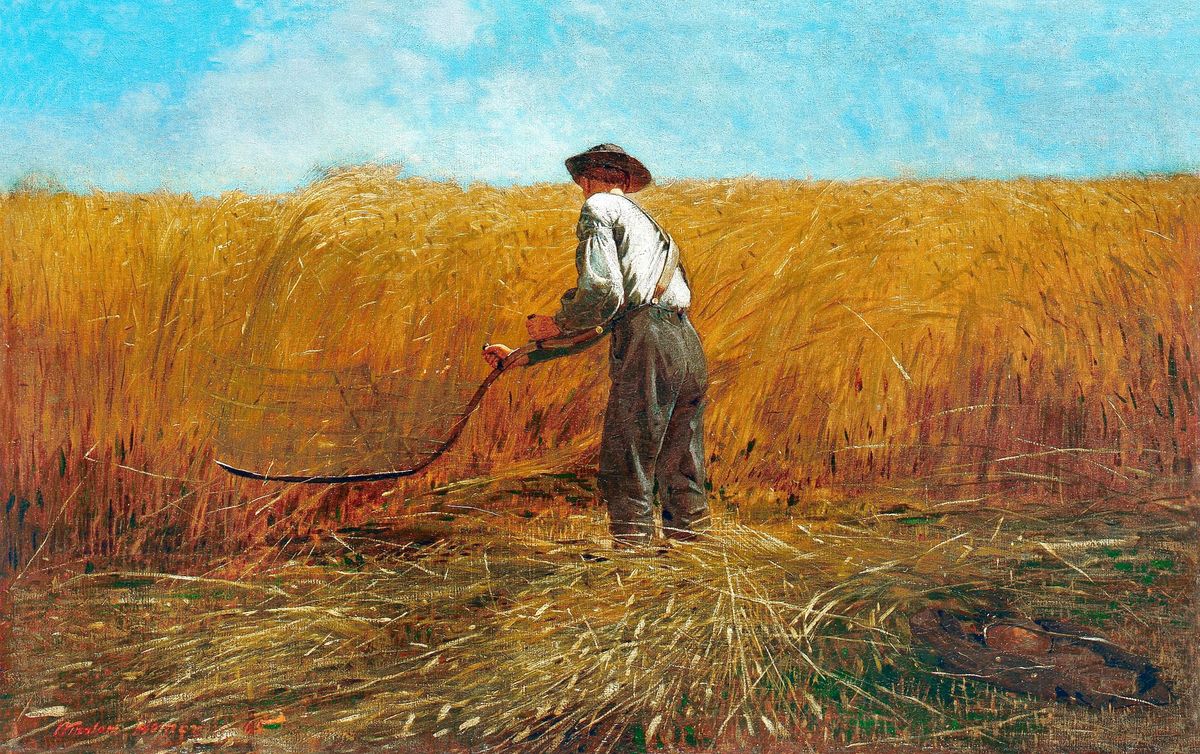
미국의 전설적인 사실주의 거장 윈슬로 호머(Winslow Homer, 1836–1910)가 1865년 가을에 완성한 유화 명작 <밀밭을 베는 사람(The Veteran in a New Field)>은 끝없이 펼쳐진 황금빛 밀밭에서 묵묵히 낫을 휘두르는 한 농부의 숭고한 뒷모습을 통해 조국의 상처를 치유하고 새로운 평화를 일구는 벅찬 감동을 담아낸 대표작입니다.
이 작품은 가로 96.8cm, 세로 61.3cm 크기의 캔버스 위에 탄탄한 유화 기법으로 제작되었으며, 바람에 넘실거리는 황금빛 밀 이삭들의 빽빽한 질감에는 도톰한 임파스토를 밀도 있게 얹고, 맑고 투명한 북미의 푸른 가을 하늘과 수확된 밀짚의 결을 정교한 명암 대비와 과감한 붓 터치로 구현해 냈습니다.
현재 미국 뉴욕 메트로폴리탄 미술관(The Metropolitan Museum of Art)에 영구 소장되어 있는 이 그림은 남북전쟁이 종전된 바로 그해, 전쟁터에서 돌아온 북군 참전용사가 군복을 벗어 던지고 고향의 풍요로운 들판에서 대형 큰낫(Cradle scythe)을 들고 새로운 수확에 몰두하는 역사적인 순간을 포착하고 있습니다.
이 그림 뒤에는 참혹했던 남북전쟁의 종군 화가로 활동하며 전쟁의 비극을 뼈저리게 목격했던 호머의 따뜻한 인간미와 치열한 예술적 고뇌가 깃들어 있습니다. 1865년 봄 전쟁이 끝나고 에이브러햄 링컨 대통령이 암살당하자 미국 사회는 깊은 슬픔과 혼란에 빠졌습니다.
호머는 죽음과 파괴의 현장을 뒤로하고 고향으로 돌아온 병사들이 총 대신 낫을 쥐고 대지를 일구는 모습에서 국가의 진정한 부활과 치유의 희망을 보았습니다. 호머는 뉴욕주 근교의 광활한 밀밭에 이젤을 펴고 실제 참전 군인이었던 청년을 모델로 세워 작업을 시작했습니다.
밀을 베던 청년이 뜨거운 가을 햇살 아래서 땀을 뻘뻘 흘리며 "화가 양반, 총포 소리가 멎으니 이 서걱거리는 밀 베는 소리가 천국의 음악 같소!"라며 수줍게 웃자, 호머는 깊은 감동을 받았습니다. 호머는 "자네가 땀 흘려 베어내는 이 황금빛 밀이야말로 전쟁의 상흔을 씻어내고 이 나라를 다시 살릴 가장 거룩한 빵이라네!"라고 화답하며 눈부신 가을빛을 캔버스에 단숨에 쏟아부었습니다.
호머는 초기 작업 때 낫에 달린 여러 갈래의 긁개(Cradle)를 그렸으나, 성경 이사야서에 나오는 "칼을 쳐서 보습을 만들고 창을 쳐서 낫을 만들리라"라는 구절처럼 고전적이고 원초적인 평화의 상징성을 극대화하기 위해 이를 단 하나의 단일 낫날로 과감히 수정했습니다.
화면 우측 하단 풀밭에 벗어놓은 북군 군복 외투와 수통, 그리고 좌측 하단 붉은 글씨로 새겨진 'Winslow Homer 65' 서명은 전쟁의 상처를 극복하고 평화로운 일상으로 돌아온 한 인간의 숭고한 여정을 증명합니다.
미술사학자들은 이 작품을 미국 남북전쟁 시대를 통틀어 가장 위대한 회화적 화해의 기념비이자 호머의 초기 대표 걸작으로 평가합니다.
죽음의 사신을 연상시키는 낫이라는 도구를 생명의 양식을 거두는 부활과 평화의 상징으로 완벽하게 전환시켰으며, 미국 미술사에서 가장 정직하고 감동적인 국민적 서사시를 완성했다는 극찬을 받습니다.
작품을 마주할 때 관람자의 무의식적인 시선은 황금빛 밀밭의 수평선과 낫의 궤적을 따라 매우 역동적이면서도 안정적인 포물선 궤적을 그리며 이동합니다. 관람객의 눈길은 가장 먼저 화면 중앙에서 흰 셔츠를 입고 다부지게 등을 돌린 채 낫을 쥐고 있는 남자의 듬직한 어깨와 단단한 팔 근육에 머뭅니다.
이어 시선은 남자가 양손으로 묵직하게 잡고 있는 낫 자루의 긴 호를 타고 내려와, 황금빛 밀을 향해 날카롭게 뻗어나간 은빛 낫날의 매끄러운 곡선으로 자연스럽게 미끄러져 갑니다.
낫날의 강렬한 운동성을 확인한 시선은 남자의 허리 높이까지 가득 차오른 눈부신 황금빛 밀밭의 거대한 물결을 지나, 화면 상단의 맑고 청명한 코발트블루빛 가을 하늘로 시원하게 상승합니다.
이후 시선은 화면 우측 하단의 풀밭 위에 가지런히 벗어놓은 짙은 남색 군복 외투와 둥근 수통의 소박한 흔적으로 내려와, 전쟁이 끝나고 찾아온 평화의 무게를 실감하며 깊은 시각적 안착을 이룹니다.
이러한 유려한 시선의 순환은 관람자의 내면에 깊은 심리적 정화와 벅찬 희망의 안도감을 선물합니다. 눈부신 햇살을 머금은 황금빛 밀밭의 따뜻한 온기와 청량한 가을바람이 빚어내는 공간감은, 복잡한 일상의 번잡함과 피로에 지친 현대인의 무의식에 마치 풍요로운 가을 들판 한가운데 서서 맑은 공기를 깊게 들이마시는 듯한 깊은 이완과 감각적 안식을 제공합니다.
과거의 고통과 상처를 뒤로하고 대지의 품에서 정직한 땀방울로 새로운 내일을 열어가는 베테랑의 의연한 뒷모습은, 보는 이로 하여금 일상의 번뇌를 내려놓고 삶의 어떤 시련 앞에서도 다시 일어설 수 있는 내면의 굳센 용기와 충만한 평정을 되찾아 주는 든든한 치유의 위로를 건넵니다.
The Veteran in a New Field
Completed in the autumn of 1865 by the celebrated American realist master Winslow Homer (1836–1910), the monumental oil masterpiece The Veteran in a New Field stands as an extraordinary tour de force capturing the national healing, agrarian renewal, and quiet heroism of post-Civil War America with profound emotional gravity.
Measuring 96.8 cm wide by 61.3 cm high on canvas, the work showcases Homer's robust handling of plein-air oil technique, applying thick, textured impasto to the undulating sea of ripe golden wheat, while articulating the vast expanse of the crisp cerulean autumn sky and the harvested stalks with bold, disciplined brushwork.
Preserved in the prestigious permanent collection of The Metropolitan Museum of Art in New York, this iconic painting portrays a Union Army veteran who has laid down his rifle to return to the northern fields, wielding a scythe in single-minded concentration as he reaps an abundant harvest in the first autumn of national peace.
Behind this restorative canvas lies Homer's deep personal engagement with the trauma of the Civil War, having served on the front lines as a field artist for Harper's Weekly. Following the tragic assassination of Abraham Lincoln and the final cessation of hostilities, Homer sought a powerful visual symbol of national resurrection and reconciliation.
Setting up his easel directly amidst the golden grain of upstate New York, Homer enlisted a returning soldier to model beneath the radiant afternoon sun.
As the veteran cut through the tall stalks, pausing to wipe his brow and remarking that the rhythmic swish of the falling grain sounded like heaven after years of cannon roar, Homer was moved by the poetic truth of the moment.
Homer replied that the golden wheat harvested by honest sweat was the most sacred bread of national healing, rapidly laying down radiant ochre and amber pigments across the linen.
Homer initially painted a multi-bladed cradled scythe, but later simplified the tool into a single, ancient blade—evoking the biblical prophecy of turning swords into plowshares and spears into pruning hooks—transforming a familiar agricultural task into a timeless allegory of life conquering death.
The discarded Union jacket and canteen resting quietly in the lower right stubble, alongside the bold red signature 'Winslow Homer 65' in the lower left, serve as authentic testaments to human resilience and historical redemption.
Art historians celebrate The Veteran in a New Field as Homer's earliest and most iconic post-war masterpiece, extolling its radical departure from conventional battlefield drama in favor of agrarian serenity. By transforming the traditional imagery of the Grim Reaper into an emblem of fruitful abundance and peaceful labor, Homer created an enduring visual monument of hope, renewal, and democratic dignity.
When engaging with the painting, the viewer's unconscious gaze undertakes an intensely stabilizing and uplifting visual journey. The eye is initially welcomed by the commanding, sunlit figure of the harvester in the center, lingering upon his broad back, simple white shirt, and the muscular focus of his stride.
The gaze then travels downward along the sweeping arc of the wooden snath, meeting the gleaming curve of the iron blade shearing effortlessly through the dense grain.
Sweeping across the boundless, sun-drenched horizon of golden wheat billowing in the autumn wind, the viewer's attention ascends into the clear, expansive dome of the pale blue sky overhead.
Finally, descending toward the foreground shadow on the right, the eye discovers the soldier's discarded dark blue uniform and canteen nestled in the cut grass, grounding the composition in historical truth and hard-won peace.
This rhythmic visual journey fosters profound psychological reassurance, gentle catharsis, and deep emotional stillness within the observer. The tactile immersion in sun-warmed grain and crisp countryside air acts as an intuitive emotional balm, dispelling ambient modern fatigue and soothing inner tension.
By presenting a world where ancient earth heals the wounds of conflict through honest labor, fruitful abundance, and incandescent daylight, Homer offers the observer a comforting sanctuary of mindfulness, inspiring a deep sense of resilience, inner equilibrium, and enduring peace.
본 리뷰에서 작품을 제외한 컨텐츠의 저작권은 팔렛트제주에 있습니다.
"퍼블릭도메인 고전명화"를 제외한 모든 창작 콘텐츠는 저작권법 제4조 및 제10조에 의거하여 보호됩니다. 무단 도용시 저작권법 제136조(벌칙)에 의거, 당사의 사전 서면 승인 없는 저작권 침해 행위를 금지합니다.