멕시코 만류 (상어 떼와 표류하는 남자) - The Gulf Stream
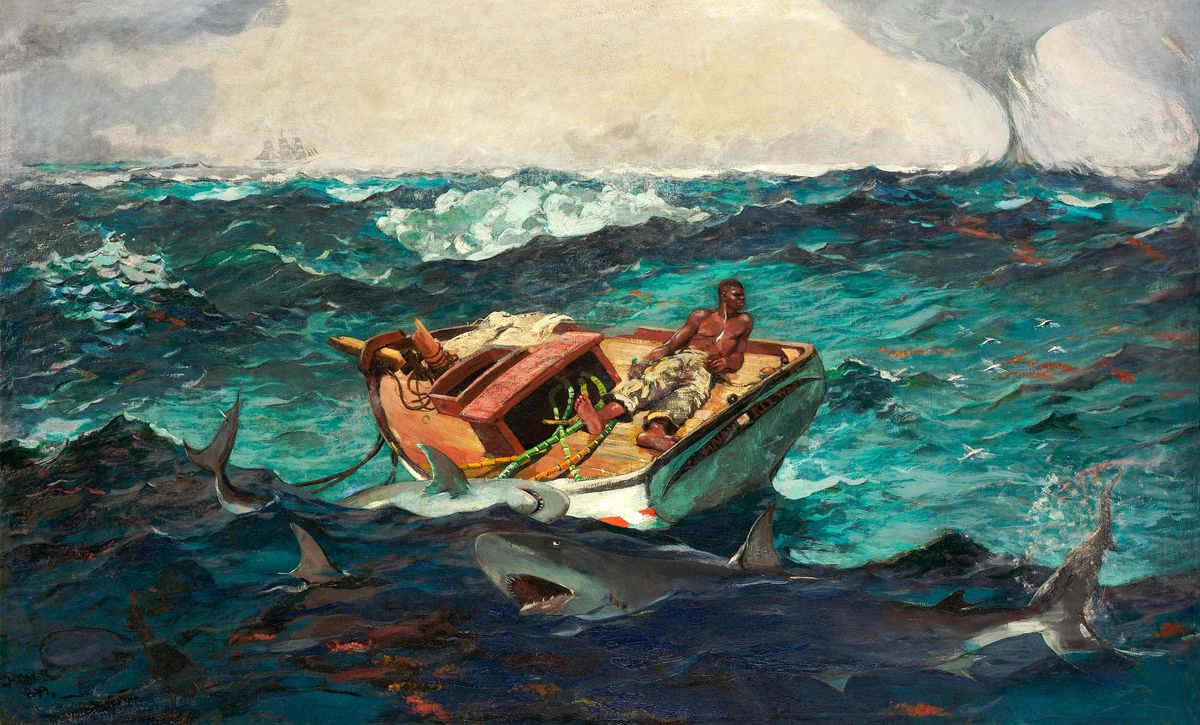
미국의 전설적인 사실주의 거장 윈슬로 호머(Winslow Homer, 1836–1910)가 1899년에 완성한 기념비적 유화 걸작 <멕시코 만류(The Gulf Stream)>는 거센 파도가 요동치는 대양 한가운데서 돛대가 부러진 나룻배에 몸을 싣고 상어 떼의 위협과 폭풍우에 맞서는 한 인간의 숭고한 생명력과 의연한 기품을 가장 압도적인 조형미로 담아낸 대표작입니다.
이 작품은 가로 124.8cm, 세로 71.4cm 크기의 대형 캔버스 위에 탄탄한 유화 기법으로 제작되었으며, 사납게 아가리를 벌린 식인상어들의 날카로운 이빨과 피로 물든 바다의 질감에는 도톰한 임파스토를 밀도 있게 얹고, 멕시코 만류 특유의 짙은 코발트블루빛과 옥빛 물결, 그리고 저 멀리 수평선에 소용돌이치는 거대한 용오름(waterspout)의 대기를 정교한 명암 대비와 과감한 붓 터치로 구현해 냈습니다.
현재 미국 뉴욕 메트로폴리탄 미술관(The Metropolitan Museum of Art)의 핵심 소장품으로 전시되어 있는 이 그림은 바하마와 멕시코 만류 해역에서, 돛대가 꺾이고 방향타가 부서진 채 표류하는 작은 범선 '키웨스트(Key West)'의 갑판 위에서 상반신을 젖힌 채 담담히 수평선을 응시하는 흑인 선원의 실존적 순간을 포착하고 있습니다.
이 그림 뒤에는 대자연의 가혹한 시험 앞에서도 결코 굴복하지 않는 인간의 존엄성을 화폭에 담고자 했던 호머의 치열한 예술혼과 흥미진진한 비하인드가 깃들어 있습니다. 호머는 1880년대 중반부터 카리브해와 바하마를 여행하며 수집한 스케치를 바탕으로, 1899년 메인주 프라우츠 넥의 화실에서 10년이 넘는 오랜 구상 끝에 이 거대한 유화를 완성했습니다.
작품이 처음 공개되었을 때 그림을 감상하던 여성 관람객들과 화상들이 호머에게 편지를 보내 "저 불쌍한 남자가 결국 상어에게 잡아먹히나요, 아니면 저 멀리 보이는 배에 구조되나요?"라며 결말을 안타깝게 물어왔습니다.
이에 호머는 빙그레 웃으며 화상에게 보낸 답장에 "그 부인들에게 저 남자는 곧 구조되어 고향으로 무사히 돌아가 행복하게 잘 살 테니 조금도 걱정하지 말라고 전해주게!"라며 재치 있게 안심시켰다는 유쾌한 일화가 전해집니다. 또한 호머는 관람객들이 인물의 생존 여부에만 지나치게 집착하자, 구조의 희망을 상징하기 위해 화면 좌측 먼 수평선 위에 세 개의 돛을 단 웅장한 범선의 실루엣을 덧그려 넣기도 했습니다.
선미에 희미하게 새겨진 배의 등록지 'KEY WEST'라는 글씨와 화면 우측 하늘을 집어삼킬 듯 솟구치는 거대한 바다 회오리, 그리고 좌측 하단 짙푸른 심해에 새겨진 'HOMER 1899' 서명은 호머가 대자연과 인간의 장엄한 대결을 얼마나 깊은 경의를 담아 관찰했는지를 증명합니다.
미술사학자들은 이 작품을 호머의 예술 인생 전체를 통틀어 가장 위대한 걸작이자, 19세기 미국 미술이 도달한 사실주의 회화의 정점으로 평가합니다.
프랑스 낭만주의 테오도르 제리코의 <메두사호의 뗏목>을 연상시키면서도, 공포에 질려 절규하는 대신 운명의 파도 앞에서도 묵묵히 의연함을 잃지 않는 단단한 인간상을 조각적 위엄으로 형상화하여 불후의 찬사를 받습니다.
작품을 마주할 때 관람자의 무의식적인 시선은 매우 긴박하면서도 안정적인 대각선 및 나선형 궤적을 그리며 이동합니다. 관람객의 눈길은 가장 먼저 화면 중앙에서 비스듬히 기울어진 붉은색 조타실을 등지고 반쯤 누워 있는 흑인 남자의 다부진 근육질 상체와 침착한 눈빛에 머뭅니다.
이어 시선은 남자의 시선이 닿는 배 주변을 훑어 내려와, 전경의 어두운 바다에서 거대한 지느러미를 번뜩이며 날카로운 이빨을 드러낸 상어들의 위협적인 몸짓과 붉은 핏빛 얼룩의 바닷물로 자연스럽게 미끄러져 갑니다.
전경의 서슬 퍼런 긴장감을 확인한 시선은 거세게 굽이치며 하얗게 부서지는 청록빛 파도의 거대한 능선을 타고 화면 우측 상단으로 솟구쳐 올라, 바다와 하늘을 잇는 거대한 회백색 용오름의 웅장한 대기감에 닿습니다.
이후 시선은 짙은 먹구름이 걷히며 화면 좌측 수평선 너머로 아스라이 모습을 드러낸 세 돛대 범선의 구원의 실루엣으로 이동한 뒤, 다시 표류선 위 남자의 단단한 어깨로 돌아와 깊고 묵직한 시각적 안착을 이룹니다.
이러한 유려한 시선의 순환은 관람자의 내면에 깊은 심리적 정화와 강력한 내적 카타르시스를 선물합니다. 화면 가득 요동치는 웅장한 대양의 에메랄드빛 파도와 원초적인 생명력의 긴장감은, 복잡한 일상의 번잡함과 피로에 지친 현대인의 무의식에 묵은 무기력을 단숨에 쓸어내리는 시원한 해방감을 불어넣어 줍니다.
사방을 에워싼 상어 떼와 거친 폭풍우 속에서도 공포에 굴하지 않고 묵묵히 다음 순간을 기다리는 남자의 의연한 자태는, 보는 이에게 일상의 번뇌를 내려놓고 삶의 어떤 위기와 시련 앞에서도 당당하게 맞설 수 있는 내면의 굳센 용기와 담담한 평정을 되찾아 주는 든든한 치유의 위로를 건넵니다.
The Gulf Stream
Completed in 1899 by the celebrated American realist master Winslow Homer (1836–1910), the monumental oil masterpiece The Gulf Stream stands as an extraordinary tour de force capturing the existential fortitude, primeval peril, and heroic resilience of the human spirit amidst the turbulent fury of the open ocean.
Measuring 124.8 cm wide by 71.4 cm high on canvas, the work showcases Homer's consummate mastery of oil technique, applying thick, tactile impasto to the frothing crests of churning emerald waves and the razor-sharp teeth of circling sharks, contrasted against the deep, luminous sapphire currents of the Gulf Stream and the menacing funnel of a distant waterspout.
Preserved in the prestigious permanent collection of The Metropolitan Museum of Art in New York, this iconic painting portrays a solitary Black sailor stranded aboard the dismasted, rudderless fishing sloop 'Key West,' reclining against the cabin roof with calm, stoic resignation as ravenous sharks thrash through the blood-streaked swells beneath a storm-laden sky.
Behind this epic canvas lies Homer's decades-long fascination with the Caribbean Sea, synthesizing watercolor sketches from his voyages to Nassau and Cuba into a monumental composition completed at his Prouts Neck studio in Maine.
When the painting was first exhibited, anxious viewers and art dealers wrote to Homer, urgently inquiring whether the unfortunate mariner would be devoured by the circling predators or rescued by the distant ship.
Amused by their intense concern, Homer sent a spirited reply to his dealer, reassuring the public that the sailor would be fully rescued and returned safely to his friends and home to live happily ever after. To provide a tangible ray of hope amidst the elemental drama, Homer intentionally reinforced the ghostly silhouette of a three-masted rescue ship sailing across the far left horizon.
The weathered registry 'KEY WEST' faintly inscribed along the transom, the towering waterspout churning the sea on the upper right, and the bold signature 'HOMER 1899' anchored in the deep lower left current serve as authentic testaments to Homer's visceral dialogue with human endurance and natural majesty.
Art historians universally acclaim The Gulf Stream as the crowning achievement of Homer's mature career and an enduring landmark of American realism. Evoking the grand tradition of Romantic maritime epics such as Géricault's The Raft of the Medusa, Homer stripped away theatrical panic in favor of quiet, sculptural dignity, creating a timeless visual monument to human courage confronting elemental fate.
When engaging with the painting, the viewer's unconscious gaze undertakes an intensely thrilling yet stabilizing visual journey. The eye is initially welcomed by the commanding, sun-bronzed figure of the sailor in the center, lingering upon his muscular physique and his calm, unwavering gaze directed toward the horizon.
The gaze then cascades downward into the churning, foam-streaked waters surrounding the listing hull, meeting the menacing forms of the sharks circling in the foreground with gaping jaws.
Tracing the dynamic, upward thrust of the turquoise breakers across the middle ground, the viewer's attention meets the dramatic gray column of the waterspout tearing through the clouds on the right.
Finally, sweeping across the expansive horizon toward the faint, hopeful silhouette of the full-rigged ship emerging on the far left, the eye settles back into the dignified, unshakable presence of the stranded mariner.
This rhythmic visual journey fosters profound psychological reassurance, cathartic strength, and deep emotional clarity within the observer. The sensory immersion in bracing ocean currents and elemental drama acts as an intuitive emotional balm, dispelling ambient modern fatigue and soothing inner tension.
By presenting a world where human dignity and inner composure remain unbroken even before the fiercest tides of fate, Homer offers the observer a comforting sanctuary of mindfulness, inspiring a deep sense of resilience, inner equilibrium, and enduring peace.
본 리뷰에서 작품을 제외한 컨텐츠의 저작권은 팔렛트제주에 있습니다.
"퍼블릭도메인 고전명화"를 제외한 모든 창작 콘텐츠는 저작권법 제4조 및 제10조에 의거하여 보호됩니다. 무단 도용시 저작권법 제136조(벌칙)에 의거, 당사의 사전 서면 승인 없는 저작권 침해 행위를 금지합니다.