전선에서 온 포로들 - Prisoners from the Front
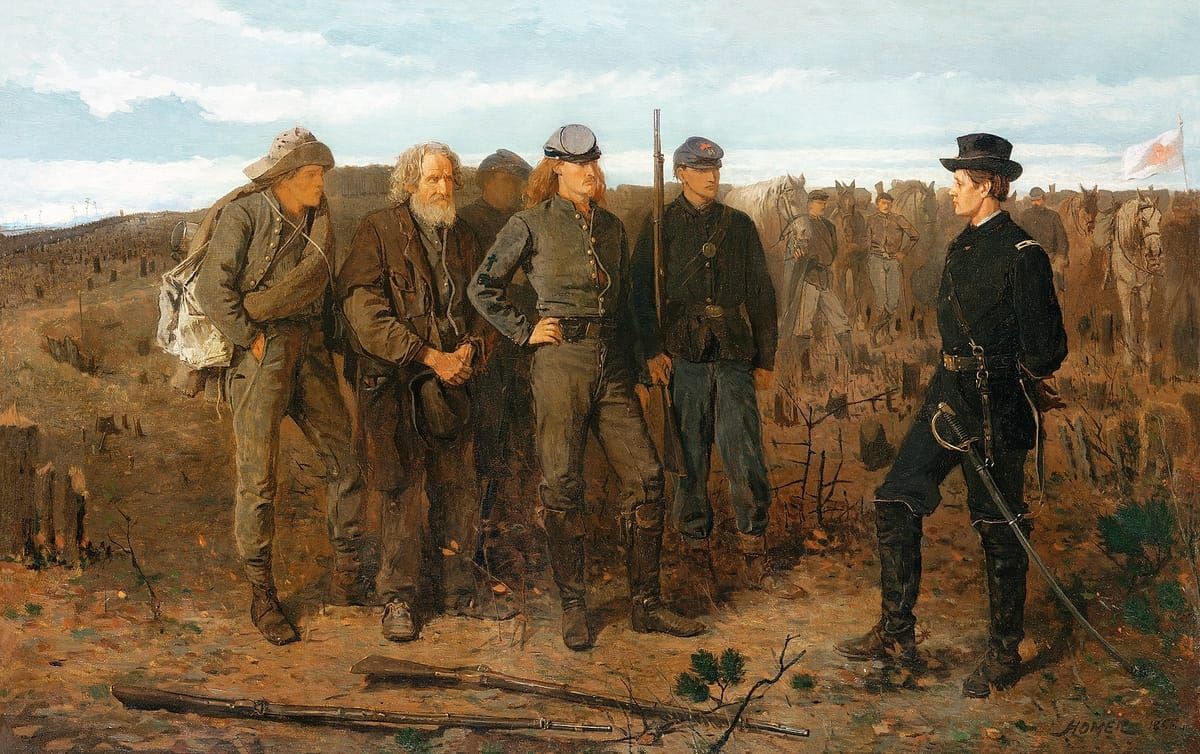
미국의 전설적인 사실주의 거장 윈슬로 호머(Winslow Homer, 1836–1910)가 1866년에 완성한 역사적 유화 걸작 <전선에서 온 포로들(Prisoners from the Front)>은 남북전쟁 당시 격전의 현장에서 마주 선 북군 장교와 남군 포로들 사이의 팽팽한 심리적 긴장감과 상호 존중을 가장 냉철하면서도 인간미 넘치는 필치로 담아낸 대표작입니다.
이 작품은 가로 약 96.5cm, 세로 약 61.0cm 크기의 캔버스 위에 탄탄한 유화 기법으로 제작되었으며, 초토화된 전장의 황량한 흙바닥과 잘려 나간 나무 그루터기들에는 묵직한 질감의 임파스토를 얹고, 인물들의 낡은 군복과 번뜩이는 눈빛 속에 흐르는 실존적 긴장감을 정교한 명암 대비와 사실적인 붓 터치로 완벽히 구현해 냈습니다.
현재 미국 뉴욕 메트로폴리탄 미술관(The Metropolitan Museum of Art)에 영구 소장되어 있는 이 그림은 1864년 버지니아주 피터즈버그 전선에서, 북군의 젊은 여단장이었던 프랜시스 채닝 발로(Francis Channing Barlow) 준장이 생포된 세 명의 남군 포로들을 심문하며 조용히 대면하는 역사적인 순간을 포착하고 있습니다.
이 그림 뒤에는 종군 화가로서 전장의 비극과 참상을 온몸으로 목격했던 호머의 날카로운 관찰력과 흥미진진한 비하인드가 깃들어 있습니다. 1864년 전선에 머물던 호머는 승패가 갈린 순간에도 서로를 향해 칼을 겨누기보다 묵묵히 마주 보며 침묵을 지키던 병사들의 비장한 모습에 깊은 영감을 받았습니다.
호머는 승자로서의 오만함이나 패자로서의 비굴함이 없는 대등한 인간 대 인간의 만남을 캔버스에 구현하기 위해 실제 군인들을 스케치했습니다.
포로 중 한 명인 붉은 머리의 젊은 남군 장교가 팔짱을 끼고 허리에 손을 얹은 채 당당한 눈빛으로 발로 장교를 쏘아보자, 호머는 그 기개에 놀라 자세를 고쳐 잡았습니다.
옆에 서 있던 북군 감시병이 포로의 불손한 태도를 나무라려 하자, 호머는 "잠깐! 저 남자의 꼿꼿한 허리와 타오르는 눈빛이야말로 전쟁이 결코 꺾을 수 없는 인간의 자존심이라네!"라며 제지했습니다. 호머는 남군 장교의 당당한 태도와 그 곁에서 모자를 벗고 서 있는 백발 노병의 처연한 침묵, 그리고 주머니에 손을 찌르고 삐딱하게 선 시골 청년의 모습을 번개처럼 캔버스에 옮겨 담았다는 감동적인 일화가 전해집니다.
전경 바닥에 차갑게 버려진 두 자루의 소총과 우측 하단 흙바닥에 단정하게 새겨진 'HOMER 1866' 서명, 그리고 저 멀리 황량한 지평선 위로 희미하게 펄럭이는 붉은 십자가 군단 깃발은 호머가 역사적 진실을 얼마나 깊은 경의를 담아 관찰했는지를 증명합니다.
미술사학자들은 이 작품을 남북전쟁을 다룬 모든 미국 미술 작품 중 최고의 걸작이자 호머를 일약 국민 화가로 발돋움시킨 결정적 계기로 평가합니다.
승자에 대한 맹목적인 찬양이나 패자에 대한 굴욕적인 묘사를 철저히 배제한 채, 각자의 신념을 지키며 싸웠던 두 진영의 인물들을 동등한 인간적 무게감으로 다룸으로써 전후 미국의 진정한 화해와 치유의 메시지를 전달했다는 극찬을 받습니다.
작품을 마주할 때 관람자의 무의식적인 시선은 인물들 사이의 보이지 않는 수평적 긴장감을 따라 매우 차분하고 균형 잡힌 좌우 순환 궤적을 그리며 이동합니다. 관람객의 눈길은 가장 먼저 화면 우측에서 짙은 감색 군복을 입고 장화를 신은 채 당당하고 절제된 자세로 서 있는 발로 장교의 날렵한 옆모습에 머뭅니다.
이어 시선은 장교의 단호한 시선이 향하는 화면 중앙으로 이동하여, 허리에 손을 얹고 모자를 눌러쓴 채 반항적이면서도 당당하게 서 있는 붉은 머리 남군 장교의 다부진 체구와 결연한 눈빛에 자연스럽게 가닿습니다.
중앙 인물의 굳센 자태를 확인한 시선은 화면 좌측으로 흘러가, 모자를 가슴에 쥐고 깊은 상념에 잠긴 백발의 노병과 주머니에 손을 넣고 멍하니 서 있는 어린 소년병의 안타까운 실루엣을 차례로 훑어 내려갑니다.
이후 시선은 전경 흙바닥에 교차되어 버려진 묵직한 소총들을 거쳐, 화면 뒤편의 북군 기병들과 끝없이 펼쳐진 황량한 전장의 수평선, 그리고 옅은 구름이 감도는 하늘로 상승하며 깊은 시각적 안착을 이룹니다.
이러한 유려한 시선의 순환은 관람자의 내면에 깊은 심리적 안정감과 묵직한 역사적 카타르시스를 선사합니다. 차분한 흙빛 톤과 불필요한 과장이 배제된 침묵의 공간감은, 복잡한 일상의 대립과 스트레스에 지친 현대인의 무의식에 마치 거대한 갈등이 지나간 뒤 찾아오는 고요한 화해의 장을 마주하는 듯한 깊은 이완과 감각적 평온을 제공합니다.
비극적인 전쟁의 상흔 속에서도 인간다운 품위와 자존심을 잃지 않고 서로를 의연하게 마주 보는 인물들의 모습은, 보는 이에게 일상의 번뇌를 내려놓고 어떤 갈등과 시련 앞에서도 서로를 존중하며 중심을 지켜낼 수 있는 내면의 단단한 용기와 맑은 평정을 되찾아 주는 든든한 치유의 위로를 건넵니다.
Prisoners from the Front
Completed in 1866 by the celebrated American realist master Winslow Homer (1836–1910), the monumental oil masterpiece Prisoners from the Front stands as an extraordinary tour de force capturing the complex human drama, mutual dignity, and profound psychological tension of the American Civil War with peerless historical objectivity.
Measuring approximately 96.5 cm wide by 61.0 cm high on canvas, the work showcases Homer's consummate mastery of plein-air oil technique, applying rich, tactile impasto to the scarred earth and devastated pine stumps, while modulating the weathered uniforms and unyielding expressions of the opposing soldiers with disciplined tonal sobriety.
Preserved in the prestigious permanent collection of The Metropolitan Museum of Art in New York, this iconic painting portrays a charged battlefield encounter near Petersburg, Virginia in 1864, where Union Brigadier General Francis Channing Barlow interrogates three captured Confederate prisoners amidst the barren trenches beneath a vast, cloud-swept sky.
Behind this historic canvas lies Homer's firsthand experience as an artist-correspondent embedded with the Army of the Potomac. Rejecting sensationalist battle heroics, Homer sought to capture the solemn humanity and mutual reckoning shared by men who had fought with equal conviction.
When the young Confederate officer in the center stood proudly with his hand on his hip, meeting the Union commander's gaze with defiant dignity rather than submissive defeat, Homer recognized the profound symbolic power of the encounter.
When an armed Union guard stepped forward to correct the prisoner's posture, Homer intervened, declaring that the soldier's upright carriage and fiery spirit embodied an unyielding human dignity that no war could extinguish.
Homer rapidly sketched the scene, rendering the contrasting types of southern soldiers: the defiant young cavalier, the weary white-bearded veteran clutching his hat in sorrowful reflection, and the bewildered country boy with his hands buried in his pockets.
The discarded muskets resting across the foreground dirt, the sharp signature 'HOMER 1866' inscribed in the lower right corner, and the distant red cross headquarters flag fluttering along the horizon serve as authentic testaments to Homer's deeply observant eye for historical truth.
Art historians celebrate Prisoners from the Front as the defining masterpiece of Civil War painting, marking Homer's instant elevation to national acclaim at the National Academy of Design exhibition of 1866. By avoiding victor's triumphalism and presenting both sides with sculptural weight and moral equivalence, Homer crafted a timeless visual monument to national reconciliation and human fortitude.
When engaging with the painting, the viewer's unconscious gaze undertakes an intensely stabilizing and reflective visual journey. The eye is initially drawn to the poised, statuesque silhouette of General Barlow standing on the right, taking in his tailored dark blue frock coat, officer's sabre, and focused countenance.
The gaze then travels across the narrow, charged void between the figures, meeting the erect, defiant stance of the central Confederate officer in his gray kepi and cavalry boots.
Sweeping toward the left, the viewer's attention takes in the weathered, bearded elder standing with bowed head and the lanky youth in the slouch hat, before descending toward the companion Union infantryman holding his musket at parade rest.
Finally, tracing the discarded rifles lying quietly in the foreground stubble and rising across the scarred earth toward the cavalry mounts on the distant horizon, the eye settles into the deep rhythmic equilibrium of the composition.
This rhythmic visual journey fosters profound psychological reassurance, moral clarity, and deep emotional stillness within the observer. The tactile immersion in muted earthen tones and vast atmospheric space acts as an intuitive emotional balm, dispelling ambient modern conflict and cooling inner tension.
By presenting a world where courage, mutual respect, and human dignity endure even through the ashes of division, Homer offers the observer a comforting sanctuary of mindfulness, inspiring a deep sense of resilience, inner equilibrium, and enduring peace.
본 리뷰에서 작품을 제외한 컨텐츠의 저작권은 팔렛트제주에 있습니다.
"퍼블릭도메인 고전명화"를 제외한 모든 창작 콘텐츠는 저작권법 제4조 및 제10조에 의거하여 보호됩니다. 무단 도용시 저작권법 제136조(벌칙)에 의거, 당사의 사전 서면 승인 없는 저작권 침해 행위를 금지합니다.