정오 측정 - Eight Bells
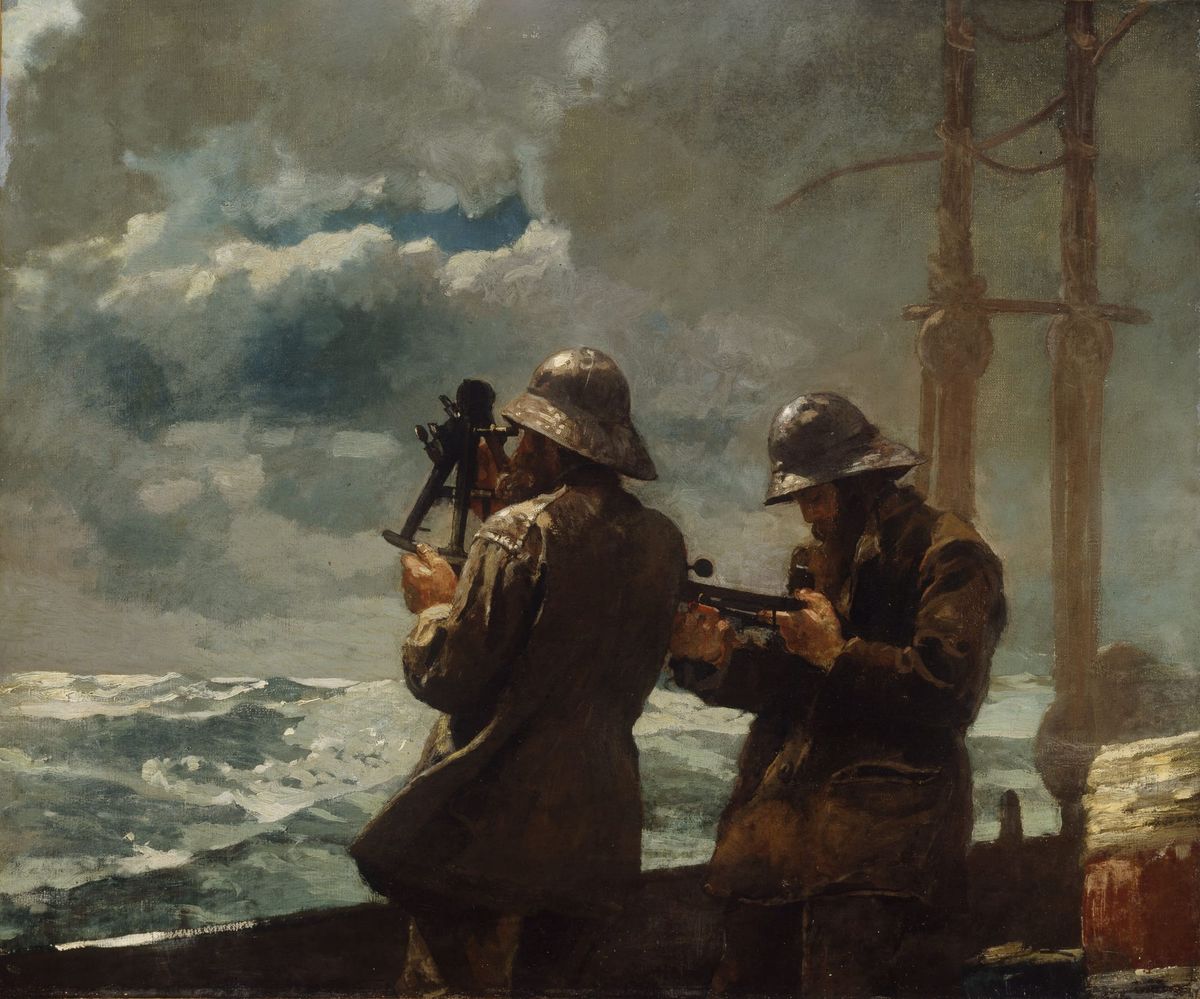
미국 사실주의 미술의 독보적인 거장 윈슬로 호머(Winslow Homer, 1836–1910)가 1886년에 완성한 기념비적인 해양 유화 걸작입니다. 현재 미국 매사추세츠주 앤도버에 위치한 필립스 아카데미 애디슨 미국 미술관(Addison Gallery of American Art, Phillips Academy)에 소장되어 있으며, 캔버스 위에 유채(Oil on canvas)로 제작된 실제 크기는 세로 64.1cm, 가로 76.5cm의 작품입니다.
호머는 거친 북대서양의 비바람과 햇살이 교차하는 순간을 포착하기 위해 두터운 임파스토와 묵직한 색채 대비를 절묘하게 결합했습니다. 검푸른 먹구름 사이로 잠시 열린 푸른 하늘과 눈부신 흰 구름 떼는 빛의 반사를 극대화한 거친 붓질로 생동감을 불어넣었고, 거칠게 출렁이는 바다 표면의 하얀 파도 포말은 날카로운 나이프 터치와 두터운 유화 물감으로 부피감을 살렸습니다. 젖은 방수모(Sou'wester)와 두터운 오일스킨 외투를 입은 선원들의 신체는 단단한 명암법으로 조각하듯 빚어내어, 요동치는 갑판 위에서도 흔들림 없는 묵직한 양감을 부여했습니다.
제목인 '에이트 벨스(Eight Bells)'는 선박의 항해 시계에서 종을 여덟 번 울려 정오(낮 12시)를 알리는 전통 해군 용어에서 유래했습니다. 구름 낀 바다를 항해하던 선원들은 정오 무렵 구름 사이로 태양이 잠시 모습을 드러내는 찰나의 순간을 포착하여, 육분의(Octant/Sextant)로 태양의 고도를 측정해 배의 정확한 위도와 위치를 계산해야만 했습니다.
비하인드 스토리로, 호머는 메인주 프라우츠넥 절벽 작업실 앞마당에 실제 배의 갑판 난간과 똑같은 목재 구조물을 직접 짜 맞추어 설치했습니다. 그리고 거친 파도와 비바람이 몰아치던 날, 친구이자 오랜 항해사인 존 개처(John Gatchell)에게 무거운 방수복을 입히고 육분의를 손에 쥐여준 채 직접 야외 모델로 서게 했습니다. 바닷바람에 몸이 얼어붙는 추위 속에서도 호머는 선원의 정밀한 손동작과 태양을 겨냥하는 날카로운 시선을 놓치지 않고 수없이 관찰했습니다. 1886년 완성된 이 그림은 발표 당시 "거대한 자연의 위협 속에서도 지성과 기술, 굳건한 용기로 자신의 길을 찾아내는 인간의 위대함을 가장 웅장하게 그려낸 미국 해양 회화의 기념비적 정점"이라는 극찬을 받았습니다.
관람자의 무의식적 시선은 화면 중앙에서 방수모를 깊게 눌러쓴 채 정밀한 육분의를 눈에 대고 구름 틈새의 태양을 정밀하게 조준하는 선원의 손과 얼굴에 가장 먼저 착지합니다. 거센 풍랑 속에서도 미동 없이 도구의 눈금에 온 신경을 집중하는 인물들의 굳건한 자세는 보는 이의 긴장감을 단숨에 누그러뜨리며 깊은 신뢰감과 몰입감을 선사합니다.
이어서 시선은 선원의 육분의 끝이 향하는 화면 좌측 상단의 밝게 열린 구름 틈새로 상승했다가, 갑판 아래로 부서지는 거친 파도의 흰 포말을 지나 우측에서 계측값을 묵묵히 확인하는 동료 선원의 손길로 유려하게 순환합니다. 칠흑 같은 먹구름 속에서도 반드시 빛을 찾아내어 배의 항로를 바로잡는 선원들의 침착한 행위는 관람객의 무의식 속에 잠재된 불안과 혼란을 씻어내며, 거친 인생의 파도 속에서도 자신의 위치를 명확히 파악하고 나아갈 수 있다는 깊은 심리적 안도감과 내면의 확신을 선물합니다.
Eight Bells
Completed in 1886 by Winslow Homer (1836–1910), a paramount figure in American Realism, this monumental marine painting is preserved in the permanent collection of the Addison Gallery of American Art at Phillips Academy in Andover, Massachusetts. Rendered in oil on canvas, the piece measures approximately 64.1 cm in height by 76.5 cm in width.
Homer masterfully captured the dramatic intersection of gale-force weather and fleeting sunlight by pairing robust impasto with dense tonal weight. The patch of luminous blue sky breaking through the bruised storm clouds was built with vigorous brushstrokes to heighten luminosity, while the churning foam breaking across the ocean swells was sculpted with tactile paint to convey physical force. Dressed in oilskins and sou'wester hats, the figures of the two mariners are modeled with sculptural solidity, grounding them firmly against the rolling deck.
The title originates from the nautical tradition of striking the ship's bell eight times to signal noon. Navigating vast, overcast waters, nineteenth-century mariners relied entirely on the brief moment the sun breached the clouds at midday, using an octant or sextant to measure its celestial altitude and determine the vessel’s precise latitude and navigational position.
An engaging studio anecdote reveals that Homer built an authentic wooden mock-up of a ship’s bulwark in the yard of his studio at Prouts Neck, Maine. During coastal gales, he asked his companion and veteran mariner, John Gatchell, to bundle into heavy weather gear with a brass navigational instrument to pose under the shifting northern sky. Homer studied the tension of the hands and the steady gaze against the freezing sea spray. Debuted in 1886, Eight Bells was universally hailed as an American masterpiece, celebrated for its noble tribute to the quiet courage, practical intellect, and stoic professionalism of working seamen mastering the open Atlantic.
The viewer's subconscious gaze immediately connects with the central navigator raising the octant to his eye, his focused silhouette anchored against the stormy horizon. His unwavering concentration amidst the rolling sea instantly arrests external tension, instilling a profound sense of security and quiet authority.
The gaze then travels upward along the instrument's line of sight into the radiant sunlit clearing among the clouds, sweeps across the cresting foam below, and returns to the second crewman carefully adjusting his apparatus on the right. This purposeful visual dialogue between celestial light and earthly calculation evokes an enduring state of mental clarity, inspiring deep inner calm and the unwavering confidence to navigate life's turbulent journeys.
본 리뷰에서 작품을 제외한 컨텐츠의 저작권은 팔렛트제주에 있습니다.
"퍼블릭도메인 고전명화"를 제외한 모든 창작 콘텐츠는 저작권법 제4조 및 제10조에 의거하여 보호됩니다. 무단 도용시 저작권법 제136조(벌칙)에 의거, 당사의 사전 서면 승인 없는 저작권 침해 행위를 금지합니다.