장교 습작 (전선에서 온 포로들 습작) - Study of an Officer for 'Prisoners from the Front'
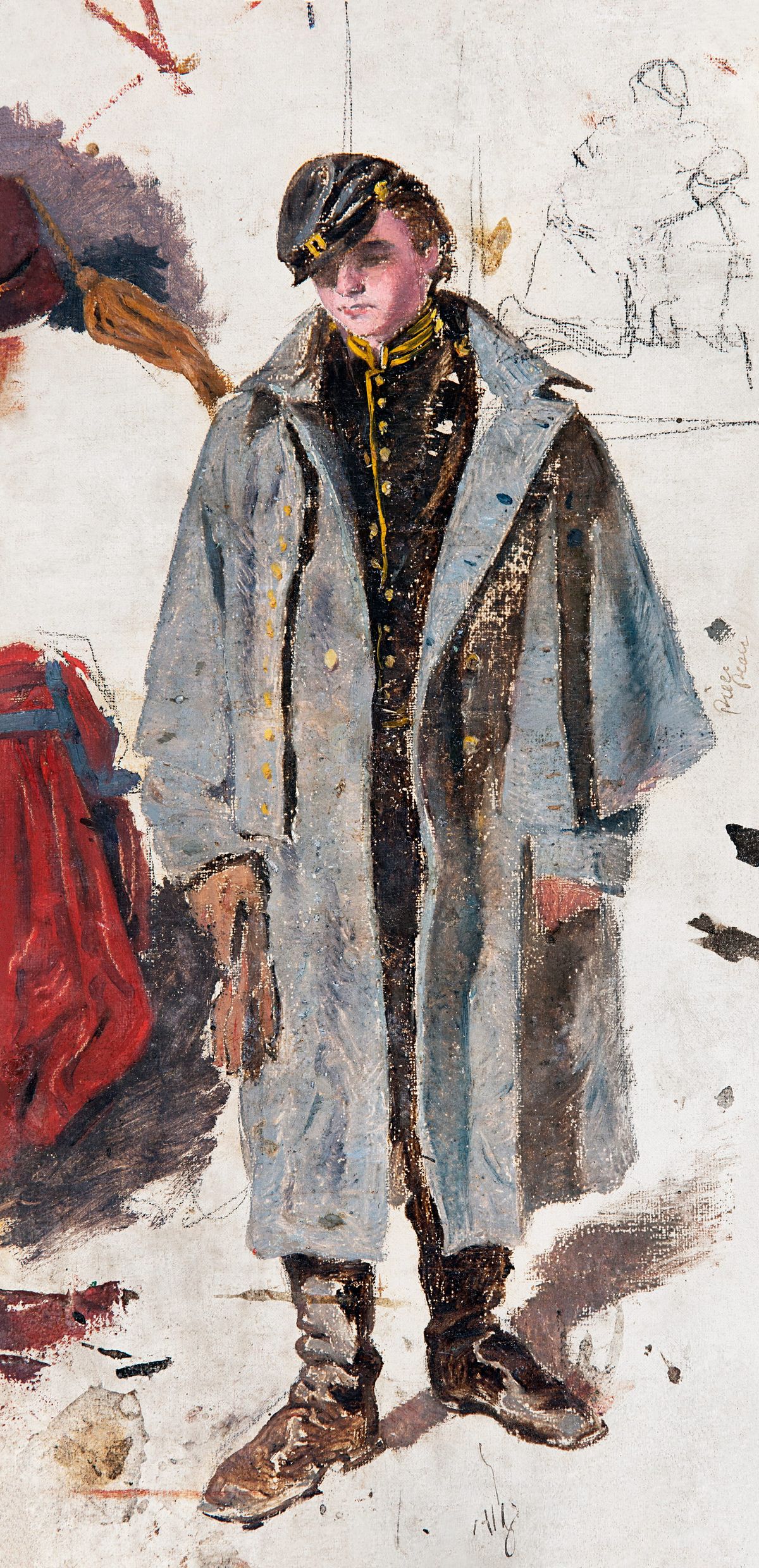
미국 사실주의 미술의 거장 윈슬로 호머(Winslow Homer, 1836–1910)가 1865년에서 1866년경 제작한 인물 유화 습작입니다. 현재 뉴욕 메트로폴리탄 미술관(The Metropolitan Museum of Art)에 소장되어 있으며, 캔버스 위에 유채(Oil on canvas)로 그려진 실제 크기는 세로 41.3cm, 가로 20.6cm의 세로형 습작 화폭입니다.
호머는 미국 남북전쟁의 종전을 상징하는 역사적 걸작 전선에서 온 포로들(Prisoners from the Front, 1866)을 완성하기 위해 캔버스 위에 직접 유화 물감과 흑연 드로잉을 병행하며 인물의 형태를 연구했습니다. 두터운 코트의 회청색 질감과 깃에 둘러진 노란색 금줄, 그리고 빛바랜 가죽 부츠의 질감을 빠른 붓놀림과 임파스토로 생생하게 포착했습니다. 화면 우측 상단과 좌측에는 본 그림에 배치될 다른 병사들과 주아브(Zouave) 군복의 붉은 천 조각을 즉흥적으로 스케치하고 덧칠한 흔적이 고스란히 남아 있어 화가의 치열한 창작 과정을 생생하게 보여줍니다.
이 작품의 주인공은 남북전쟁 당시 북군 장교로 활약했던 프랜시스 채닝 발로우(Francis Channing Barlow) 준장으로 알려져 있습니다. 호머는 잡지 하퍼스 위클리(Harper's Weekly)의 종군 화가로 전선을 누비며 전쟁의 참상을 직접 목격했는데, 영웅주의적인 전투 장면 대신 전쟁의 피로와 인간적인 고뇌를 화면에 담는 데 집중했습니다.
비하인드 스토리로, 당시 겨우 스물여섯 살의 젊은 나이에 뛰어난 지휘력으로 사단장이 되었던 발로우 장군은 체구가 작고 앳된 얼굴을 지녀 '소년 장군'이라 불렸습니다. 호머는 거친 군복 코트 속에 파묻힌 장군의 앳된 얼굴과 내리깐 시선을 통해 전쟁의 가혹함과 젊은 군인의 복잡한 내면을 가감 없이 포착했습니다. 1866년 완성된 본 작품이 전시되었을 때 미국 평단은 "호머는 단 한 장의 그림으로 남북전쟁의 비극과 화해의 본질을 완벽하게 표현했다"며 그를 단숨에 미국 최고의 역사화가 반열에 올려놓았습니다.
관람자의 무의식적 시선은 화면 상단, 챙이 눌린 모자 아래로 고요히 시선을 떨구고 있는 젊은 장교의 창백하고 앳된 얼굴에 가장 먼저 머뭅니다. 정면을 똑바로 마주하지 않고 바닥을 향해 내리깐 장군의 깊은 눈빛은 보는 이의 긴장감을 누그러뜨리며 깊은 심리적 연민과 공감을 불러일으킵니다.
이어서 시선은 깃의 선명한 금색 라인을 거쳐 헐렁하게 걸친 회청색 외투의 수직적인 주름을 따라 아래로 흐르며, 진흙에 젖은 낡은 가죽 부츠로 안정감 있게 내려앉습니다. 화려한 전쟁의 영광 대신 묵묵히 자리를 지키는 인물의 고요한 입석 구도는 관람객의 마음을 차분하게 가라앉히고, 혼란스러운 일상 속에서 잠시 멈추어 자신의 내면을 성찰하게 만드는 묵직한 심리적 안도감과 정서적 위로를 선사합니다.
Study of an Officer for 'Prisoners from the Front'
Created between 1865 and 1866 by Winslow Homer (1836–1910), a pioneering giant of American Realism, this expressive oil study is housed in the permanent collection of The Metropolitan Museum of Art in New York. Rendered in oil on canvas, the vertical study measures approximately 41.3 cm in height by 20.6 cm in width.
Homer painted this compositional study while preparing his landmark Civil War masterpiece, Prisoners from the Front (1866). Working spontaneously with fluid brushwork and rich impasto on primed canvas, he defined the heavy grayish-blue wool of the overcoat, the crisp yellow piping on the standing collar, and the weathered patina of the riding boots. The surrounding canvas preserves raw graphite lines and adjacent patches of red fabric from Zouave uniforms, offering an unvarnished window into Homer’s rigorous creative process.
The subject depicted is widely recognized as Brigadier General Francis Channing Barlow, an extraordinary Union commander known for his strategic brilliance at Gettysburg and Spotsylvania. Having traversed the battlefields as an artist-correspondent for Harper's Weekly, Homer deliberately rejected romanticized martial heroics, choosing instead to focus on the human vulnerability and psychological weight borne by soldiers.
A fascinating historical detail lies in Barlow’s youthful persona; having attained the rank of general at the mere age of twenty-six, his slight build and gentle features earned him the nickname 'the boy general.' Homer captured this poignant contrast by cloaking the boyish, downcast officer in an oversized military overcoat. When the final canvas debuted at the National Academy of Design in 1866, critics universally hailed Homer as the foremost chronicler of the war, praising his ability to distill national reconciliation and the solemn reality of conflict into a single, profound vision.
The viewer's subconscious gaze immediately alights upon the officer’s youthful, contemplative face framed by the visor of his forage cap. His introspective, downward glance gently disarms the spectator, dissolving barriers and inviting deep emotional empathy.
The gaze then travels down the vertical axis of the coat, guided by the gilded accents of the uniform, before resting securely on the heavy boots planted firmly on the ground. This grounded verticality imparts a sense of steadfast resilience amidst devastation, helping quiet external noise and guiding the mind into a serene space of quiet reflection and restorative inner balance.
본 리뷰에서 작품을 제외한 컨텐츠의 저작권은 팔렛트제주에 있습니다.
"퍼블릭도메인 고전명화"를 제외한 모든 창작 콘텐츠는 저작권법 제4조 및 제10조에 의거하여 보호됩니다. 무단 도용시 저작권법 제136조(벌칙)에 의거, 당사의 사전 서면 승인 없는 저작권 침해 행위를 금지합니다.