자갈 해변의 아이들 - Children on the Beach / Pebble Beach, Gloucester
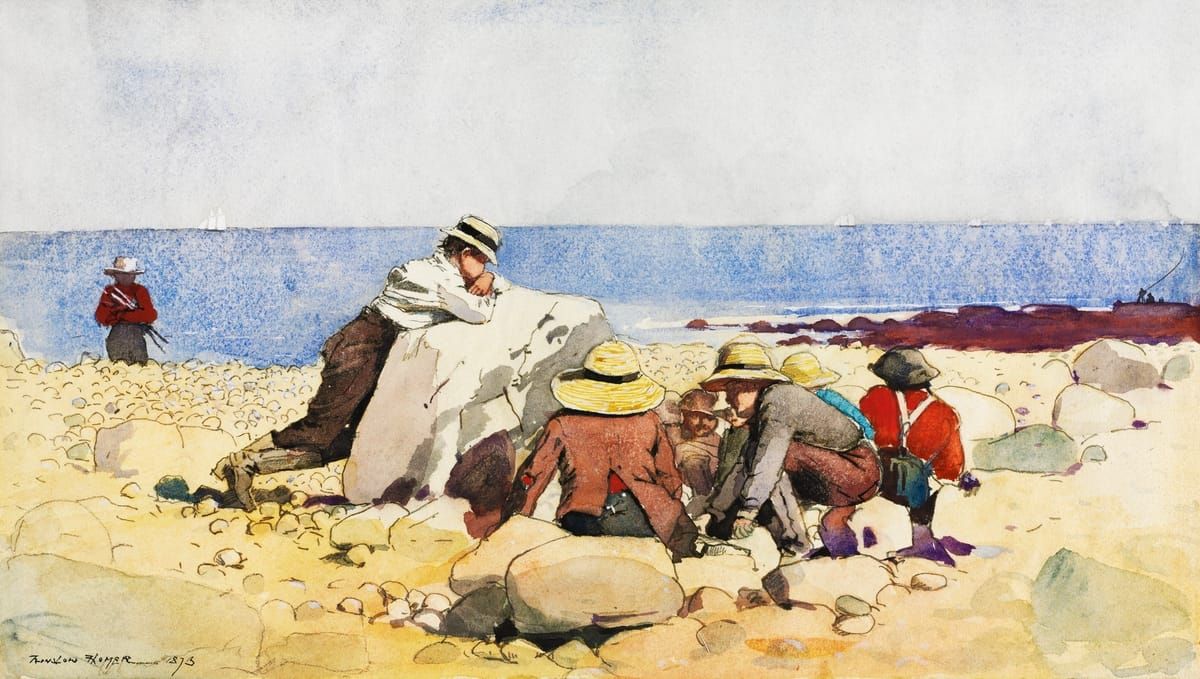
미국의 전설적인 사실주의 거장 윈슬로 호머(Winslow Homer, 1836–1910)가 1873년에 완성한 투명 수채화 명작 <자갈 해변의 아이들(Children on the Beach / Pebble Beach, Gloucester)>은 눈부신 대서양 해변에서 조약돌과 게를 잡으며 놀이에 몰두한 아이들의 순수한 동심을 가장 맑고 청량한 필치로 포착해 낸 수작입니다.
이 작품은 가로 약 35.2cm, 세로 약 24.5cm 크기의 고급 워브 종이 위에 흑연 연필로 정갈하게 인물들의 동세를 잡은 후, 투명 수채 물감의 촉촉한 번짐으로 맑은 바다와 햇살에 달궈진 모래펄을 표현하고, 종이의 백색 여백과 흰색 구아슈 물감을 섬세하게 활용하여 바위의 밝은 면과 밀짚모자의 바삭한 질감을 극대화한 혼합 수채 기법으로 제작되었습니다.
현재 미국 유수 미술관 및 주요 개인 컬렉션에서 소중히 다루어지는 이 그림은 매사추세츠주 글로스터(Gloucester)의 자갈 해변에서, 큰 바위에 턱을 괴고 바다를 바라보는 소년과 옹기종기 모여 앉아 작은 게와 조개를 관찰하는 아이들의 정겨운 여름 한때를 담고 있습니다.
이 그림 뒤에는 호머가 수채화의 매력에 흠뻑 빠져들어 글로스터의 바닷가를 누비던 1873년 여름의 유쾌하고 따뜻한 비하인드 스토리가 깃들어 있습니다. 당시 호머는 항구 마을의 어촌 아이들이 모래밭과 바위틈에서 조개껍데기를 줍고 물장구를 치며 노는 꾸밈없는 모습에 깊이 매료되었습니다.
호머는 아이들에게 포즈를 부탁하며 바위 곁에 둘러앉게 했습니다. 하지만 호기심 많은 소년들은 가만히 앉아 있기는커녕 바위 틈새에서 기어나온 작은 게 한 마리를 발견하고는 신이 나서 웅성거리기 시작했습니다. 한 소년이 손가락을 물릴 뻔하며 뒤로 엉덩방아를 찧자 아이들의 웃음보가 터졌습니다.
아이들이 흐트러지자 당황하기는커녕 호머는 "게가 자네들을 완벽한 관객으로 만들었군! 억지로 굳은 표정을 짓는 것보다 호기심에 반짝이는 그 눈망울이야말로 바다가 준 최고의 선물이라네!"라며 껄껄 웃었습니다. 호머는 아이들이 게를 들여다보며 웅크린 자연스러운 자세와 바위에 느긋하게 턱을 괸 소년의 나른한 옆모습을 번개처럼 종이 위에 포착해 냈다는 훈훈한 일화가 전해집니다.
화면 좌측 멀리 서서 붉은 셔츠를 입고 바다를 바라보는 아이의 실루엣과, 자갈밭 너머로 아스라이 지나가는 먼 돛단배들의 하얀 삼각 돛, 그리고 좌측 하단에 적힌 'Winslow Homer 1873' 서명은 호머가 현장의 생생한 여름 정취를 얼마나 진솔하게 기록했는지를 증명합니다.
미술사학자들은 이 작품을 호머가 1870년대 초 수채화 매체로 거둔 혁신적인 성취를 증명하는 대표작으로 평가합니다.
프랑스 인상주의보다 앞서 야외 자연광의 찬란한 산란과 바닷바람의 청량한 공기감을 수채화의 투명한 번짐으로 구현했으며, 어린 시절의 순수한 자유와 인간과 자연의 조화를 소박하면서도 서정적인 시각 언어로 승화시켰다는 극찬을 받습니다.
작품을 마주할 때 관람자의 무의식적인 시선은 매우 편안하고 안정적인 수평 및 원형 궤적을 그리며 이동합니다. 관람객의 눈길은 가장 먼저 화면 중앙에서 햇살을 받아 하얗게 빛나는 커다란 바위와, 그 위에 팔을 괴고 편안하게 엎드려 있는 밀짚모자 소년의 나른한 모습에 머뭅니다.
이어 시선은 바위 주변에 옹기종기 웅크리고 앉아 노란 밀짚모자를 맞대고 있는 아이들의 정겨운 뒤태와 붉은 조끼를 입은 소년의 알록달록한 색감으로 자연스럽게 흘러갑니다.
아이들의 활기찬 모임을 훑은 시선은 발치 아래 깔린 따스한 황금빛 조약돌과 바위들의 포근한 질감을 거쳐, 화면 좌측 뒤편에서 홀로 서서 수평선을 응시하는 붉은 옷을 입은 아이의 호젓한 실루엣으로 이동합니다.
이후 시선은 짙고 푸른 코발트블루빛 바다의 맑은 수평선과 점점이 떠 있는 흰 돛단배들, 그리고 옅은 구름이 감도는 시원한 여름 하늘로 상승하며 탁 트인 공간적 해방감을 만끽하게 됩니다.
이러한 유려한 시선의 순환은 관람자의 내면에 깊은 심리적 안정감과 포근한 동심의 회복을 선사합니다. 부서지는 바닷바람과 따스한 모래의 온기가 감도는 해변의 공간감은, 복잡한 일상의 긴장과 스트레스에 지친 현대인의 무의식에 마치 어린 시절 뛰놀던 여름 바닷가에 서 있는 듯한 깊은 이완과 감각적 평온을 선물합니다.
세상의 번잡한 소란에서 벗어나 대자연의 품속에서 소박한 놀이에 흠뻑 빠져든 아이들의 순수한 모습은, 보는 이로 하여금 일상의 번뇌를 내려놓고 삶의 가장 맑고 따뜻한 행복과 내면의 평정을 되찾아 주는 든든한 치유의 위로를 건넵니다.
Children on the Beach / Pebble Beach, Gloucester
Completed in 1873 by the celebrated American realist master Winslow Homer (1836–1910), the watercolor masterpiece Children on the Beach (also celebrated as Pebble Beach, Gloucester) stands as an extraordinary tour de force capturing the sunlit innocence, salty ocean breezes, and unhurried charm of nineteenth-century American childhood by the sea.
Measuring approximately 35.2 cm wide by 24.5 cm high on fine wove paper, the work showcases Homer's breakthrough watercolor technique, employing crisp graphite underdrawing, transparent cobalt and ochre washes across the sun-warmed pebbled shore, and luminous reserves of paper to articulate the bright highlights on the central boulder and straw hats.
Preserved and celebrated across prominent public and private American art collections, this painting portrays a group of barefoot boys on a stony beach in Gloucester, Massachusetts, where one lad reclines thoughtfully against a pale boulder while his companions gather closely around a tidal crevice to inspect small shore life under the brilliant summer sky.
Behind this delightful composition lies Homer's pivotal summer of 1873, when he first discovered the expressive freedom of watercolor while staying among the maritime families of Cape Ann. Captivated by the spontaneous joy of seaside youngsters, Homer set up his stool along the rocky cove to paint directly from the living scene.
Homer gathered the local boys and asked them to rest near the shoreline boulders. However, rather than holding rigid poses, the mischievous boys soon spotted a small shore crab scuttling between the stones, leaning in eagerly with wide-eyed excitement.
When one boy recoiled with surprised laughter as the crab raised its claws, the entire group erupted in genuine mirth.
Instead of scolding the restless children, Homer laughed heartily, declaring that the little crab had proven to be the finest stage director of all and that their candid curiosity was far more truthful than any stiff academic pose. Working with swift, fluid brushes, Homer immortalized the unposed huddle of straw bonnets alongside the drowsy boy leaning over the stone.
The solitary child standing in a red shirt on the left gazing out toward the breakers, the tiny white triangles of distant sailing vessels along the horizon, and the bold signature 'Winslow Homer 1873' in the lower left stand as authentic testaments to Homer's vivid engagement with coastal life.
Art historians celebrate this painting as a defining highlight of Homer's early mature watercolor oeuvre, praising its extraordinary lightness of touch and atmospheric freshness. Predating the popularization of Impressionism in America, Homer's crisp treatment of direct sunlight and sea spray elevated an ordinary seaside afternoon into a timeless visual sanctuary of pastoral purity and youthful freedom.
When engaging with the painting, the viewer's unconscious gaze undertakes an inherently refreshing and grounding visual journey. The eye is initially welcomed by the sun-bleached boulder anchoring the center, resting upon the relaxed posture of the boy resting his chin upon his folded arms.
The gaze then travels downward into the vibrant circle of boys gathered in the foreground, taking in the warm golden textures of their straw hats, the rich red jacket of the kneeling boy, and the curious huddle over the stones.
Sweeping across the textured expanse of sun-baked pebbles and boulders lining the shore, the viewer's attention meets the standing child on the far left before gliding across the deep, saturated cobalt ribbon of the ocean horizon dotted with distant sails.
Finally, ascending into the pale, breezy atmosphere of the expansive sky, the eye embraces the boundless spatial clarity of the open sea.
This rhythmic visual journey fosters profound psychological reassurance, gentle nostalgia, and deep emotional stillness within the observer. The tactile immersion in warm sunshine and crisp ocean breezes acts as an intuitive emotional balm, dispelling ambient modern fatigue and soothing inner tension.
By presenting an idyllic world where children exist in pure harmony with the rhythm of the tides, Homer offers the observer a comforting sanctuary of mindfulness, inspiring a deep sense of renewal, sweet contentment, and enduring inner peace.
본 리뷰에서 작품을 제외한 컨텐츠의 저작권은 팔렛트제주에 있습니다.
"퍼블릭도메인 고전명화"를 제외한 모든 창작 콘텐츠는 저작권법 제4조 및 제10조에 의거하여 보호됩니다. 무단 도용시 저작권법 제136조(벌칙)에 의거, 당사의 사전 서면 승인 없는 저작권 침해 행위를 금지합니다.