일몰의 서풍 - West Wind
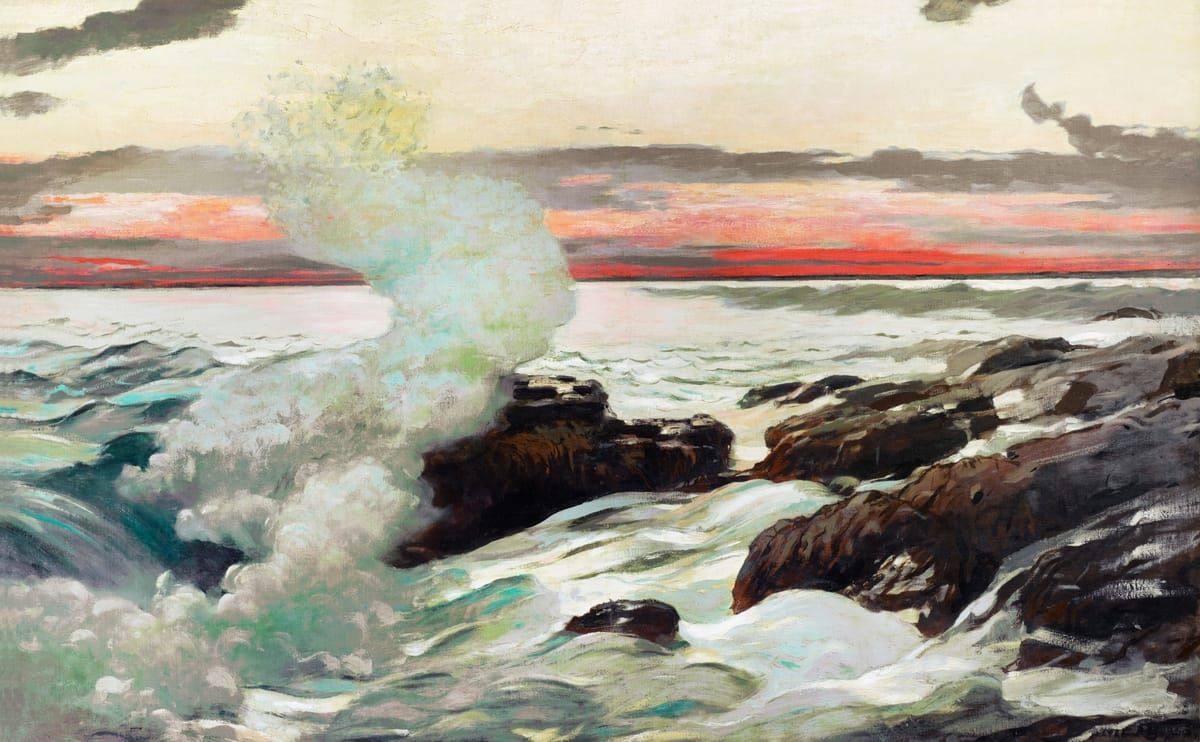
미국의 전설적인 사실주의 거장 윈슬로 호머(Winslow Homer, 1836–1910)가 1891년에 완성한 유화 걸작 <일몰의 서풍(West Wind / Sunset, Saco Bay)>은 거친 해안 암초에 부딪혀 솟구치는 거대한 백색 물보라와 붉게 타오르는 저녁노을의 장엄한 대조를 가장 웅장하고 밀도 높은 필치로 포착해 낸 수작입니다.
이 작품은 가로 약 111.8cm, 세로 약 76.2cm 크기의 캔버스 위에 제작되었으며, 하늘 높이 솟구쳐 오르는 거대한 포말의 폭발적인 질감에는 도톰한 유화 임파스토를 밀도 있게 얹고, 수평선을 따라 붉게 타오르는 저녁 하늘과 어두운 먹구름의 층위는 정교한 글레이징과 부드러운 붓 터치로 완성했습니다.
현재 미국 매사추세츠주 애디슨 미국미술관(Addison Gallery of American Art, Phillips Academy)에 소장되어 있는 이 그림은 메인주 프라우츠 넥(Prouts Neck)의 사코 만(Saco Bay) 해안가에서 강렬한 서풍이 불어올 때, 흑갈색 화강암 암초를 집어삼키며 하늘로 용솟음치는 거대한 파도의 폭발적인 순간을 담고 있습니다.
이 그림에는 메인주의 험준한 절벽 위에 홀로 머물며 오직 바다의 순수한 원초성에 영혼을 바쳤던 호머의 치열한 예술혼과 유쾌한 인간적 비하인드가 가득합니다. 호머는 해 질 무렵 서쪽에서 강한 돌풍이 몰아치며 하늘이 붉게 물드는 날이면 어김없이 방수 외투를 걸치고 절벽 끝으로 뛰어나갔습니다.
호머는 날아갈 듯 몰아치는 비바람과 절벽을 타고 튀어 오르는 차가운 바닷물 분무 속에서 캔버스가 흔들리지 않도록 무거운 돌을 받쳐두고 작업에 몰두했습니다. 당시 지나가던 이웃 주민이 벼랑 끝에서 파도를 관찰하던 호머를 발견하고 "화가 양반, 날도 저물고 파도가 저렇게 거센데 무섭지도 않소?"라고 외치자, 호머는 "저 붉은 노을과 성난 파도가 부딪히는 소리가 들리지 않소? 저건 바다가 연주하는 세상에서 가장 위대한 교향곡이라네!"라며 호탕하게 웃었다는 훈훈한 일화가 전해집니다.
호머는 단 몇 분 만에 사라져 버리는 일몰의 붉은빛과 솟구치는 파도의 형상을 놓치지 않기 위해 바닷물이 얼굴과 안경을 적셔도 아랑곳하지 않고 신들린 듯 붓을 휘둘렀으며, 화면 우측 하단의 바위 표면에는 짙은 유화 물감으로 자신의 서명을 힘차게 새겨 넣었습니다.
미술사학자들은 이 작품을 호머가 1890년대에 완성한 기념비적 해양 연작 중에서도 조형적 긴장감과 색채의 숭고미가 절정에 달한 명작으로 평가합니다.
인간의 형상이나 내러티브를 완전히 배제하고 오직 붉은 하늘과 거친 파도, 그리고 견고한 암초의 삼중주만으로 대자연의 실존적 위엄을 응축해 냄으로써, 훗날 20세기 미국 현대 회화와 추상표현주의의 태동에 깊은 시각적 영감을 건넸다는 찬사를 받습니다.
작품을 마주할 때 관람자의 무의식적인 시선은 매우 역동적이고 웅장한 S자형 및 대각선 상승 궤적을 그리며 이동합니다. 관람객의 눈길은 가장 먼저 화면 좌측 중앙에서 마치 살아 움직이는 거대한 용처럼 하늘 높이 솟구쳐 오르는 눈부신 백색 물보라의 장엄한 기둥에 단숨에 사로잡힙니다.
이어 시선은 바위를 때리고 부서져 내리는 파도의 하얀 포말을 타고 화면 전경으로 미끄러져 내려와, 화면 앞쪽에서 소용돌이치며 쏟아져 내리는 우윳빛 물결의 투명하고 시원한 흐름에 가닿습니다.
물의 운동성을 확인한 시선은 화면 우측을 묵직하게 채우고 있는 흑갈색 화강암 암초의 단단한 능선을 타고 대각선 위로 올라간 뒤, 수평선을 따라 붉고 선명하게 타오르는 저녁노을의 찬란한 띠와 화면 상단의 짙은 먹구름으로 상승하며 장엄한 공간감을 만끽하게 됩니다.
이러한 유려한 시선의 순환은 관람자의 내면에 깊은 심리적 정화와 강력한 내적 카타르시스를 선물합니다. 화면 가득 맹렬하게 솟구쳐 오르는 파도의 폭발적인 생명력은 복잡한 일상의 번잡함과 피로에 지친 현대인의 무의식에 묵은 스트레스를 단숨에 쓸어내리는 시원한 해방감을 불어넣어 줍니다.
어떤 거센 파도의 충돌 속에서도 미동조차 없이 굳건하게 자리를 지키는 거대한 암초와 그 뒤를 비추는 따스한 일몰의 붉은빛은, 보는 이로 하여금 일상의 불안과 조급함을 내려놓고 삶의 어떤 시련 앞에서도 흔들리지 않는 내면의 단단한 중심과 맑은 평정을 되찾아 주는 깊은 치유의 위로를 건넵니다.
West Wind
Completed in 1891 by the celebrated American realist master Winslow Homer (1836–1910), the monumental oil masterpiece West Wind (also known as Sunset, Saco Bay) stands as an extraordinary tour de force capturing the primeval collision between crashing ocean breakers and the incandescent glory of a coastal sunset with breathtaking dramatic power.
Measuring approximately 111.8 cm wide by 76.2 cm high on canvas, the work showcases Homer's consummate mastery of heavy impasto and fluid brushwork, applying thick, raised mounds of brilliant white to convey the soaring geyser of spray, contrasted against the glowing horizontal band of fiery vermilion along the horizon and the somber charcoal storm clouds above.
Preserved in the prestigious permanent collection of the Addison Gallery of American Art at Phillips Academy in Andover, Massachusetts, this painting powerfully portrays the rocky ledges of Prouts Neck along Saco Bay, Maine, where ferocious breakers driven by westerly gales erupt against the ancient dark granite under the twilight sky.
Behind this iconic composition lies Homer's solitary vigil along the rugged Maine coast and an inspiring array of personal anecdotes. Throughout the 1890s, Homer eagerly watched for evening storms when westerly gales whipped the ocean into rolling swells while the setting sun ignited the horizon.
Braving blinding salt spray and howling gusts that threatened to upend his canvas, Homer anchored his easel with heavy stones upon the slippery ledges, determined to seize the fleeting twilight glow before the darkness set in.
When a local neighbor called out in alarm, asking if he was not terrified standing so close to the roaring surf in the fading light, Homer laughed heartily, replying that the crashing waves and the burning sky were playing the grandest symphony nature could ever offer, furiously dabbing paint onto the canvas to capture the incandescent spray.
The artist worked with urgent intensity, undeterred by the damp sea spray misting his spectacles, completing the dramatic encounter and firmly inscribing his signature into the dark foreground rocks in the lower right.
Art historians celebrate West Wind as a defining summit of Homer's mature marine oeuvre, extolling its radical compositional economy and dynamic equilibrium. By eliminating all human figures and narrative details to focus entirely on the elemental dialogue between rock, water, and sky, Homer elevated a coastal scene into an enduring visual allegory of cosmic majesty that prefigured twentieth-century modernism.
When engaging with the painting, the viewer's unconscious gaze undertakes an intensely thrilling yet stabilizing visual journey. The eye is initially seized by the monumental column of luminous white spray erupting dramatically on the left, soaring high against the dark coastal clouds.
The gaze then cascades downward along the swirling torrents of white foam in the foreground, sliding across the solid, textured shelves of dark granite anchoring the right side of the composition.
Ascending naturally toward the middle ground, the viewer's attention meets the radiant, horizontal ribbon of burning red and amber light blazing across the horizon, before rising into the vaporous, storm-laden sky above.
This rhythmic visual journey fosters profound psychological reassurance, cathartic release, and deep emotional stillness within the observer. The roaring spectacle of water and rock illuminated by the warm glow of sunset acts as an intuitive emotional balm, sweeping away ambient modern stress and accumulated inner fatigue.
By presenting the eternal balance between the kinetic fury of the waves, the unyielding fortress of ancient bedrock, and the benevolent light of dusk, Homer offers the observer a comforting sanctuary of mindfulness, inspiring a deep sense of resilience, inner composure, and enduring peace.
본 리뷰에서 작품을 제외한 컨텐츠의 저작권은 팔렛트제주에 있습니다.
"퍼블릭도메인 고전명화"를 제외한 모든 창작 콘텐츠는 저작권법 제4조 및 제10조에 의거하여 보호됩니다. 무단 도용시 저작권법 제136조(벌칙)에 의거, 당사의 사전 서면 승인 없는 저작권 침해 행위를 금지합니다.