화이트 산맥의 신부 (말을 타고 산을 내려오는 여인) - The Bridle Path, White Mountains
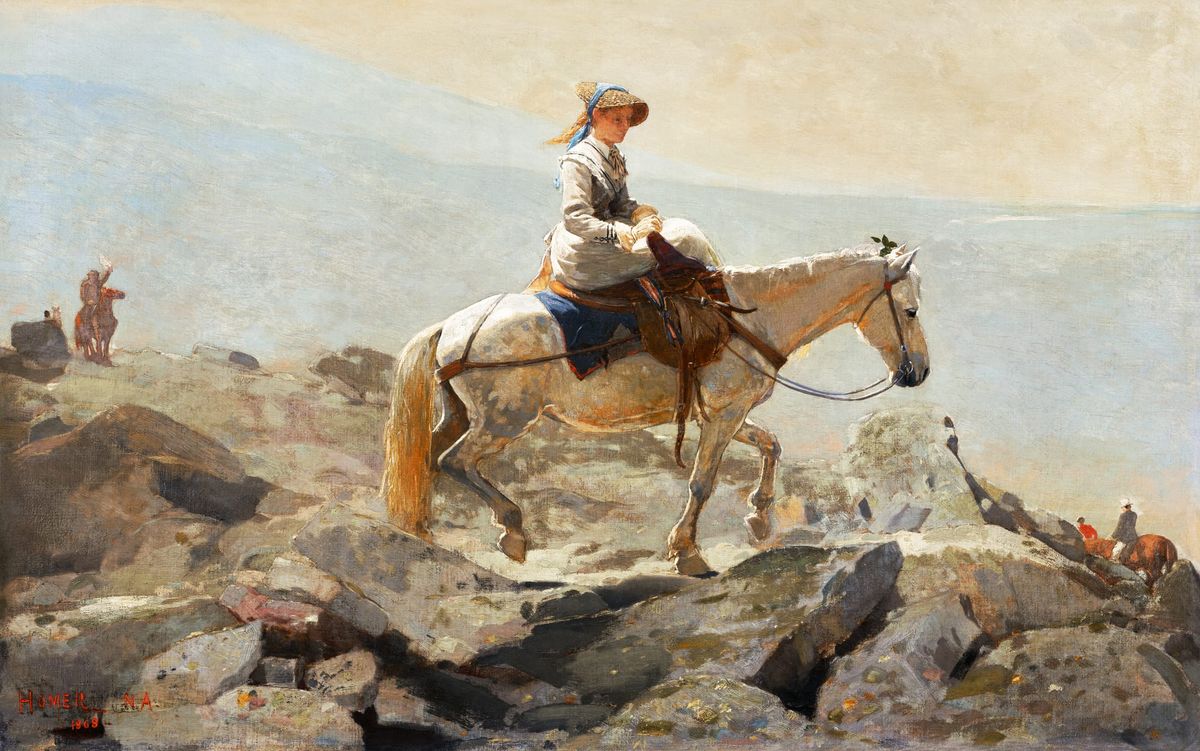
미국의 전설적인 사실주의 거장 윈슬로 호머(Winslow Homer, 1836–1910)가 1868년에 완성한 유화 걸작 <화이트 산맥의 신부(The Bridle Path, White Mountains)>는 험준한 바위산 능선을 따라 백마를 타고 조심스레 하산하는 우아한 여인의 기품 있는 자태와 맑은 산악 대기 속으로 부서져 내리는 눈부신 태양광선을 가장 정갈하고 서정적인 필치로 포착해 낸 수작입니다.
이 작품은 가로 약 96.5cm, 세로 약 61.3cm 크기의 캔버스 위에 정교한 유화 기법으로 제작되었으며, 울퉁불퉁한 거대한 화강암 암반과 바위 표면의 이끼에는 도톰한 임파스토를 밀도 있게 얹고, 눈부신 자연광을 받아 빛나는 여인의 흰 옷자락과 백마의 근육, 그리고 저 멀리 안개 속에 아스라이 펼쳐진 연푸른 산맥의 대기감을 섬세한 명암 대비와 사실적인 붓 터치로 완벽히 구현해 냈습니다.
현재 미국 매사추세츠주 윌리엄스타운의 클라크 미술관(Sterling and Francine Clark Art Institute)에 소장되어 있는 이 그림은 뉴햄프셔주 화이트 마운틴의 워싱턴 산 정상 부근 브라이들 패스(Bridle Path)에서, 푸른 리본 밀짚모자를 쓰고 말을 탄 젊은 여인이 험한 암석 지대를 침착하게 내려오며 자연의 장엄한 파노라마와 마주하는 고즈넉한 순간을 담고 있습니다.
이 그림 뒤에는 남북전쟁의 종군 화가 생활을 마치고 1860년대 후반 뉴잉글랜드의 아름다운 산악 지대를 여행하며 미국 특유의 레저 문화와 자연의 숭고미를 탐구했던 호머의 순수한 예술적 열정과 흥미진진한 비하인드가 깃들어 있습니다. 당시 호머는 거친 산악 지형을 두려움 없이 누비는 미국 여성들의 주체적인 건강미와 자연 속의 조화로운 생명력에 깊은 시각적 매료를 느끼고 있었습니다.
호머는 바위산을 내려오는 백마의 조심스러운 발걸음과 산마루의 청명한 빛을 포착하기 위해 가파른 바위 능선에 이젤을 고정했습니다. 모델을 서주던 여인이 타고 있던 말이 바위 틈새의 작은 들풀을 뜯어 먹으려 갑자기 고개를 푹 숙이자, 여인의 모자가 벗겨질 뻔하며 말이 멈춰 서는 유쾌한 소동이 벌어졌습니다.
여인이 웃음을 터뜨리며 고삐를 바로잡고 말을 다독이자, 호머 역시 껄껄 웃음을 터뜨렸습니다. 호머는 "잠깐, 그대로 가만히 계십시오! 바위산 위로 쏟아지는 햇살을 받으며 말을 다독이는 당신의 그 의연한 눈빛과 백마의 당당한 발걸음이야말로 오늘 화이트 산맥이 내 캔버스 위에 선물한 가장 눈부신 생명의 행진입니다!"라며 환호했습니다. 호머는 험준한 바위의 거친 질감과 여인의 우아한 실루엣을 놓칠세라 신나게 붓을 놀렸고, 화면 좌측 하단 붉은 물감으로 'HOMER N.A. 1868' 서명을 힘차게 새겨 넣었다는 훈훈한 일화가 전해집니다.
화면 좌측 먼 바위턱 위에서 말을 타고 길을 재촉하는 다른 여행자들의 정겨운 실루엣과 화면 우측 아래로 먼저 내려가는 안내인의 붉은 옷깃, 그리고 말의 귀에 꽂힌 앙증맞은 나뭇잎 장식은 호머가 산악 여행의 생생한 현장감을 얼마나 진솔하고 세심한 애정으로 관찰했는지를 증명합니다.
미술사학자들은 이 작품을 호머가 1860년대 후반에 이룩한 야외 광선 연구의 백미이자, 19세기 미국 풍경화와 인물화가 완벽한 조화를 이룬 기념비적인 최고 걸작으로 평가합니다.
프랑스 바르비종파와 인상주의의 태동을 잇는 독창적인 명암 대비를 통해 거친 야생의 자연과 세련된 인간의 휴식을 웅장하게 결합했으며, 자연과 당당히 마주하는 인간의 고결한 존엄성을 소박하면서도 깊이 있는 시각적 안식처로 승화시켰다는 극찬을 받습니다.
작품을 마주할 때 관람자의 무의식적인 시선은 백마의 듬직한 대각선 하강 축을 따라 매우 안정적이고 포근한 좌우 및 원형 순환 궤적을 그리며 이동합니다. 관람객의 눈길은 가장 먼저 화면 중앙에서 눈부신 햇살을 받으며 백마를 타고 있는 여인의 단아한 옆모습과 푸른 리본을 날리는 밀짚모자, 그리고 청초한 흰색 여행복에 머뭅니다.
이어 시선은 여인의 단단한 자세를 지나 탄탄한 근육을 자랑하며 조심스레 앞발을 내딛는 백마의 우아한 목선과 말안장의 짙은 가죽 질감으로 자연스럽게 흘러갑니다.
말의 발걸음을 따라간 시선은 화면 전경을 가득 메운 거대한 회갈색 화강암 암초들의 울퉁불퉁한 단면과 틈새에 자라난 이끼의 묵직한 질감을 훑고 내려와, 화면 우측 하단 비탈길을 따라 내려가는 붉은 옷의 기마 안내인에게 가닿습니다.
이후 시선은 화면 좌측 먼 능선 위에 우뚝 서 있는 여행자들의 실루엣을 지나, 화면 상단과 뒤편으로 안개처럼 아스라이 펼쳐진 화이트 산맥의 광활하고 시원한 연푸른 대기감 속으로 상승한 뒤, 다시 의연하게 산을 내려오는 여인의 맑은 평정으로 돌아와 깊고 아늑한 시각적 안착을 이룹니다.
이러한 유려한 시선의 순환은 관람자의 내면에 깊은 심리적 안정감과 탁 트인 청량감을 선물합니다. 산마루를 스치는 서늘한 바람과 눈부신 햇살, 그리고 거대한 산맥이 자아내는 웅장한 공간감은, 복잡한 일상의 번잡함과 피로에 지친 현대인의 무의식에 마치 맑은 산 공기를 깊게 들이마시며 고요한 정상을 바라보는 듯한 깊은 이완과 감각적 휴식을 선사합니다.
험준한 바윗길 앞에서도 두려움 없이 침착하게 고삐를 쥐고 나아가는 여인과 백마의 당당한 조화는, 보는 이에게 일상의 번뇌를 내려놓고 삶의 어떤 거친 여정 앞에서도 우아함과 중심을 잃지 않는 내면의 단단한 용기와 맑은 평정을 되찾아 주는 든든한 치유의 위로를 건냅니다.
The Bridle Path, White Mountains
Completed in 1868 by the celebrated American realist master Winslow Homer (1836–1910), the monumental oil masterpiece The Bridle Path, White Mountains stands as an extraordinary tour de force capturing the crystalline mountain luminescence, equestrian poise, and restorative sublime of nineteenth-century American wilderness tourism with peerless compositional harmony.
Measuring approximately 96.5 cm wide by 61.3 cm high on canvas, the work showcases Homer's consummate command of plein-air oil technique, applying thick, tactile impasto to the weathered granite boulders, lichen-covered ledges, and rocky trail, while modulating the radiant direct sunlight illuminating the rider's white traveling costume, straw sunbonnet, and pale mount with crisp tonal clarity against the soft atmospheric blue of the distant peaks.
Preserved in the prestigious permanent collection of the Sterling and Francine Clark Art Institute in Williamstown, Massachusetts, this iconic painting portrays a young woman riding sidesaddle upon a steady white horse along the Bridle Path near Mount Washington in New Hampshire, carefully descending the rugged alpine terrain beneath an expansive, sun-warmed sky.
Behind this captivating canvas lies Homer's post-Civil War sketching expeditions to the White Mountains during the late 1860s. Moving beyond the formal studio conventions of the time, Homer was deeply inspired by the emerging spirit of independent American women engaging actively with the untamed landscape, discovering in their serene confidence a harmonious dialogue between modern leisure and primeval wilderness.
Setting up his easel along the steep rocky ridge to record the tactile anatomy of the mountain path and the dazzling outdoor light, Homer observed the descent.
When the white horse momentarily paused to nibble a hardy tuft of alpine grass between the rocks, causing the rider's blue hat ribbon to flutter as she gently checked the reins, the quiet ridge broke into spontaneous amusement.
As the rider laughed warmly and steadied her mount with graceful composure, Homer laughed heartily in return, declaring that her calm demeanor and the horse's resolute stance amidst the granite were the finest verse of living poetry the White Mountains could ever offer an artist's brush. Homer swiftly applied rich strokes of vermilion, raw umber, and luminous white to immortalize the unposed moment, proudly inscribing 'HOMER N.A. 1868' in vibrant red pigment across the lower left rocks.
The distant silhouettes of fellow riders navigating the high left ridge, the red coat of the guide leading the way down the right slope, and the small sprig of greenery tucked into the horse's bridle serve as authentic testaments to Homer's deeply observant eye for the humble poetry of mountain travel.
Art historians celebrate The Bridle Path, White Mountains as a defining pinnacle of Homer's early career, praising its extraordinary planar balance and innovative handling of direct outdoor light. By uniting the grandeur of the Hudson River School's vast spaces with the intimate, psychological truth of human presence, Homer created an enduring visual sanctuary of physical fortitude, natural harmony, and contemplative peace.
When engaging with the painting, the viewer's unconscious gaze undertakes an inherently soothing and grounding visual journey. The eye is initially welcomed by the sun-drenched silhouette of the young woman in the center, lingering upon her blue ribbon, straw hat, and the crisp, sculptural folds of her white riding habit.
The gaze then travels smoothly along the arched neck and sturdy gait of the white horse, descending through the dark leather harness into the tactile mass of massive granite boulders dominating the foreground.
Following the downward slope toward the right to meet the descending guide in his red coat, the viewer's attention sweeps upward across the high ridge on the left where distant travelers pause upon the rocks.
Finally, ascending into the vast, vaporous expanse of the pale mountain range and embracing the boundless spatial freedom of the sky, the eye settles comfortably back into the steady, poised presence of the equestrian.
This rhythmic visual journey fosters profound psychological reassurance, sensory clarity, and deep emotional stillness within the observer. The tactile immersion in crisp alpine air, fragrant mountain lichen, and sun-warmed rock acts as an intuitive emotional balm, dispelling ambient modern fatigue and soothing inner tension.
By presenting an idyllic world where human grace and rugged nature exist in pure equilibrium, Homer offers the observer a comforting sanctuary of mindfulness, inspiring a deep sense of renewal, sweet contentment, and enduring inner peace.
본 리뷰에서 작품을 제외한 컨텐츠의 저작권은 팔렛트제주에 있습니다.
"퍼블릭도메인 고전명화"를 제외한 모든 창작 콘텐츠는 저작권법 제4조 및 제10조에 의거하여 보호됩니다. 무단 도용시 저작권법 제136조(벌칙)에 의거, 당사의 사전 서면 승인 없는 저작권 침해 행위를 금지합니다.