고요한 수면 위의 범선 - Schooner at Anchor
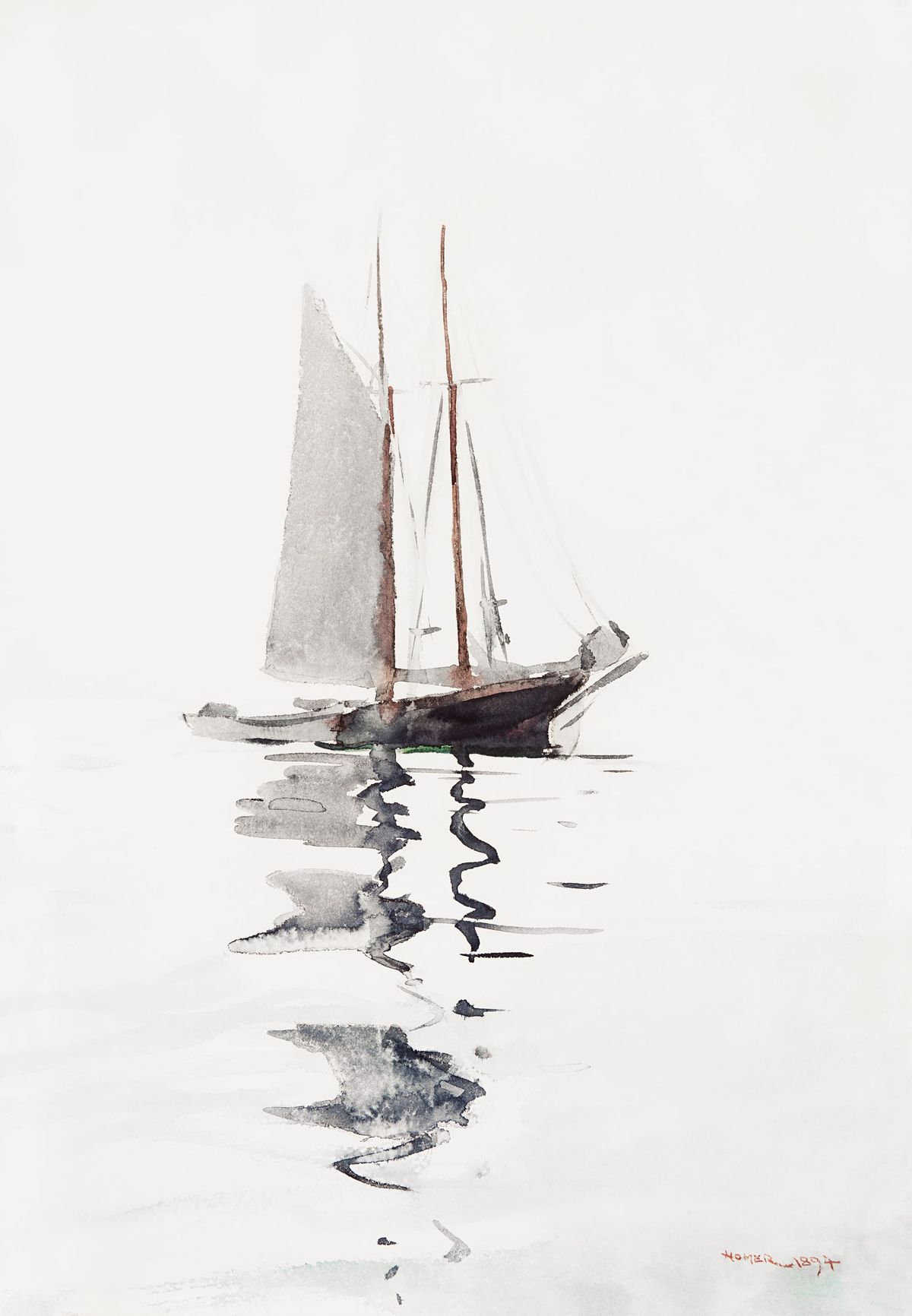
미국 사실주의 미술의 독보적인 거장 윈슬로 호머(Winslow Homer, 1836–1910)가 1894년에 완성한 절제미의 극치를 보여주는 수채화 소품입니다. 현재 미국 보스턴 미술관(Museum of Fine Arts, Boston)에 소장되어 있으며, 두꺼운 직조 화지 위에 흑연 연필과 투명 수채물감(Watercolor and graphite on wove paper)으로 제작된 실제 크기는 세로 35.6cm, 가로 25.4cm의 정갈한 세로형 규격입니다.
호머는 동양의 수묵화를 연상시키는 극단적인 여백의 미학을 서양의 투명 수채화에 완벽하게 녹여냈습니다. 수평선이나 하늘의 윤곽조차 그리지 않고 종이의 흰 바탕을 그대로 살려 안개 낀 바다와 맑은 대기의 빛을 표현했으며, 단 몇 번의 절제된 붓질로 돛대와 선체의 묵직한 구조를 세웠습니다. 특히 잔잔하게 일렁이는 수면에 비친 돛대의 흑회색 그림자는 젖은 화면에 물감을 자연스럽게 번지게 하는 웻온웻(Wet-on-wet) 기법과 물결을 따라 꺾이는 리드미컬한 필선으로 포착하여, 최소한의 터치로 물의 유동성과 깊이를 놀랍도록 생생하게 전달합니다.
이 작품이 제작된 1894년은 호머가 메인주 프라우츠넥의 절벽 작업실에서 거친 파도와 바다를 집요하게 관찰하던 시기였습니다. 호머는 복잡한 세상사를 멀리하고 오직 바다와 날씨의 변화에 온 신경을 집중하며 은둔에 가까운 삶을 살았습니다.
비하인드 스토리로, 당시 한 화상과 수집가가 그에게 찾아와 "배경에 섬이나 구름, 갈매기라도 몇 마리 그려 넣어 화면을 더 꽉 채워달라"고 조심스럽게 요청하자, 호머는 "이 그림에서 더 손을 대는 순간 바다의 침묵과 공기는 영원히 파괴된다. 손을 떼야 할 정확한 순간을 아는 것이야말로 진정한 화가의 능력이다"라며 단칼에 거절했다는 유명한 일화가 전해집니다. 후대 미술사학자들과 평론가들은 이 작품을 두고 "형태를 군더더기 없이 덜어내어 침묵과 빛 그 자체를 남긴 윈슬로 호머 후기 수채화 미학의 정점"이자 서양 회화에서 구현된 가장 현대적인 미니멀리즘의 선구적 명작으로 평가합니다.
관람자의 무의식적 시선은 화면 정중앙에 고요히 닻을 내린 범선의 짙은 선체와 꼿꼿하게 솟은 두 개의 돛대에 먼저 가닿습니다. 잔잔한 바다 위에 흔들림 없이 자리한 배의 명확한 형태는 보는 이의 시각적 초점을 단숨에 모아주며 번잡한 주의력을 정돈해 줍니다.
이어서 시선은 물결의 미세한 떨림을 따라 아래로 굽이치며 번져나가는 선체의 어두운 그림자를 타고 하단으로 유려하게 흘러내립니다. 군더더기 없는 광활한 백색 여백은 뇌파를 명상적인 안정 상태인 세타파로 이끌며 시각적 과부하를 즉각적으로 해소해 줍니다. 바람 한 점 없는 고요한 바다 위에 떠 있는 배의 자태는 일상의 거센 소음과 파도를 벗어나 완전한 내면의 고요와 평온한 안식처를 마주하게 만드는 깊은 심리적 정화 효과를 선사합니다.
Schooner at Anchor
Created in 1894 by Winslow Homer (1836–1910), a titan of American Realism, this poetic watercolor is housed in the permanent collection of the Museum of Fine Arts, Boston. Executed on heavy wove paper using transparent watercolor and delicate graphite underdrawing, the intimate vertical work measures approximately 35.6 cm in height by 25.4 cm in width.
Homer achieved a breathtaking economy of means, evoking the contemplative aesthetics of Eastern ink wash within the Western watercolor tradition. Completely omitting painted horizons or skies, he allowed the pristine white reserve of the paper to breathe life into the misty sea air and ambient light. With just a few swift, decisive brushstrokes, he structured the hull and masts, while the fluid, meandering reflection in the water was rendered with spontaneous wet-on-wet washes that convey the gentle swell and buoyant depth of the tide.
This piece was conceived in 1894 while Homer lived in solitary communion with the ocean at his cliffside studio in Prouts Neck, Maine. Detached from urban bustle, the artist devoted himself entirely to capturing the shifting temperaments of sea and atmosphere.
A famous anecdote recounts that when an art dealer gently suggested adding clouds, a distant shoreline, or sea gulls to fill the vast empty spaces, Homer fiercely declined, declaring that touching the canvas further would only ruin the profound silence of the scene, adding that knowing precisely when to stop is the true mark of a master. Modern critics and art historians celebrate this minimalist jewel as a crowning summit of Homer's late watercolors, where subject matter dissolves into pure atmosphere, light, and modern visual poetry.
The viewer's subconscious gaze immediately fastens upon the crisp silhouette of the schooner anchored serenely at the composition's center. The grounded, upright verticality of the twin masts provides an instant focal anchor, quickly settling mental turbulence and inviting deep visual concentration.
The eye is then pulled downward along the rhythmic, serpentine ripples of the reflection dissolving into the tranquil sea below. The vast, unpainted white space acts as a visual sanctuary for the mind, swiftly dissipating sensory exhaustion and inducing a meditative alpha-wave calm. Resting weightlessly upon the glassy stillness, the solitary vessel becomes an enduring metaphor for inner stillness, offering deep psychological respite and lasting emotional peace from the tempestuous currents of daily life.
본 리뷰에서 작품을 제외한 컨텐츠의 저작권은 팔렛트제주에 있습니다.
"퍼블릭도메인 고전명화"를 제외한 모든 창작 콘텐츠는 저작권법 제4조 및 제10조에 의거하여 보호됩니다. 무단 도용시 저작권법 제136조(벌칙)에 의거, 당사의 사전 서면 승인 없는 저작권 침해 행위를 금지합니다.