동풍 (프라우츠 넥의 북동풍 파도) - Northeaster
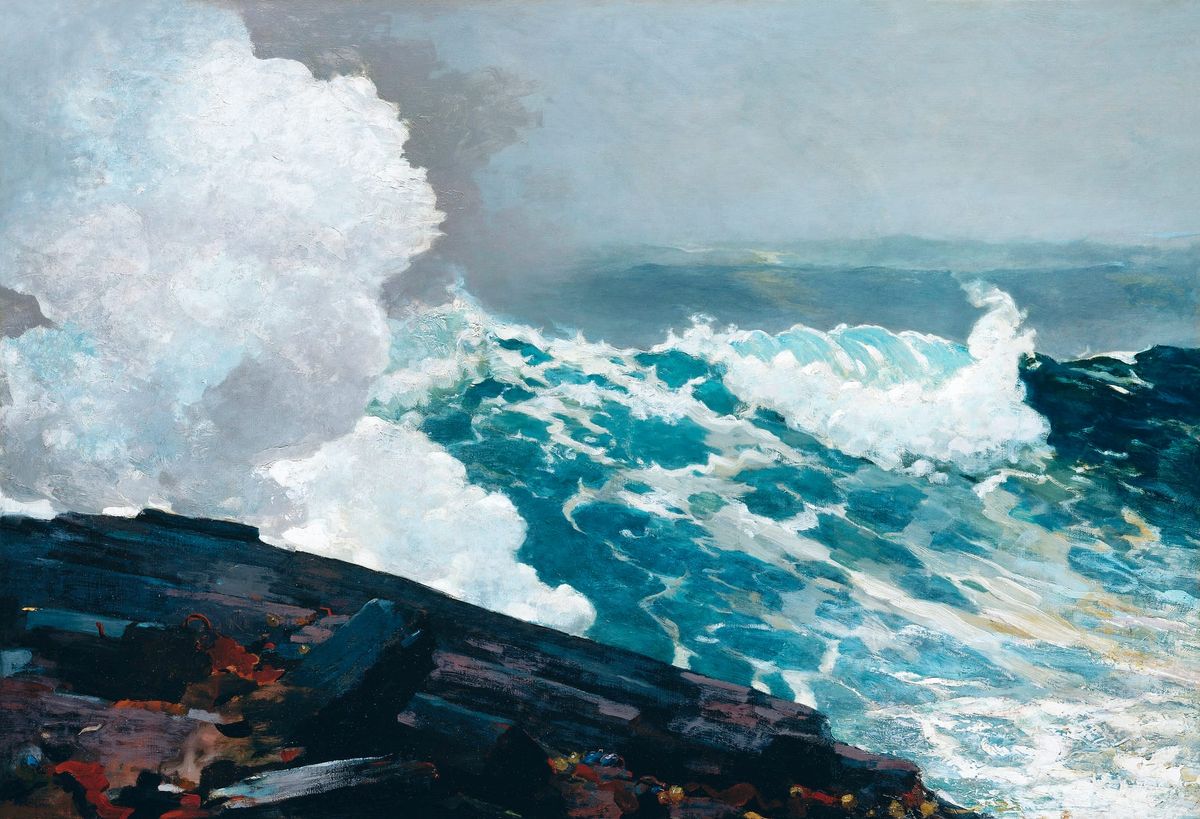
미국의 전설적인 사실주의 거장 윈슬로 호머(Winslow Homer, 1836–1910)가 1895년에 완성하고 1901년에 재작업을 거쳐 불후의 명작으로 완성한 기념비적 대형 유화 <동풍(Northeaster)>은 북대서양의 거센 폭풍우 속에서 집채만 한 청록빛 파도가 검푸른 해안 암벽을 집어삼킬 듯 맹렬하게 강타하며 하얀 물보라로 폭발하는 찰나를 가장 웅장하고 압도적인 조형미로 포착해 낸 수작입니다.
이 작품은 가로 약 127.0cm, 세로 약 87.6cm 크기의 웅장한 캔버스 위에 탄탄한 정통 유화 기법으로 제작되었으며, 포효하며 부서지는 백색 포말과 솟구치는 거대한 물기둥, 그리고 물기에 젖어 번뜩이는 검은 화강암 암초의 묵직한 단면에는 도톰한 임파스토를 밀도 높게 쌓아 올리고, 차가운 에메랄드빛과 짙은 코발트블루가 교차하는 파도의 속도감을 대담한 나이프 터치와 유려한 붓질로 완벽히 구현해 냈습니다.
현재 미국 뉴욕 메트로폴리탄 미술관(The Metropolitan Museum of Art)의 핵심 소장품으로 영구 전시되어 있는 이 그림은 메인주 프라우츠 넥(Prouts Neck)의 험준한 바위 해안에서, 북동풍(Northeaster)이 몰고 온 거대한 너울성 파도가 단단한 암반을 들이받으며 천지를 뒤흔들 듯 포효하는 장엄한 대자연의 원초적 에너지를 담고 있습니다.
이 그림 뒤에는 대서양의 야생적 숨결과 고독하게 마주하며 평생 바다의 초상화를 캔버스에 바쳤던 호머의 치열한 예술혼과 흥미진진한 비하인드가 깃들어 있습니다. 1883년 메인주 프라우츠 넥의 외딴 절벽 끝에 이동식 바퀴가 달린 화실을 짓고 정착한 호머는, 북동풍 폭풍이 불어닥쳐 마을 사람들이 모두 문을 걸어 잠글 때 비로소 방수 외투를 챙겨 입고 해안 절벽으로 뛰어나갔습니다.
호머는 파도가 암초와 충돌하는 순간의 찰나적 무게감을 포착하기 위해 파도의 비말이 날아드는 바위턱에 이젤을 고정하고 며칠이고 파도의 형태를 관찰했습니다.
1895년 초판 완성 당시 호머는 암벽 위에 바다를 바라보는 작은 두 명의 인물을 그려 넣었으나, 그림을 계속 바라보던 호머는 인간의 형상이 대자연의 순수한 숭고미를 방해한다고 판단했습니다.
1901년 호머는 결연한 표정으로 붓을 들어 암벽 위의 인물들을 완전히 지워버리고 파도의 포말과 물기둥을 한층 더 거대하고 맹렬하게 덧칠하는 파격적인 재작업을 감행했습니다. 화상을 비롯한 주변 사람들이 완성된 그림에 손을 대는 것을 말리자 호머는 "저 거대한 물보라의 포효 앞에 인간의 자잘한 이야기는 군더더기일 뿐이라네! 오직 바다와 암벽의 정직한 충돌만이 내 캔버스가 도달해야 할 유일한 진실이지!"라며 호탕하게 웃었습니다. 호머의 이러한 과감한 결단 덕분에 작품은 인간 중심의 서사를 벗어나 영원한 자연의 에너지를 담은 불멸의 걸작으로 다시 태어나게 되었습니다.
화면 전경을 듬직하게 받치고 있는 젖은 암초 틈새의 붉은 해조류와 저 멀리 짙은 해무 속으로 아스라이 사라지는 수평선, 그리고 화면 좌측 하단 암벽 그늘에 묵직하게 새겨진 호머의 서명은 그가 북대서양의 숭고한 현장감을 온몸으로 체득하며 기록한 위대한 증거입니다.
미술사학자들은 이 작품을 호머의 후기 해양 유화 연작 중에서도 조형적 완결성과 자연주의적 숭고미가 정점에 달한 절대적인 최고 걸작으로 평가합니다.
인간의 존재를 배제한 채 물과 돌, 공기의 순수한 물리적 충돌만으로 화면을 가득 채운 이 파격적인 구성은, 훗날 20세기 미국 현대 추상표현주의 화가들에게도 지대한 영감을 주며 사실주의 회화의 새로운 지평을 열었다는 극찬을 받습니다.
작품을 마주할 때 관람자의 무의식적인 시선은 화면 좌측 하단에서 우측 상단으로 솟구치는 거대한 대각선 궤적을 따라 매우 역동적이고 웅장한 순환 궤적을 그리며 이동합니다. 관람객의 눈길은 가장 먼저 화면 좌측에서 하늘을 집어삼킬 듯 맹렬하게 솟구쳐 오르는 거대한 은백색 물보라의 폭발적인 에너지와 눈부신 포말에 사로잡힙니다.
이어 시선은 물기둥의 하강 곡선을 타고 화면 중앙의 짙푸른 에메랄드빛 파도 능선으로 미끄러져 내려와, 소용돌이치며 굽이치는 바닷물의 투명한 옥빛과 하얗게 부서지는 물마루의 질감을 타고 자연스럽게 흘러갑니다.
사납게 굽이치는 파도의 궤적을 따라간 눈길은 화면 우측에서 또 한 번 솟구쳐 오르는 파도의 날카로운 물방울들을 지나, 화면 전경을 단단하고 묵직하게 가로막고 선 어두운 화강암 암반의 거친 단면과 붉은 해조류의 축축한 질감으로 내려앉습니다.
이후 시선은 암벽을 적시며 흘러내리는 은빛 물길을 거쳐, 화면 상단을 묵직하게 감싸 안은 짙은 잿빛 폭풍 구름과 해무 속으로 상승하며 탁 트인 공간감 속에서 깊고 완전한 시각적 안착을 이룹니다.
이러한 유려한 시선의 순환은 관람자의 내면에 깊은 심리적 정화와 가슴 벅찬 카타르시스를 선물합니다. 화면 가득 포효하며 부서지는 차가운 바닷물의 청량함과 거대한 파도의 생명력은, 복잡한 일상의 번잡함과 피로에 지친 현대인의 무의식에 묵은 스트레스와 무기력을 단숨에 쓸어내리는 시원한 해방감을 불어넣어 줍니다.
성난 파도의 맹렬한 습격 앞에서도 변함없이 굳건하게 자리를 지키는 거대한 바위의 단단한 무게감은, 보는 이로 하여금 일상의 번뇌를 내려놓고 삶의 어떤 거센 풍파 앞에서도 흔들리지 않는 내면의 굳센 중심과 맑은 평정을 되찾아 주는 든든한 치유의 위로를 건냅니다.
Northeaster
Completed in 1895 and reworked to definitive perfection in 1901 by the celebrated American realist master Winslow Homer (1836–1910), the monumental oil masterpiece Northeaster stands as an extraordinary tour de force capturing the primeval kinetic fury, roaring atmospheric power, and elemental majesty of the North Atlantic with peerless visceral intensity.
Measuring approximately 127.0 cm wide by 87.6 cm high on canvas, the work showcases Homer's consummate mastery of oil technique, applying thick, sculptural impasto to the detonating column of blinding white foam and the spray-swept crests, while modulating the wet, glistening surfaces of the dark granitic ledge with rich umbers, prussian blues, and deep ochres.
Preserved in the prestigious permanent collection of The Metropolitan Museum of Art in New York, this iconic painting portrays the rugged coast of Prouts Neck, Maine, where a ferocious gale from the northeast drives colossal turquoise swells crashing against the immovable rock shelf in a monumental explosion of white water beneath a brooding coastal sky.
Behind this restorative canvas lies Homer's solitary existence upon the rocky promontory of Maine, where he lived in intimate communion with the ocean tides, often venturing directly to the spray-drenched cliffs in heavy sea gear to study the raw architecture of storm surges.
Determined to record the unvarnished collision between water and stone, Homer spent days observing the anatomy of the surf from his mobile painting shack.
When first exhibited in 1895, the composition originally included two small figures crouching upon the rocks to watch the sea, but Homer grew dissatisfied with the anecdotal distraction they created.
In 1901, Homer boldly resolved to paint out the human observers entirely, broadening the wall of foaming spray and intensifying the monolithic power of the wave itself. When associates expressed apprehension about reworking a finished canvas, Homer laughed heartily, declaring that human spectators were mere clutter before the sacred roar of the ocean and that the pure confrontation between surf and granite was the only truth his brush needed to speak.
The rich russet seaweed clinging to the crevices of the foreground ledge, the dense gray curtain of coastal fog obscuring the horizon, and the artist's resolute signature anchored in the lower shadows stand as authentic testaments to Homer's profound dialogue with the elemental forces of nature.
Art historians celebrate Northeaster as the crowning summit of Homer's mature marine oeuvre, praising its monumental compositional daring, modern planar balance, and emotional resonance. By stripping away narrative convention to confront the sublime power of the open sea, Homer created an enduring visual sanctuary of existential fortitude, ecological grandeur, and transcendent strength.
When engaging with the painting, the viewer's unconscious gaze undertakes an intensely thrilling yet stabilizing visual journey. The eye is initially seized by the monumental column of frothing white water exploding on the left, lingering upon the turbulent geyser of spray that reaches into the stormy sky.
The gaze then cascades downward along the churning curtain of foam into the luminous trough of emerald and cobalt water in the center, tracing the undulating rhythm of the advancing swell.
Sweeping toward the right where a companion crest curls and shatters against the open horizon, the viewer's attention descends into the dark, grounding mass of the granitic ledge dominating the lower foreground.
Finally, tracing the wet, glistening ledges washed by descending ribbons of foam and rising into the dense, vaporous expanse of the overcast sky above, the eye settles comfortably into the balanced equilibrium of the composition.
This rhythmic visual journey fosters profound psychological reassurance, cathartic release, and deep emotional stillness within the observer. The tactile immersion in cool ocean mist, roaring surf, and bracing maritime air acts as an intuitive emotional balm, dispelling ambient modern fatigue and soothing inner tension.
By presenting a world where immovable bedrock stands resolute against the fiercest tides of nature, Homer offers the observer a comforting sanctuary of mindfulness, inspiring a deep sense of resilience, inner fortitude, and enduring peace.
본 리뷰에서 작품을 제외한 컨텐츠의 저작권은 팔렛트제주에 있습니다.
"퍼블릭도메인 고전명화"를 제외한 모든 창작 콘텐츠는 저작권법 제4조 및 제10조에 의거하여 보호됩니다. 무단 도용시 저작권법 제136조(벌칙)에 의거, 당사의 사전 서면 승인 없는 저작권 침해 행위를 금지합니다.