동풍 (절벽에 부서지는 파도) - Eastern Point
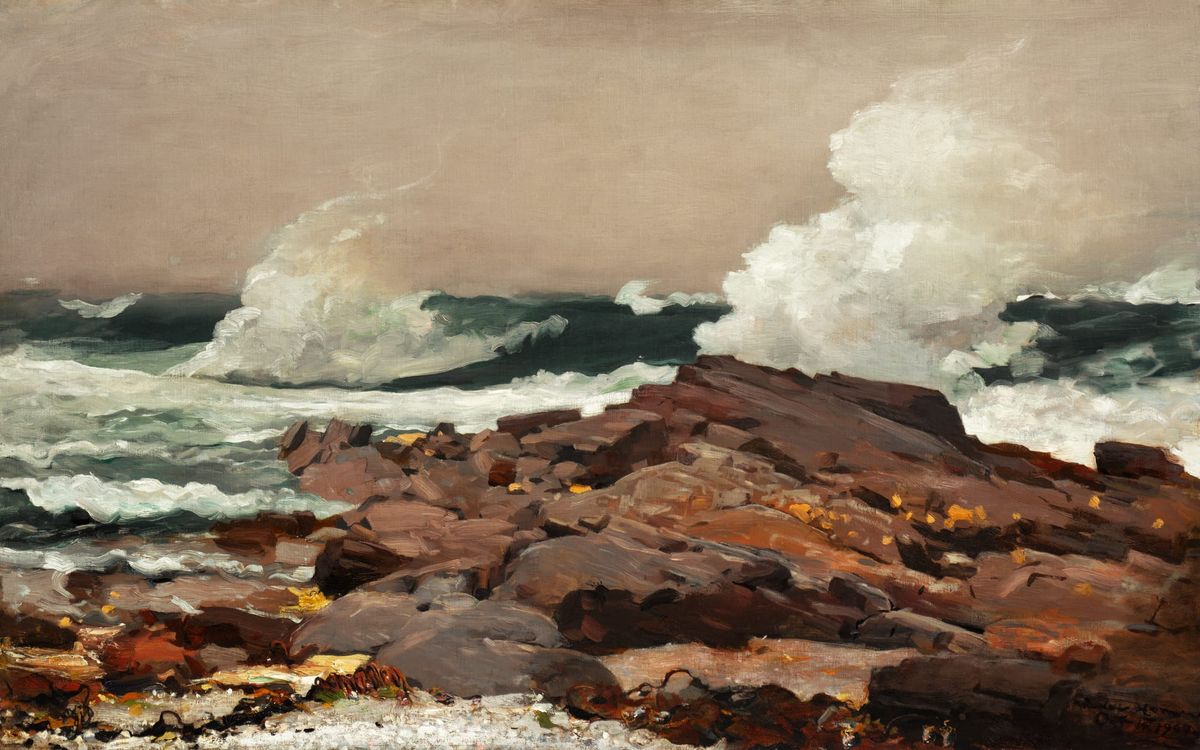
미국의 전설적인 사실주의 거장 윈슬로 호머(Winslow Homer, 1836–1910)가 1900년 10월 14일 메인주 프라우츠 넥의 거친 해안에서 완성한 기념비적 유화 걸작 <동풍(Eastern Point / Prout's Neck, Breakers)>은 북대서양의 맹렬한 파도와 고대 암벽의 장엄한 충돌을 가장 대담하고 밀도 높은 붓 터치로 포착해 낸 수작입니다.
이 작품은 가로 76.5cm, 세로 51.1cm 크기의 캔버스 위에 제작되었으며, 화면 우측에서 하늘 높이 솟구쳐 오르는 거대한 백색 물보라의 포말에는 두터운 유화 임파스토를 과감히 얹고, 붉은빛과 흑갈색으로 풍화된 화강암 암초의 묵직한 질감을 팔레트 나이프와 역동적인 붓질로 완벽하게 조형해 냈습니다.
현재 미국 매사추세츠주 클라크 아트 인스티튜트(Clark Art Institute)에 소장되어 있는 이 그림은 메인주 프라우츠 넥의 가장 동쪽 끝 바위 절벽인 이스턴 포인트에서 거센 동풍이 몰아칠 때, 성난 너울성 파도가 암초를 집어삼키며 하얗게 폭발하는 대자연의 원초적 순간을 담고 있습니다.
이 그림 뒤에는 바다의 변화무쌍한 찰나를 놓치지 않기 위해 시간과 사투를 벌였던 노거장의 뜨거운 집념과 유쾌한 인간적 에피소드가 깃들어 있습니다. 호머는 완벽한 파도의 형상과 가을 햇빛의 각도를 수개월 동안 기다려왔으며, 1900년 10월 14일 마침내 자신이 그리던 완벽한 파도가 밀려오자 번개처럼 화구 상자를 들고 절벽 끝으로 뛰어나갔습니다.
호머는 날아갈 듯 몰아치는 바닷바람과 차가운 바닷물 분무가 안경과 얼굴을 적시는 악천후 속에서도 꼼짝하지 않고 단 하루 만에 이 거대한 유화를 단숨에 완성했습니다.
그림을 완성한 직후 손가락이 곱아들고 온몸이 젖은 채 화실로 돌아온 호머는 동생 아서에게 보낸 편지에서 "오늘 오후 4시, 마침내 벼랑 끝에서 파도를 단숨에 낚아챘다네! 젖은 붓을 씻기도 전에 캔버스 위에 서명이 마를 정도였지!"라며 어린아이처럼 기뻐 날뛰었다는 생생한 일화가 전해집니다.
마을 주민들이 왜 위험천만한 파도 앞에 홀로 서서 그림을 그리느냐고 걱정할 때마다, 호머는 "바다는 내게 평생 마르지 않는 영감의 우물이자 가장 정직한 벗이라네!"라며 호탕하게 웃어넘겼습니다.
미술사학자들은 이 작품을 호머의 후기 해양 유화 연작 중에서도 조형적 순도와 즉흥적 역동성이 절정에 달한 명작으로 평가합니다.
인간이나 배 같은 서사적 요소를 완전히 배제한 채 오직 바위와 파도, 하늘의 웅장한 삼중주만으로 대자연의 실존적 숭고미를 완성하여, 훗날 20세기 미국 표현주의 및 현대 풍경화의 지평을 연 선구적 걸작으로 찬사를 받습니다.
작품을 마주할 때 관람자의 무의식적인 시선은 매우 역동적이고 웅장한 대각선 상승 궤적을 그리며 이동합니다. 관람객의 눈길은 가장 먼저 화면 우측에서 마치 거대한 연기처럼 하늘 높이 솟구쳐 오르는 눈부신 백색 물보라의 거대한 기둥에 단숨에 사로잡힙니다.
이어 시선은 화면 좌측에서 균형을 맞추며 솟아오르는 또 다른 파도의 포말을 지나, 화면 중앙과 앞쪽으로 넓게 펼쳐진 단단한 흑갈색 화강암 암초의 묵직한 능선을 따라 부드럽게 미끄러져 내려옵니다.
바위 표면에 묻어난 황금빛 이끼와 붉은 흙의 질감을 훑은 시선은 전경의 하얀 자갈밭과 짙은 해조류 더미를 거쳐, 다시 저 멀리 짙푸른 에메랄드빛으로 넘실거리는 북대서양의 수평선과 묵직한 회갈색 하늘로 상승하며 탁 트인 공간감을 만끽하게 됩니다.
이러한 유려한 시선의 순환은 관람자의 내면에 깊은 심리적 정화와 강력한 내적 카타르시스를 선물합니다. 화면 가득 맹렬하게 부서지는 거대한 파도의 생명력은 복잡한 일상의 번잡함과 피로에 지친 현대인의 무의식에 묵은 체증을 단숨에 씻어내는 시원한 해방감을 불어넣어 줍니다.
어떤 거친 풍파와 파도의 습격 속에서도 미동조차 없이 굳건하게 자리를 지키는 거대한 암벽의 존재감은, 보는 이에게 번뇌를 내려놓고 삶의 어떤 시련 앞에서도 흔들리지 않는 내면의 중심과 단단한 용기를 되찾아 주는 깊은 치유의 위로를 전합니다.
Eastern Point
Completed on October 14, 1900 by the celebrated American realist master Winslow Homer (1836–1910), the oil masterpiece Eastern Point (also known as Prout's Neck, Breakers) stands as a monumental tour de force capturing the primeval fury, sculptural weight, and elemental collision of the North Atlantic Ocean with breathtaking immediacy.
Measuring 76.5 cm wide by 51.1 cm high on canvas, the work showcases Homer's consummate command of heavy impasto and rapid, assertive brushwork, applying thick mounds of pure white to convey the explosive surf while rendering the ancient, weather-beaten granite ledges in richly modulated earth tones of ochre, umber, and russet.
Preserved in the prestigious permanent collection of the Clark Art Institute in Williamstown, Massachusetts, this painting powerfully portrays Eastern Point, the rugged rocky promontory of Prouts Neck, Maine, where ferocious ocean swells driven by easterly gales erupt in towering geysers of spray against the immovable bedrock.
Behind this iconic composition lies Homer's passionate duel with time and the shifting moods of nature. Having waited months for the precise autumnal lighting and heavy ocean swells, Homer seized his portable gear the moment the storm peaked on the afternoon of October 14, rushing directly to the spray-drenched cliffs.
Working with furious speed amidst biting salt spray that coated his face and spectacles, Homer completed this monumental canvas in a single, electrifying session of unbroken concentration.
Returning to his studio shivering yet triumphant, Homer wrote enthusiastically to his brother Arthur, exclaiming with childlike joy that he had seized the wild wave directly from the cliffs before four o'clock, marveling that the signature was dry almost before his brushes were cleaned.
When neighboring fishermen expressed concern over his solitary vigils on the perilous ledges, Homer laughed warmly, replying that the ocean was his most honest companion and an inexhaustible fountain of creative vitality.
Art historians celebrate this painting as a defining summit of Homer's late marine oeuvre, extolling its radical compositional economy and dynamic visual equilibrium. By eliminating all narrative and human distractions to focus solely on the cosmic dialogue between surging water, bedrock, and brooding sky, Homer created an enduring visual monument to existential resilience that prefigured twentieth-century modernism.
When engaging with the painting, the viewer's unconscious gaze undertakes an intensely thrilling yet stabilizing visual journey. The eye is initially seized by the massive column of luminous white spray erupting dramatically on the right, soaring high against the overcast atmosphere.
The gaze then travels across the churning, foam-laced troughs toward the secondary surge on the left, before descending along the heavy, muscular contours of the dark granite ledge that anchors the foreground.
Sweeping past the delicate touches of golden lichen, amber sea-wrack, and white pebbles along the lower margin, the viewer's attention rises naturally through the deep, velvety expanse of emerald and indigo waters toward the boundless horizon, absorbing the immense spatial clarity of the open sea.
This rhythmic visual journey fosters profound psychological reassurance, cathartic release, and deep emotional stillness within the observer. The roaring spectacle of water and rock acts as an intuitive emotional balm, sweeping away ambient modern stress and accumulated inner fatigue.
By presenting the eternal balance between the volatile kinetic power of the sea and the silent fortitude of ancient stone, Homer offers the observer a comforting sanctuary of mindfulness, inspiring a deep sense of resilience, inner composure, and enduring peace.
본 리뷰에서 작품을 제외한 컨텐츠의 저작권은 팔렛트제주에 있습니다.
"퍼블릭도메인 고전명화"를 제외한 모든 창작 콘텐츠는 저작권법 제4조 및 제10조에 의거하여 보호됩니다. 무단 도용시 저작권법 제136조(벌칙)에 의거, 당사의 사전 서면 승인 없는 저작권 침해 행위를 금지합니다.