동풍 - Eastern Point, Prout's Neck
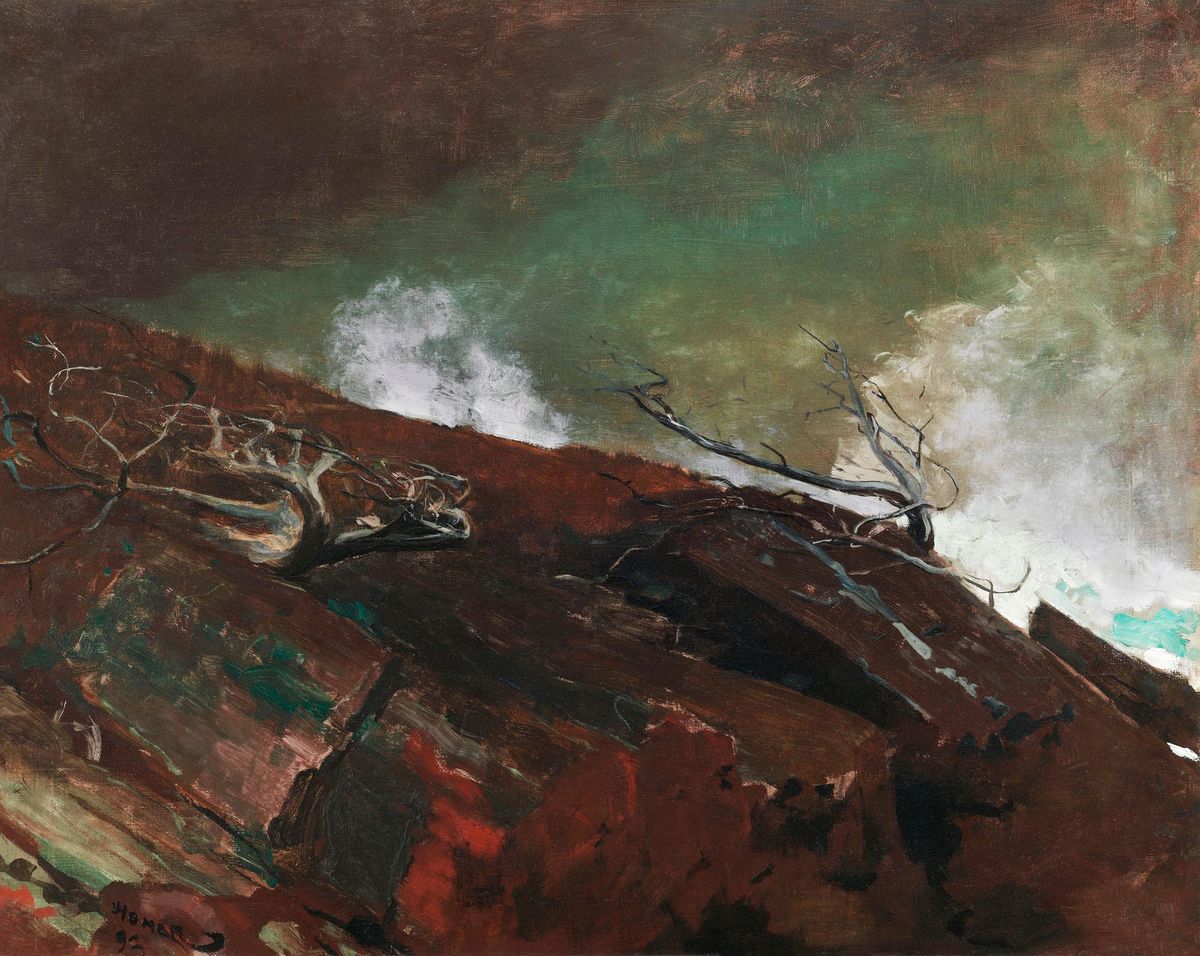
미국의 대표적인 사실주의 거장 윈슬로 호머(Winslow Homer, 1836–1910)가 1900년경(서명 표기 1893년 기반 재작업)에 완성한 유화 걸작 <동풍(Eastern Point, Prout's Neck)>은 메인주 해안 절벽의 장엄한 원시성과 대자연의 거친 호흡을 극적으로 응축해 낸 대표작입니다.
이 작품은 가로 72.4cm, 세로 57.2cm 크기의 캔버스 위에 묵직한 유화 물감을 두껍게 얹어내는 임파스토(impasto) 기법과 거친 붓질, 나이프 터치를 혼용하여 바위의 단단한 질감과 바다 안개의 자욱한 대기감을 생생하게 구현해 냈습니다.
현재 미국 매사추세츠주 클라크 아트 인스티튜트(Clark Art Institute)에 소장되어 있는 이 그림은 메인주 프라우츠 넥의 동쪽 끝 절벽에서 바라본 풍경으로, 매서운 북대서양의 비바람에 꺾여 쓰러진 마른 고목들과 붉은 암벽, 그리고 그 뒤편으로 하얗게 부서지며 솟구치는 거대한 파도의 분출을 담고 있습니다.
이 그림에는 메인주의 거친 절벽 위에 은둔하며 오직 자연의 순수한 힘에만 몰두했던 호머의 치열하고도 괴짜 같은 인간적 면모가 고스란히 담겨 있습니다. 1883년 이후 프라우츠 넥의 마차 헛간을 개조한 화실에 틀어박힌 호머는 문앞에 '접근 금지' 팻말을 걸어두고 외부인의 방문을 극도로 꺼렸습니다.
그는 화창하고 온화한 날씨에는 낮잠을 자거나 산책을 즐기다, 동풍이 불어 닥치고 거대한 폭풍우가 절벽을 뒤흔들 때면 비로소 눈을 번쩍이며 기름 묻은 작업복과 장화를 신고 벼랑 끝으로 뛰쳐나갔습니다.
주민들이 비바람에 휩쓸려 바다로 떨어질까 걱정하며 소리치면, 호머는 "바람이 불어야 바다가 살아 숨 쉰다!"라며 비바람을 막아줄 거대한 이동식 목재 부스를 절벽 위에 직접 끌고 가 그 안에서 성난 파도를 마주하며 캔버스에 물감을 짓이기듯 발라 나갔습니다.
작품을 발표했을 당시 화상들과 수집가들은 왜 아름다운 여인이나 배, 혹은 등대 같은 인간적인 요소를 전혀 넣지 않고 황량한 벼랑과 죽은 나무만 그렸느냐고 불평 섞인 질문을 던졌습니다. 그러자 호머는 인간 따위가 없어야 자연이 온전히 그 장엄함을 드러낼 수 있다고 무뚝뚝하게 쏘아붙이며, 찰나의 장식적 아름다움 대신 자연 그 자체가 지닌 영원한 실존의 힘을 지켜냈습니다.
미술사학자들은 이 작품을 미국 해양 회화의 기념비적인 성취이자, 20세기 현대 추상 표현주의의 태동을 예고한 선구적인 명작으로 평가합니다. 화면을 과감하게 대각선으로 양분하여 거칠고 붉은 암벽과 에메랄드빛 안개 속 파도를 충돌시키는 극적인 구도는, 자연의 장엄한 숭고미를 현대적인 조형 언어로 승화시켰다는 극찬을 받습니다.
작품을 마주할 때 관람자의 무의식적인 시선은 매우 역동적이면서도 궁극적인 안도감을 선사하는 대각선 궤적을 그리며 움직입니다. 관람객의 눈길은 가장 먼저 화면을 대담하게 가로지르는 붉은빛 암벽의 날카로운 경사면과 그 위에 뼈대처럼 쓰러져 있는 하얀 고목의 나뭇가지에 가닿습니다.
이어 시선은 바위 능선 너머에서 마치 거대한 숨결처럼 솟아오르는 하얀 물보라와 짙은 에메랄드빛 바다 안개의 신비로운 공간으로 상승합니다. 안개와 파도의 웅장한 포말을 훑은 시선은 다시 전경 좌측 하단의 묵직한 흙빛과 선명한 붉은 단풍빛 대지로 자연스럽게 내려와 단단한 공간적 안착을 이룹니다.
이러한 유려한 시선의 순환은 관람자의 내면에 깊은 심리적 정화와 내적 강인함을 선물합니다. 대지를 집어삼킬 듯 맹렬하게 부서지는 파도와 비바람 속에서도 미동조차 없이 굳건하게 자리를 지키는 거대한 바위의 존재감은, 복잡한 스트레스와 삶의 불안에 짓눌린 현대인의 무의식에 강력한 안정감의 닻을 내려 줍니다.
어떤 모진 비바람에도 흔들리지 않는 대지의 묵직한 힘과 자연의 원초적인 생명력은, 관람자에게 번잡한 잡념을 씻어내고 자신의 내면에 자리한 흔들리지 않는 중심과 숭고한 용기를 되찾게 하는 깊은 치유의 에너지를 건넵니다.
Eastern Point, Prout's Neck
Completed around 1900 by the celebrated American realist master Winslow Homer (1836–1910), the oil masterpiece Eastern Point, Prout's Neck stands as an extraordinary tour de force capturing the primeval grandeur and untamed energy of the North Atlantic coast.
Measuring 72.4 cm wide by 57.2 cm high on canvas, the work showcases Homer's masterful command of dense impasto, assertive brushstrokes, and deliberate palette knife applications that brilliantly evoke the rugged texture of granite ledges and the atmospheric density of ocean mist.
Preserved in the prestigious permanent collection of the Clark Art Institute in Williamstown, Massachusetts, this painting powerfully depicts the weather-beaten cliffs at Eastern Point in Prouts Neck, Maine, where bleached, gale-fallen cedar branches cling to reddish ledges against the volcanic spray of surging ocean swells.
Behind this powerful canvas lies the legendary and eccentric solitary lifestyle Homer cultivated on the rocky Maine coast. Having converted a carriage house at Prouts Neck into his secluded hermitage in 1883, Homer posted blunt warning signs to ward off visitors and lived entirely absorbed in the primal rhythms of nature.
While mild sunny afternoons left him indifferent, Homer came alive the moment an eastern squall stirred the ocean into a fury. Clad in heavy storm boots and oilskins, he would rush out to the wind-whipped cliffs with a specially built portable wooden painting shelter, battling howling gales and salty sea spray to lay thick strokes of oil paint onto the canvas.
When perplexed dealers and patrons questioned why he refused to depict fashionable figures, sailing vessels, or lighthouses in the scene, Homer tersely responded that the absence of human interference allowed nature to reveal its purest and most monumental majesty.
Art historians celebrate this painting as a transformative milestone in American art that anticipated twentieth-century modernism. By dividing the composition along a bold, ascending diagonal of earth and tempestuous sea, Homer elevated the coastal landscape into a timeless monument to cosmic power and existential endurance.
When engaging with the painting, the viewer's unconscious gaze undertakes an intensely invigorating yet stabilizing psychological journey. The eye is initially drawn along the powerful diagonal crest of the reddish ledge, pausing upon the sculptural, silver branches of the prostrate cedar.
The gaze then leaps across the rocky precipice into the radiant white plume of sea foam erupting against the brooding expanse of emerald mist and turbulent sky. Ascending through the atmospheric haze, the viewer's attention gently returns downward, settling into the rich, grounding terra-cotta tones and deep umber shadows of the foreground ledge.
This rhythmic visual journey fosters profound psychological resilience and emotional stillness within the observer. The unyielding permanence of the bedrock amidst the relentless assault of ocean waves acts as a mental anchor, dissolving ambient anxieties and modern fatigue.
By presenting the eternal balance between the furious kinetic energy of the waves and the silent endurance of ancient stone, Homer offers the observer a sanctuary of fortitude, inspiring a deep-seated inner peace and an unshakeable sense of clarity amidst life's fiercest tempests.
본 리뷰에서 작품을 제외한 컨텐츠의 저작권은 팔렛트제주에 있습니다.
"퍼블릭도메인 고전명화"를 제외한 모든 창작 콘텐츠는 저작권법 제4조 및 제10조에 의거하여 보호됩니다. 무단 도용시 저작권법 제136조(벌칙)에 의거, 당사의 사전 서면 승인 없는 저작권 침해 행위를 금지합니다.