칠판 앞의 여교사 (칠판) - The Blackboard
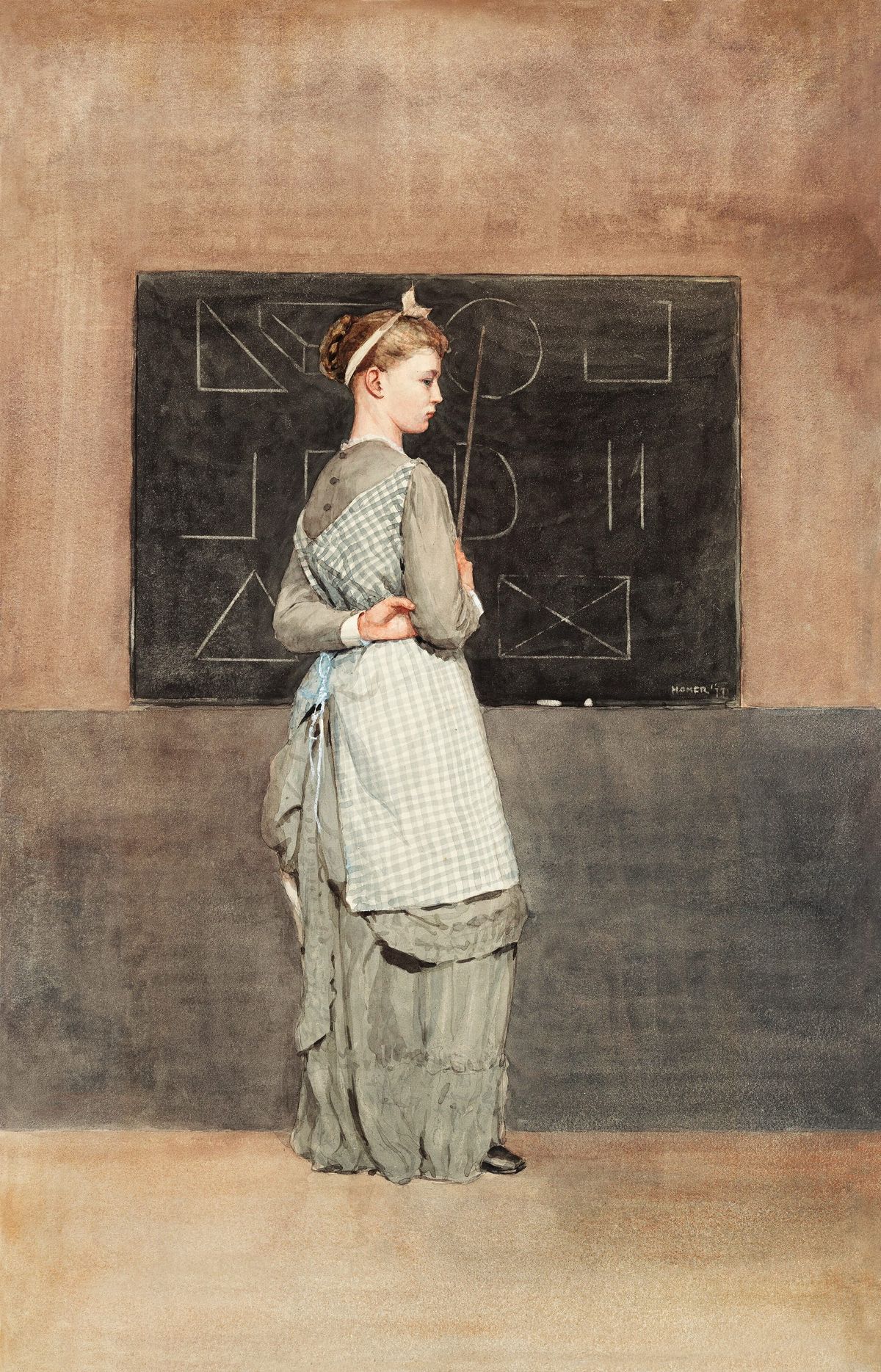
미국의 전설적인 사실주의 거장 윈슬로 호머(Winslow Homer, 1836–1910)가 1877년에 완성한 수채화 명작 <칠판 앞의 여교사(The Blackboard)>는 19세기 시골 학교의 고요한 교실 안에서 칠판 앞에 단정하게 서 있는 젊은 여교사의 지적이고 청초한 자태를 가장 우아하고 절제된 필치로 포착해 낸 수작입니다.
이 작품은 가로 약 32.7cm, 세로 약 49.5cm 크기의 고급 워브 종이 위에 흑연 연필로 정갈하게 인물과 기하학 도형의 선을 잡은 후, 투명 수채 물감의 유려한 번짐과 스며듦으로 교실 벽면의 따스한 갈색 톤과 칠판의 깊은 흑색을 칠하고, 흰색 불투명 구아슈 물감 터치와 종이의 백색 여백을 활용해 체크무늬 앞치마와 분필 가루의 질감을 살려낸 혼합 수채 기법으로 제작되었습니다.
현재 미국 유수 미술관 및 주요 개인 컬렉션에서 높이 평가받는 이 그림은 뉴욕주 또는 뉴잉글랜드의 작은 시골 학교 교실에서, 기하학 도형들이 빼곡히 그려진 칠판 앞에 선 여교사가 지시봉을 손에 쥐고 등을 돌린 채 학생들을 응시하거나 생각에 잠겨 있는 고즈넉한 순간을 담고 있습니다.
이 그림 뒤에는 남북전쟁 이후 미국 공교육의 든든한 주역으로 자리 잡은 여성 교사들의 지적 존엄성에 깊은 경의를 표했던 호머의 따뜻한 시선과 흥미진진한 비하인드가 깃들어 있습니다. 1870년대 호머는 뉴욕 허드슨 밸리 일대의 시골 학교들을 찾아다니며 당시 미국의 새로운 직업 여성상을 탐구하는 교실 연작에 몰두했습니다.
호머는 칠판에 분필로 삼각형, 사각형, 원형 등 정교한 기하학 도형들을 직접 그려 넣으며 교실의 엄숙하면서도 정돈된 분위기를 연출했습니다. 당시 모델을 서주던 젊은 교사는 호머가 그림을 그리는 내내 진지하게 자세를 유지하다가, 칠판에 그려진 도형들을 보고 "화가 선생님, 이 어려운 기하학 문제를 진짜로 학생들에게 풀라고 내신 건가요?"라며 조용히 웃음을 터뜨렸습니다.
호머는 미소를 지으며 "자네가 칠판 앞에 서 있는 그 단정하고 당당한 실루엣이야말로 복잡한 수학 공식보다 훨씬 완벽하고 아름다운 비례를 품고 있다네!"라며 화답했고, 여교사의 뺨에 감도는 풋풋한 온기와 푸른빛이 도는 깅엄 체크 앞치마의 질감을 놓칠세라 신나게 붓을 놀렸다는 다정한 일화가 전해집니다.
칠판 밑에 살포시 놓인 하얀 분필 토막들과 칠판 우측 하단 흑색 바탕 위에 새겨진 'HOMER 77' 서명, 그리고 머리에 묶은 앙증맞은 흰 리본은 호머가 현장의 생생한 교실 정취를 얼마나 세심한 애정으로 관찰했는지를 증명합니다.
미술사학자들은 이 작품을 호머가 1870년대 후반에 완성한 수채화 연작 중에서도 조형적 완결성과 절제미가 가장 돋보이는 걸작으로 평가합니다.
감상주의에 빠지기 쉬운 학창 시절의 소재를 지극히 절제된 구성과 흑판의 기하학적 현대성으로 승화시켰으며, 여성의 지적 노동과 교실의 고요한 질서를 미국 사실주의의 독창적인 시각 언어로 구현했다는 극찬을 받습니다.
작품을 마주할 때 관람자의 무의식적인 시선은 매우 차분하고 안정적인 수직 및 사각 순환 궤적을 그리며 이동합니다. 관람객의 눈길은 가장 먼저 화면 중앙에서 흰 리본을 두르고 살포시 고개를 돌린 여교사의 단아한 옆모습과 투명한 피부에 머뭅니다.
이어 시선은 여교사의 등 뒤로 둘러진 하늘빛 깅엄 체크 앞치마의 잔잔한 격자무늬를 타고 내려와, 바닥까지 길게 늘어진 회녹색 롱드레스의 단정한 주름과 살포시 드러난 구두 끝으로 자연스럽게 흘러갑니다.
인물의 수직적인 안정감을 확인한 시선은 여교사의 손끝에 쥐어진 가느다란 지시봉을 따라 화면 뒤편의 칠판으로 이동하며, 흑판 위에 하얗게 그려진 기하학적 도형들의 정갈한 직선과 곡선을 차례로 훑어 올라갑니다.
이후 시선은 교실 벽면을 따뜻하게 감싸 안은 부드러운 흙빛 황갈색 대기감을 지나 다시 여교사의 지적인 얼굴과 흰 리본으로 돌아와 완전하고 아늑한 시각적 안착을 이룹니다.
이러한 유려한 시선의 순환은 관람자의 내면에 깊은 심리적 안정감과 포근한 내적 평온을 선물합니다. 칠판의 정돈된 기하학적 조형미와 부드러운 교실의 갈색 톤이 자아내는 고요한 공간감은, 복잡한 일상의 소음과 번잡한 스트레스에 지친 현대인의 무의식에 마치 조용한 오후의 교실에 홀로 앉아 있는 듯한 깊은 이완과 감각적 휴식을 제공합니다.
세상의 번잡함을 뒤로한 채 배움의 공간에서 묵묵히 자신의 자리를 지키는 여교사의 의연한 자태는, 보는 이에게 일상의 번뇌를 내려놓고 삶의 가장 소박하고 맑은 질서와 내면의 깊은 평정을 되찾아 주는 든든한 치유의 위로를 건넵니다.
The Blackboard
Completed in 1877 by the celebrated American realist master Winslow Homer (1836–1910), the watercolor masterpiece The Blackboard stands as an extraordinary tour de force capturing the quiet intellectual poise, serene order, and innocent charm of nineteenth-century American education.
Measuring approximately 32.7 cm wide by 49.5 cm high on fine wove paper, the work showcases Homer's refined command of transparent watercolor, laying down warm earthen washes across the classroom walls, while contrasting the velvety charcoal surface of the chalkboard with the crisp gingham apron and delicate gouache accents highlighting the chalk lines and ribbon.
Preserved and celebrated across prominent public and private American art collections, this painting portrays a young schoolteacher standing in profile before a large slate blackboard covered in geometric diagrams in a rural New York or New England schoolhouse, holding a wooden pointer behind her back in gentle contemplation.
Behind this restorative watercolor lies Homer's deep respect for the vital role played by women educators in post-Civil War American society. During the 1870s, Homer frequented small rural schoolhouses throughout the Hudson Valley, fascinated by the quiet dignity and disciplined grace of the country schoolmarm.
Homer personally sketched the array of geometric cubes, spheres, and intersecting planes across the slate to establish a balanced backdrop. When the young teacher modeling for the scene glanced at the complex drawings and playfully asked whether her students were truly expected to solve such formidable geometry, Homer smiled with gentle warmth.
Homer replied that her poised, modest silhouette standing before the dark slate possessed a harmony far truer and more graceful than any mathematical theorem, swiftly laying down fluid washes to capture the soft blush upon her cheek and the cool blue-gray folds of her dress.
The small pieces of chalk resting quietly upon the lower wooden tray, the crisp signature 'HOMER 77' etched into the corner of the slate, and the pristine white ribbon in her hair serve as authentic testaments to Homer's deeply observant eye for classroom intimacy.
Art historians celebrate this painting as a defining highlight of Homer's late 1870s watercolor oeuvre, praising its extraordinary compositional clarity and proto-modern geometric balance. By avoiding sentimentality in favor of formal restraint and psychological stillness, Homer elevated a humble schoolroom scene into a timeless visual sanctuary of learning, dignity, and quiet grace.
When engaging with the painting, the viewer's unconscious gaze undertakes an inherently soothing and grounding visual journey. The eye is initially welcomed by the refined profile of the young teacher, lingering upon the delicate white ribbon tied around her hair and her focused, thoughtful expression.
The gaze then travels downward along the subtle blue-and-white grid of her gingham pinafore, tracing the long, elegant vertical folds of her slate-gray skirt toward the dark leather shoe resting on the floor.
Ascending naturally along the slender diagonal of the wooden pointer held behind her back, the viewer's attention meets the crisp white diagrams inscribed upon the dark slate, exploring the clean geometry of triangles, circles, and cubes.
Finally, sweeping into the warm, velvety ochre atmosphere of the surrounding classroom wall, the eye settles comfortably back into the calm, anchored presence of the teacher.
This rhythmic visual journey fosters profound psychological reassurance, mental clarity, and deep emotional stillness within the observer. The tactile immersion in quiet classroom light and dusty chalk tones acts as an intuitive emotional balm, dispelling ambient modern fatigue and soothing inner tension.
By presenting a world defined by unhurried concentration, moral dignity, and benevolent interior light, Homer offers the observer a comforting sanctuary of mindfulness, inspiring a deep sense of renewal, sweet contentment, and enduring inner peace.
본 리뷰에서 작품을 제외한 컨텐츠의 저작권은 팔렛트제주에 있습니다.
"퍼블릭도메인 고전명화"를 제외한 모든 창작 콘텐츠는 저작권법 제4조 및 제10조에 의거하여 보호됩니다. 무단 도용시 저작권법 제136조(벌칙)에 의거, 당사의 사전 서면 승인 없는 저작권 침해 행위를 금지합니다.