채널 배스 - Channel Bass
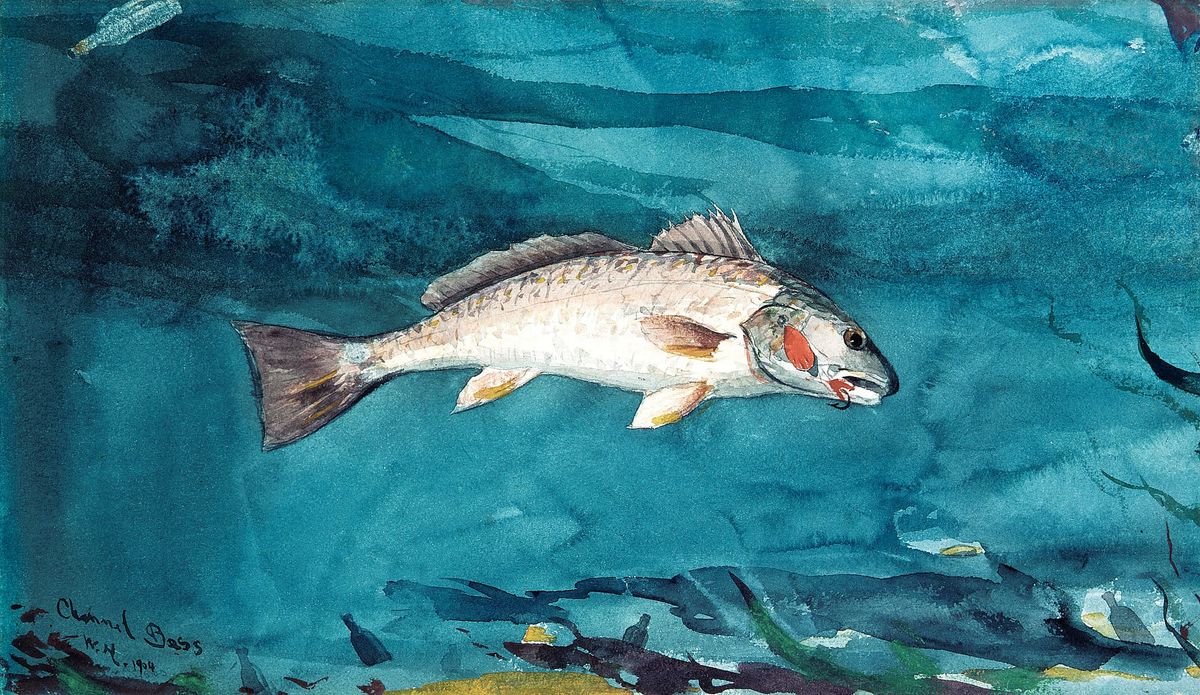
미국의 전설적인 사실주의 거장 윈슬로 호머(Winslow Homer, 1836–1910)가 생애 말년인 1904년에 완성한 수채화 명작 <채널 배스(Channel Bass / Red Drum)>는 바닷속 신비로운 물빛과 미끼를 문 거대한 물고기의 생동감 넘치는 찰나를 가장 대담하고 투명한 필치로 포착해 낸 수작입니다.
이 작품은 가로 49.5cm, 세로 28.6cm 크기의 고급 워브 종이 위에 흑연 연필로 윤곽을 섬세하게 구축한 후, 깊고 맑은 바다의 청록빛을 촉촉하게 스며들게 하는 웨트 온 웨트(wet-on-wet) 기법과 물감을 긁어내거나 닦아내어 물고기 비늘의 반짝임과 지느러미의 투명도를 극대화하는 정교한 수채 기법으로 제작되었습니다.
현재 미국 매사추세츠주 메트로폴리탄 미술관(The Metropolitan Museum of Art) 및 유수 아카이브에 영구 기록되어 있는 이 그림은 플로리다주 호모사사(Homosassa) 인근의 깊고 푸른 바닷속에서 붉은 아가미를 드러낸 채 낚싯바늘에 걸린 먹이를 삼키고 유영하는 대형 어종 채널 배스(홍점민어)의 역동적인 유영을 담고 있습니다.
이 그림에는 평생을 열렬한 낚시꾼으로 살아가며 물고기의 생태와 수중 세계의 빛에 매료되었던 호머의 깊은 관찰력과 유쾌한 인간적 에피소드가 깃들어 있습니다. 만년에 호머는 추운 메인주의 겨울을 피해 플로리다의 호모사사 강과 멕시코만 연안으로 낚시 여행을 떠나곤 했습니다.
호머는 단순히 물고기를 낚아 올리는 손맛에 머물지 않고, 투명한 물속에서 햇살이 부서질 때 물고기의 비늘이 뿜어내는 오묘한 색채 변화를 포착하기 위해 보트 바닥에 엎드려 수면 아래를 뚫어져라 관찰했습니다.
그는 갓 잡아 올린 채널 배스를 즉시 조리해 먹자는 낚시 가이드의 제안을 물리치고, 맑은 바닷물을 채운 큰 양동이에 물고기를 살려둔 채 햇빛 아래에서 반짝이는 은빛 비늘과 아가미의 선홍색을 관찰하며 신들린 듯 붓을 놀렸습니다.
물고기가 힘차게 꼬리를 쳐 양동이 물이 호머의 얼굴과 옷자락에 사방으로 튀자, 호머는 "이 녀석이 제 초상화가 마음에 안 든다고 시위를 하는군!"이라며 껄껄 웃고는 물에 젖은 스케치북 위에 푸른 물감을 번지게 하여 바닷속 대기감을 완성했다는 유쾌한 일화가 전해집니다.
그림의 구석을 자세히 살펴보면 해저 바닥과 수면 부근에 버려진 유리병들이 둥둥 떠 있거나 가라앉아 있는 모습을 볼 수 있는데, 이는 호머가 현장의 사실적인 디테일과 함께 인간 문명의 흔적이 닿은 바다의 풍경을 위트 있게 기록한 결과물입니다.
미술사학자들은 이 작품을 호머가 남긴 스포츠 및 야생 동물 수채화 연작 중에서도 조형적 긴장감과 수채 기법의 숙련도가 절정에 달한 걸작으로 평가합니다. 수면 위가 아닌 수중 시점(underwater perspective)을 과감하게 선택하여 물의 밀도감과 부유하는 빛을 표현한 구성은 당대 서양 회화에서 보기 드문 독창적이고 현대적인 시도로 찬사를 받습니다.
작품을 마주할 때 관람자의 무의식적인 시선은 매우 청량하고 유연한 수평 나선형 궤적을 그리며 이동합니다. 관람객의 눈길은 가장 먼저 화면 중앙을 당당하게 가로지르는 채널 배스의 은백색 몸체와 햇빛을 받아 반짝이는 등지느러미, 그리고 입가에 걸린 낚싯바늘의 붉은 미끼에 가닿습니다.
이어 시선은 물고기의 붉은 아가미 덮개와 유려한 꼬리지느러미의 힘찬 곡선을 따라 움직인 뒤, 물고기를 감싸고 있는 깊고 투명한 터키석 및 코발트블루빛 물결의 층위로 자연스럽게 번져 갑니다.
물의 흐름을 훑은 시선은 해저 바닥에 드리워진 짙은 해조류의 그림자와 푸른 유리병들의 실루엣을 지나, 화면 상단에서 부드럽게 일렁이는 수면의 빛줄기로 상승하며 깊은 바닷속의 아늑한 공간감을 완성합니다.
이러한 유려한 시선의 순환은 관람자의 내면에 깊은 심리적 정화와 시원한 해방감을 선사합니다. 눈이 시릴 만큼 맑고 투명한 청록색 수중 세계의 고요함은 복잡한 일상의 소음과 답답한 스트레스에 지친 현대인의 무의식에 마치 시원한 물속으로 잠수해 들어간 듯한 청량한 카타르시스와 마음의 이완을 제공합니다.
바닷속을 거침없이 유영하며 생명력을 뿜어내는 물고기의 굳센 자태는, 보는 이에게 번잡한 잡념을 씻어내고 자신의 내면에 잠재된 유연한 에너지와 맑은 평온을 되찾아 주는 든든한 치유의 위로를 선물합니다.
Channel Bass
Completed in 1904 by the celebrated American realist master Winslow Homer (1836–1910), the watercolor masterpiece Channel Bass (also widely known as Red Drum) stands as an extraordinary tour de force capturing the luminous mystery of the underwater realm and the primeval vitality of a game fish with breathtaking clarity.
Measuring 49.5 cm wide by 28.6 cm high on fine wove paper, the work showcases Homer's consummate watercolor technique through fluid wet-on-wet washes of deep aquamarine, deliberate scraping to articulate the tactile sheen of fish scales, and subtle lifting that conveys the translucent glow of water filtered by natural sunlight.
Preserved and celebrated in the prestigious permanent collection of The Metropolitan Museum of Art and prominent national archives, this painting dramatically portrays a large channel bass gliding through the crystalline ocean depths off Homosassa, Florida, its gills flared in vibrant vermilion as it takes a hooked bait.
Behind this captivating aquatic composition lies Homer's lifelong passion for angling and a delightful array of personal anecdotes. In his later years, seeking respite from the harsh Maine winters, Homer frequently journeyed to the warm waters of Florida, exploring the untamed rivers and Gulf coast with rod and sketchbook in hand.
Homer was not merely interested in the thrill of the catch; he was profoundly fascinated by the fluid dynamics of light refracting through moving water and the iridescent colors of living fish.
Rather than allowing his fishing guide to prepare the prized catch for dinner, Homer kept the spirited fish in a sea-filled live well, eagerly observing the shifting silver and copper reflections along its flanks under the midday sun.
When a sudden thrash of the fish's tail sent a shower of saltwater across Homer's palette and clothing, the master laughed heartily, joking that the fish was lodging a wet protest against its portrait, while using the splashed drops to enrich the atmospheric washes upon his paper.
A careful examination of the seabed and upper margins reveals submerged glass bottles resting in the weeds, a witty, authentic detail through which Homer subtly integrated the understated presence of human leisure within the wild coastal environment.
Art historians celebrate this painting as a definitive pinnacle of Homer's late sporting watercolors, praising its revolutionary underwater vantage point. By plunging the viewer directly beneath the surface to witness the interplay of liquid density and aquatic life, Homer established an extraordinarily modern visual perspective that prefigured twentieth-century realism.
When engaging with the painting, the viewer's unconscious gaze undertakes an inherently refreshing and centering visual journey. The eye is initially seized by the powerful, horizontal silhouette of the bass at the center, resting upon the warm silver-white scales and the brilliant flash of scarlet at the hook and gills.
The gaze then travels along the muscular sweep of the body toward the broad tail fin, before diffusing outward into the enveloping layers of turquoise, teal, and deep ultramarine washes.
Drifting across the shadowed sea grasses and submerged bottles resting along the ocean floor, the viewer's attention rises toward the gentle, undulating light playing across the upper water surface, absorbing the serene spatial depth of the aquatic sanctuary.
This rhythmic visual journey fosters profound psychological reassurance, mental lightness, and deep emotional clarity within the observer. The pristine aquatic palette acts as an intuitive emotional balm, dispelling ambient modern fatigue and cooling inner tension.
By presenting a solitary creature navigating the silent depths with effortless strength and grace, Homer offers the observer a comforting sanctuary of mindfulness, inspiring a deep sense of resilience, inner equilibrium, and enduring peace.
본 리뷰에서 작품을 제외한 컨텐츠의 저작권은 팔렛트제주에 있습니다.
"퍼블릭도메인 고전명화"를 제외한 모든 창작 콘텐츠는 저작권법 제4조 및 제10조에 의거하여 보호됩니다. 무단 도용시 저작권법 제136조(벌칙)에 의거, 당사의 사전 서면 승인 없는 저작권 침해 행위를 금지합니다.