부서지는 파도 (프라우츠 넥의 거센 파도) - Breaking Wave / Prout's Neck, Breakers
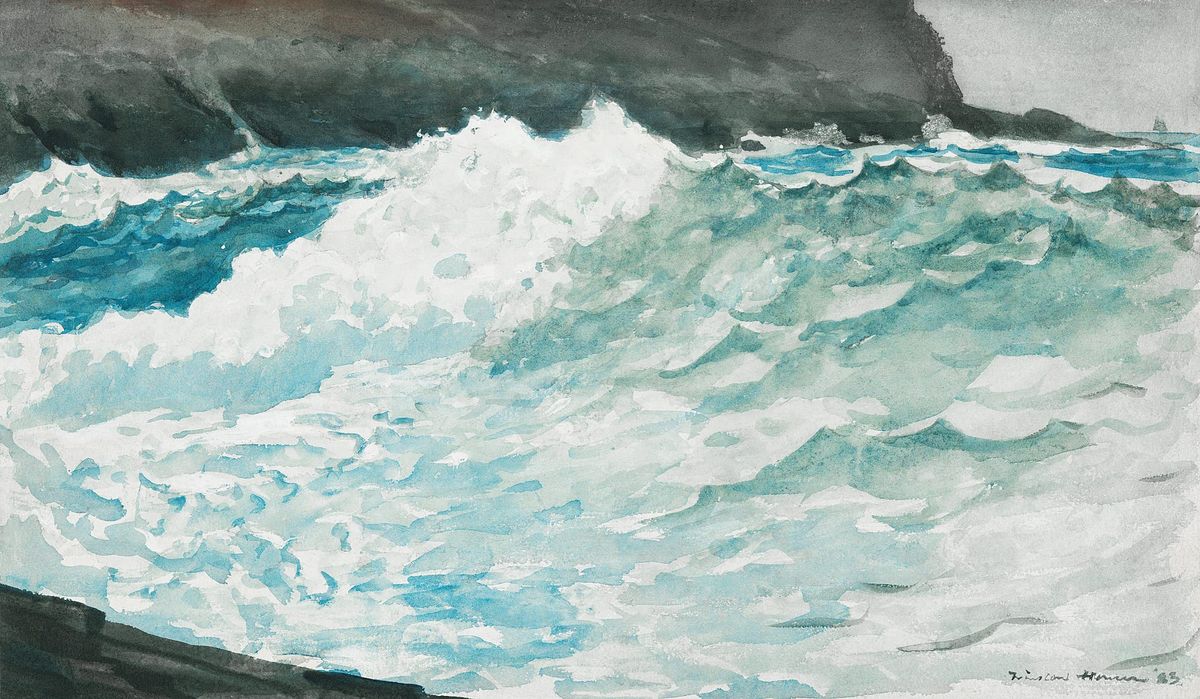
미국의 전설적인 사실주의 거장 윈슬로 호머(Winslow Homer, 1836–1910)가 1883년에 완성한 수채화 명작 <부서지는 파도(Breaking Wave / Prout's Neck, Breakers / The Surf)>는 거친 북대서양의 비바람 속에서 검푸른 화강암 암초를 향해 맹렬하게 솟구쳐 오르며 눈부신 하얀 포말로 부서지는 파도의 압도적인 운동감과 대자연의 호쾌한 숨결을 가장 청량하고 대담한 필치로 포착해 낸 수작입니다.
이 작품은 가로 약 54.6cm, 세로 약 35.6cm 크기의 고급 워브 종이 위에 흑연 연필로 거대한 파도의 능선과 해안 암벽의 묵직한 윤곽을 정갈하게 잡은 후, 투명 수채 물감의 유려한 번짐과 스며듦으로 짙은 먹빛 암벽과 청록빛 파도를 칠하고, 종이 본연의 밝은 흰 여백을 절묘하게 살려두며 날카로운 긁어내기 기법을 활용해 수면 위로 눈부시게 폭발하는 백색 포말과 은빛 물보라의 역동적인 질감을 극대화한 혼합 수채 기법으로 완성되었습니다.
현재 미국 주요 미술관 및 유수 프라이빗 컬렉션에서 높이 평가받는 이 그림은 메인주 프라우츠 넥(Prouts Neck)의 험준한 바위 해안에서, 거대한 너울성 파도가 검은 해안 절벽을 집어삼킬 듯 솟구쳐 하얗게 부서져 내리고 저 멀리 아스라이 희미한 돛단배의 실루엣이 스치는 장엄하고 생생한 대자연의 교향악을 담고 있습니다.
이 그림 뒤에는 1883년 메인주 프라우츠 넥의 절벽 끝에 바퀴 달린 이동식 화실을 짓고 정착하여 평생 바다의 초상화를 그리는 일에 헌신했던 호머의 치열한 예술혼과 유쾌한 인간적 비하인드가 깃들어 있습니다. 당시 호머는 사람들의 발길이 끊긴 거친 겨울 바닷가에서 오직 파도 소리와 바닷바람만을 벗 삼아 대자연의 순수한 에너지와 교감하는 작업에 깊이 몰두했습니다.
호머는 파도가 암초에 부딪히며 포말을 뿜어내는 찰나의 폭발력을 화폭에 담기 위해 방수 외투를 챙겨 입고 파도의 비말이 들이치는 바위턱에 이젤을 고정했습니다.
한창 거친 물마루를 칠하던 중 예상보다 훨씬 거대한 파도가 암벽을 치고 올라와 차가운 바닷물이 호머의 머리 위로 쏟아지며 스케치북과 팔레트를 흠뻑 적시는 아찔한 소동이 벌어졌습니다.
물에 젖은 수염을 닦아내며 털털하게 일어선 호머는 뒤에서 걱정스레 달려온 동생을 향해 "대서양이 내 그림에 직접 서명을 하고 싶었나 보군! 이보다 더 완벽한 바닷물의 터치가 어디 있겠는가!"라며 껄껄 웃음을 터뜨렸습니다. 호머는 젖은 종이 위로 자연스럽게 번져나가는 청록빛 물감의 질감과 하얀 여백의 조화를 놓칠세라 신나게 붓을 놀렸고, 화면 우측 하단 맑은 포말 위에 'Winslow Homer 83' 서명을 힘차게 새겨 넣었다는 감동적인 일화가 전해집니다.
화면 상단을 묵직하게 가로지르는 어두운 해안 절벽의 듬직한 능선과 화면 우측 먼 수평선에 아스라이 떠 있는 작은 돛단배의 고즈넉한 실루엣, 그리고 화면 가득 소용돌이치며 밀려오는 옥빛 물결의 디테일은 호머가 북대서양의 생생한 현장감을 얼마나 진솔하고 세심한 애정으로 관찰했는지를 증명합니다.
미술사학자들은 이 작품을 호머가 1883년 프라우츠 넥 정착 초기에 도달한 해양 수채화의 절대적인 분수령이자, 자연의 숭고한 힘을 완벽한 현대적 조형미로 승화시킨 대표 걸작으로 평가합니다.
인간의 구체적인 형상을 배제한 채 물과 바위, 공기의 순수한 물리적 충돌만으로 화면을 채워 극적인 긴장감을 유도했으며, 투명 수채화의 여백과 물 번짐을 통해 대자연의 영원한 생명력을 장엄한 시각 언어로 구현했다는 극찬을 받습니다.
작품을 마주할 때 관람자의 무의식적인 시선은 화면 좌측 상단에서 우측 하단으로 쏟아져 내리는 거대한 파도의 포물선을 따라 매우 시원하고 역동적인 순환 궤적을 그리며 이동합니다. 관람객의 눈길은 가장 먼저 화면 중앙 좌측에서 웅장한 백색으로 솟구쳐 오르는 거대한 물마루의 눈부신 포말과 맹렬한 파도의 정점에 사로잡힙니다.
이어 시선은 하얗게 부서지며 쏟아져 내리는 파도의 물기둥을 타고 화면 중앙의 짙푸른 에메랄드빛 소용돌이와 잔잔하게 갈라지는 청록색 물결의 맑은 층위로 자연스럽게 미끄러져 내려옵니다.
수면 위로 찰랑이는 은빛 윤슬의 질감을 확인한 시선은 화면 상단을 든든하게 받치고 있는 짙은 흑갈색 해안 암벽의 묵직한 양감을 타고 우측으로 이동하여, 먼 수평선 너머로 아스라이 스치는 작은 돛단배의 평화로운 실루엣에 닿습니다.
이후 시선은 화면 전경 좌측 하단을 묵직하게 가로막고 선 차가운 화강암 바위의 단면을 거쳐, 화면 전체를 시원하게 메운 은백색 거품의 청량한 흐름을 타고 다시 솟구쳐 오르는 거대한 파도의 중심부로 돌아와 깊고 아늑한 시각적 안착을 이룹니다.
이러한 유려한 시선의 순환은 관람자의 내면에 깊은 심리적 정화와 가슴 뻥 뚫리는 시원한 해방감을 선물합니다. 화면 가득 포효하며 부서지는 차가운 바닷물의 청량함과 거대한 파도의 생명력이 자아내는 공간감은, 복잡한 일상의 번잡함과 피로에 지친 현대인의 무의식에 묵은 스트레스와 답답함을 단숨에 씻어내는 짜릿한 카타르시스와 감각적 활력을 선사합니다.
거센 비바람과 파도의 습격 앞에서도 변함없이 굳건하게 자리를 지키는 거대한 바위와 끊임없이 약동하는 파도의 의연한 조화는, 보는 이에게 일상의 번뇌를 내려놓고 삶의 어떤 거센 풍파 앞에서도 당당하게 중심을 지켜낼 수 있는 내면의 단단한 용기와 맑은 평정을 되찾아 주는 든든한 치유의 위로를 건냅니다.
Breaking Wave / Prout's Neck, Breakers
Completed in 1883 by the celebrated American realist master Winslow Homer (1836–1910), the watercolor masterpiece Breaking Wave (also known as Prout's Neck, Breakers / The Surf) stands as an extraordinary tour de force capturing the kinetic power, crystalline freshness, and elemental drama of the North Atlantic surf with peerless atmospheric economy.
Measuring approximately 54.6 cm wide by 35.6 cm high on fine wove paper, the work showcases Homer's consummate mastery of transparent watercolor during his pivotal transition to coastal Maine, applying fluid wet-on-wet washes of deep Prussian blue, viridian, and charcoal across the churning swells, while utilizing sweeping reserves of pristine white paper and sharp scraping to articulate the detonating crest of sea foam and the wind-swept spray.
Preserved and celebrated across prominent public and private American art collections, this painting portrays the rocky coastline of Prouts Neck, Maine, where a massive emerald breaker rears against the dark granitic headland, collapsing into a magnificent cascade of white water beneath an overcast, storm-swept sky.
Behind this electrifying watercolor lies Homer's permanent move to the rugged Maine promontory in 1883, where he embraced a life of stoic solitude, dedicated to recording the unvarnished majesty of the ocean tides in all their seasonal power.
Setting up his portable sketching board along the spray-swept ledge to study the anatomy of breaking water, Homer observed the collision of the surf against the stone.
When an unexpected surge swept over the shelf and drenched his easel with cold sea spray, soaking his palette and paper, the artist rose with hearty laughter rather than dismay.
Wiping the brine from his beard, Homer called out to his brother that the Atlantic had simply insisted on contributing its own authentic touch to the composition. Homer worked with electric speed to harness the natural dispersion of wet pigment and open paper, capturing the living breath of the surging tide before proudly signing 'Winslow Homer 83' across the translucent foam in the lower right foreground.
The dense charcoal wall of the rocky cliff anchoring the upper register, the faint silhouette of a solitary sail gliding along the far right horizon, and the swirling ribbons of pale turquoise water cascading across the foreground serve as authentic testaments to Homer's deeply observant eye for the monumental poetry of the sea.
Art historians celebrate this painting as a defining pinnacle of Homer's early Maine watercolor oeuvre, praising its breathtaking compositional balance and modern chromatic vitality. By omitting anecdotal narrative to concentrate purely upon the sacred dialogue between water, stone, and wind, Homer created an enduring visual sanctuary of elemental energy, existential fortitude, and contemplative peace.
When engaging with the painting, the viewer's unconscious gaze undertakes an intensely refreshing and stabilizing visual journey. The eye is initially seized by the towering crest of frothing white water exploding in the upper left, lingering upon the turbulent eruption of sea spray rising against the dark cliff.
The gaze then cascades smoothly downward along the churning curtain of translucent foam into the deep emerald and cobalt trough in the center, tracing the undulating rhythm of the advancing swell.
Sweeping toward the right where the wave crest dissolves into lighter ripples and discovering the ghostlike sail resting upon the pale horizon, the viewer's attention descends across the dark granitic ledge anchoring the lower left foreground.
Finally, navigating through the intricate lace of pale blue washes and sunlit foam spreading across the foreground shallows, the eye settles comfortably back into the balanced, anchored equilibrium of the breaking wave.
This rhythmic visual journey fosters profound psychological reassurance, cathartic release, and deep emotional stillness within the observer. The tactile immersion in cool ocean spray, salty breezes, and the rhythmic roar of breaking water acts as an intuitive emotional balm, dispelling ambient modern fatigue and soothing inner tension.
By presenting an idyllic world where immovable stone and fluid vitality exist in pure harmony with eternal time, Homer offers the observer a comforting sanctuary of mindfulness, inspiring a deep sense of renewal, sweet contentment, and enduring inner peace.
본 리뷰에서 작품을 제외한 컨텐츠의 저작권은 팔렛트제주에 있습니다.
"퍼블릭도메인 고전명화"를 제외한 모든 창작 콘텐츠는 저작권법 제4조 및 제10조에 의거하여 보호됩니다. 무단 도용시 저작권법 제136조(벌칙)에 의거, 당사의 사전 서면 승인 없는 저작권 침해 행위를 금지합니다.