보트 위의 소년들 (글로스터 항구의 나룻배) - Boys in a Dory / Gloucester Harbor
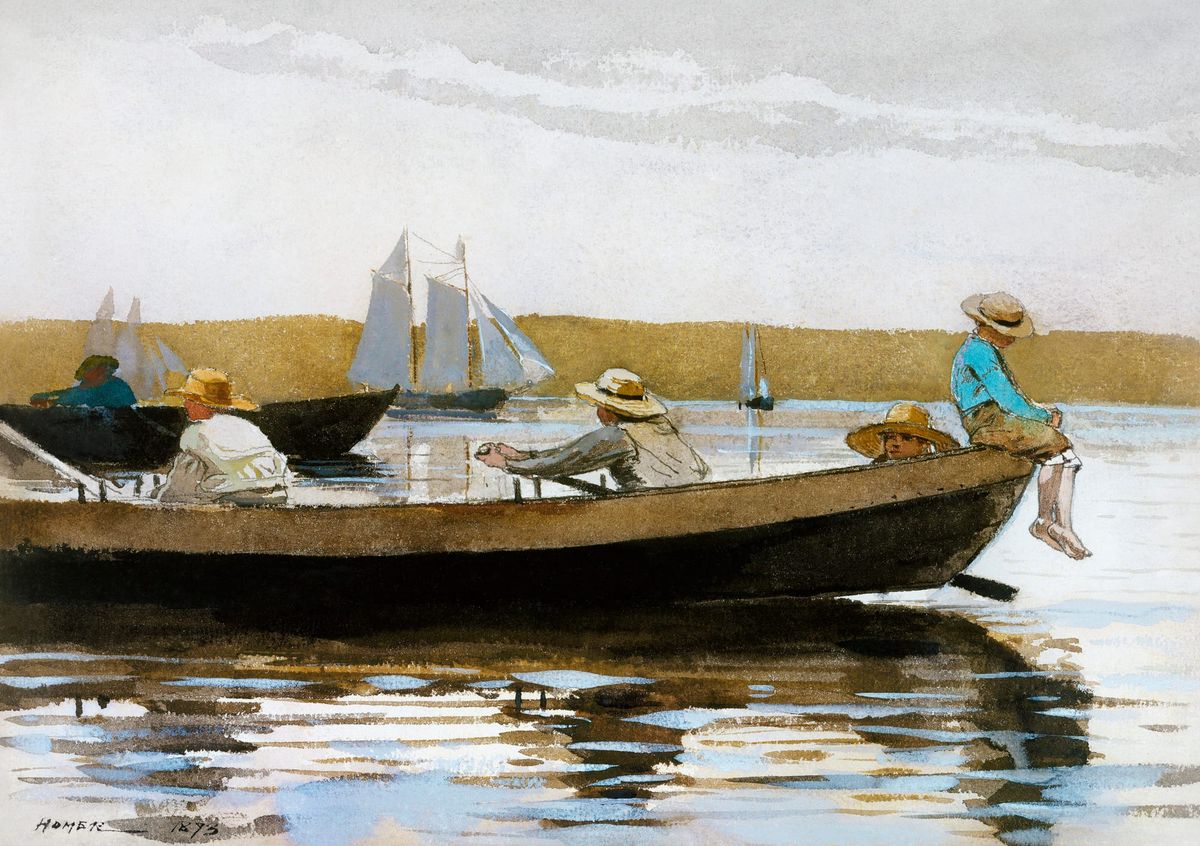
미국의 전설적인 사실주의 거장 윈슬로 호머(Winslow Homer, 1836–1910)가 1873년에 완성한 수채화 걸작 <보트 위의 소년들(Boys in a Dory / Gloucester Harbor)>은 은은한 햇살이 내려앉은 잔잔한 항구 바다 위에서 작은 목조 도리 보트에 몸을 싣고 한가로운 여름 한때를 즐기는 어촌 소년들의 순박한 동심과 평화로운 서정을 가장 맑고 따뜻한 필치로 포착해 낸 수작입니다.
이 작품은 가로 약 35.6cm, 세로 약 24.8cm 크기의 고급 워브 종이 위에 흑연 연필로 보트와 인물들의 윤곽을 정갈하게 잡은 후, 투명 수채 물감의 유려한 번짐과 스며듦으로 은은한 바다 안개와 잔잔한 물결을 칠하고, 종이 본연의 밝은 흰 여백을 절묘하게 남겨두어 하얀 돛단배와 소년들의 셔츠, 그리고 수면 위로 찰랑이는 은빛 윤슬의 반사광을 극대화한 혼합 수채 기법으로 제작되었습니다.
현재 미국 주요 미술관 및 유수 프라이빗 컬렉션에서 높이 평가받는 이 그림은 매사추세츠주 글로스터(Gloucester) 항구의 잔잔한 만에서, 밀짚모자를 쓴 네 명의 소년들이 나무 나룻배에 나란히 앉아 노를 젓거나 뱃머리에 걸터앉아 맨발을 물가에 드리운 채 수평선에 떠 있는 범선들을 바라보는 서정적인 순간을 담고 있습니다.
이 그림 뒤에는 1873년 여름 글로스터에 머물며 수채화라는 매체의 신선한 매력에 흠뻑 빠졌던 호머의 따뜻한 시선과 흥미진진한 비하인드가 깃들어 있습니다. 당시 호머는 거친 파도와 싸우는 어부들의 삶뿐만 아니라, 바다를 놀이터 삼아 자라나는 바닷가 아이들의 티 없이 맑은 일상에 깊은 시각적 애정을 품고 있었습니다.
호머는 물결 위에 떠 있는 보트의 묵직한 그림자와 아이들의 자연스러운 자세를 스케치하기 위해 부둣가 바위턱에 이젤을 세웠습니다. 뱃머리 끝에 걸터앉아 맨발을 흔들던 파란 셔츠의 소년이 물속에 비친 자기 그림자를 발가락으로 툭툭 건드리다가 중심을 잃고 물에 빠질 뻔하자, 노를 잡고 있던 소년이 다급하게 옷자락을 낚아채며 "조심해! 바다에 빠지면 물고기들이 네 발가락을 미끼인 줄 알고 물어뜯을 거야!"라고 외쳐 아이들이 일제히 웃음을 터뜨리는 유쾌한 소동이 벌어졌습니다.
그 모습을 지켜보던 호머는 껄껄 웃으며 "잠깐, 그대로 있게! 물결 위로 살랑이는 자네의 그 맨발과 파란 셔츠야말로 오늘 여름 바다가 내 종이 위에 선물한 가장 맑은 동심의 보석이라네!"라며 환호했습니다. 호머는 아이들의 순수한 웃음과 물결 위에 어른거리는 보트의 그림자를 번개처럼 종이 위에 포착해 냈고, 화면 좌측 하단 찰랑이는 물빛 위에 'HOMER 1873' 서명을 힘차게 새겨 넣었다는 훈훈한 일화가 전해집니다.
화면 뒤편으로 아스라이 떠 있는 흰 돛단배들의 고즈넉한 실루엣과 황금빛 언덕 능선, 그리고 전경의 맑은 바닷물 위에 투명하게 일렁이는 푸른 하늘의 반사광은 호머가 북미 해안의 여름 정취를 얼마나 진솔하고 세심한 애정으로 관찰했는지를 증명합니다.
미술사학자들은 이 작품을 호머가 1873년 글로스터 체류 시절에 이룩한 초기 수채화 혁신의 대표 걸작이자, 훗날 완성된 불후의 유화 명작 <순풍을 안고(Breezing Up)>의 서정적 모태가 된 수작으로 평가합니다.
프랑스 인상주의보다 앞서 대낮의 은은한 자연광과 물의 투명한 광학적 반사를 수채화의 맑은 여백으로 완벽히 포착했으며, 평범한 바닷가 아이들의 휴식을 순수한 동심과 평화로운 자연의 조화가 깃든 시각적 안식처로 승화시켰다는 극찬을 받습니다.
작품을 마주할 때 관람자의 무의식적인 시선은 보트의 길고 완만한 수평선을 따라 매우 안정적이고 포근한 좌우 순환 궤적을 그리며 이동합니다. 관람객의 눈길은 가장 먼저 화면 우측 뱃머리에 얹혀 다리를 대롱거리며 앉아 있는 파란 셔츠 소년의 단아한 옆모습과 밀짚모자에 머뭅니다.
이어 시선은 뱃머리 안쪽에서 얼굴을 빼꼼 내민 귀여운 소년과 중앙에서 노를 잡고 힘을 주는 사공 소년의 듬직한 등줄기를 타고 화면 좌측으로 자연스럽게 미끄러져 갑니다.
선미에서 하얀 셔츠를 입고 조용히 바다를 응시하는 또 다른 소년과 그 뒤편 검은 보트의 실루엣을 확인한 시선은, 보트 아래로 길고 짙게 드리워진 청록빛 물 그림자와 수면 위로 찰랑이며 반짝이는 은빛 윤슬의 맑은 파문을 훑어 내려옵니다.
이후 시선은 수평선 너머로 평화롭게 항해하는 두 척의 하얀 범선과 황금빛으로 물든 해안 구릉을 지나, 화면 상단을 은은하게 감싸 안은 맑은 여름 하늘로 상승한 뒤, 다시 뱃머리 소년의 맨발로 돌아와 완전하고 아늑한 시각적 안착을 이룹니다.
이러한 유려한 시선의 순환은 관람자의 내면에 깊은 심리적 안정감과 포근한 유년의 향수를 선물합니다. 잔잔한 물결이 자아내는 고요함과 따스한 여름 햇살의 공간감은, 복잡한 일상의 번잡함과 피로에 지친 현대인의 무의식에 마치 시원한 나룻배에 누워 찰랑이는 물소리를 듣는 듯한 깊은 이완과 감각적 휴식을 선사합니다.
세상의 번잡함을 잊은 채 대자연의 품속에서 친구들과 함께 잔잔한 바다를 유영하는 소년들의 순수한 자태는, 보는 이에게 일상의 번뇌를 내려놓고 삶의 가장 소박하고 맑은 행복과 내면의 깊은 평정을 되찾아 주는 든든한 치유의 위로를 건냅니다.
Boys in a Dory / Gloucester Harbor
Completed in 1873 by the celebrated American realist master Winslow Homer (1836–1910), the watercolor masterpiece Boys in a Dory (also known as Gloucester Harbor) stands as an extraordinary tour de force capturing the sunlit tranquility, seaside innocence, and unhurried charm of nineteenth-century American coastal youth.
Measuring approximately 35.6 cm wide by 24.8 cm high on fine wove paper, the work showcases Homer's refined command of transparent watercolor during his pivotal early period, laying down fluid wet-on-wet washes of pale cobalt, ochre, and warm slate across the calm harbor and distant hills, while utilizing untouched white paper reserves to articulate the sunlit schooner sails, the boys' shirts, and the shimmering sky reflections dancing over the glassy water.
Preserved and celebrated across prominent public and private American art collections, this painting portrays a peaceful summer morning in Gloucester, Massachusetts, where four young boys in broad straw hats drift leisurely aboard a wooden fishing dory, resting upon their oars and dangling their bare feet over the bow beneath a luminous sky.
Behind this delightful watercolor lies Homer's transformative summer of 1873 in Gloucester, where he first embraced watercolor as a serious exhibition medium, deeply captivated by the carefree camaraderie of harbor children whose playground was the tidal sea.
Setting up his field stool along the rocky shoreline to record the interplay of soft coastal light and aquatic reflections, Homer observed the lads adrift in the calm shallows.
When the boy perched upon the bow leaned over to stir his reflection with his bare toes and nearly lost his balance, the youth at the oars quickly caught his shirt with a laugh, warning him that the crabs below were waiting for a nibble.
Amused by their lively exchange, Homer laughed heartily, reassuring them that the dangling bare feet and the vibrant blue shirt were the finest touches of nature that an artist could ever welcome onto his paper. Homer swiftly applied fluid washes of indigo, amber, and viridian to capture the unposed rhythm of the boat and its deep shadow cast across the water, proudly inscribing 'HOMER 1873' in the lower left foreground.
The pale white sails of passing schooners gliding across the distance, the warm ochre bluffs framing the harbor, and the soft calligraphic ripples breaking across the foreground shallows stand as authentic testaments to Homer's deeply observant eye for the pastoral poetry of coastal life.
Art historians celebrate this painting as a defining highlight of Homer's early mature watercolor oeuvre and a crucial developmental study leading toward his celebrated 1876 oil masterpiece Breezing Up. By elevating an everyday harbor pastime into a harmonious meditation on youth and nature, Homer created an enduring visual sanctuary of atmospheric purity, innocent wonder, and contemplative peace.
When engaging with the painting, the viewer's unconscious gaze undertakes an inherently soothing and grounding visual journey. The eye is initially welcomed by the sun-drenched silhouette of the barefoot boy perched upon the bow on the right, lingering upon his straw hat, vivid cerulean shirt, and relaxed posture.
The gaze then travels smoothly along the dark wooden gunwale of the dory toward the left, discovering the peeking face of the young boy nestled in the hull and the sturdy form of the rower grasping his oars.
Following the line of figures to the boy in the crisp white shirt resting at the stern, the viewer's attention descends into the deep, transparent water reflections and the delicate blue ripples lapping against the hull in the foreground.
Finally, ascending toward the distant white schooners drifting peacefully beneath the pale, sun-warmed sky and the golden bluffs on the horizon, the eye settles comfortably back into the innocent, anchored fellowship of the children.
This rhythmic visual journey fosters profound psychological reassurance, gentle nostalgia, and deep emotional stillness within the observer. The tactile immersion in warm sunshine, gentle harbor swells, and fresh sea air acts as an intuitive emotional balm, dispelling ambient modern fatigue and soothing inner tension.
By presenting an idyllic world where youthful trust flourishes in pure harmony with the rhythm of the tides, Homer offers the observer a comforting sanctuary of mindfulness, inspiring a deep sense of renewal, sweet contentment, and enduring inner peace.
본 리뷰에서 작품을 제외한 컨텐츠의 저작권은 팔렛트제주에 있습니다.
"퍼블릭도메인 고전명화"를 제외한 모든 창작 콘텐츠는 저작권법 제4조 및 제10조에 의거하여 보호됩니다. 무단 도용시 저작권법 제136조(벌칙)에 의거, 당사의 사전 서면 승인 없는 저작권 침해 행위를 금지합니다.