보트 안의 남자 - Man in a Punt
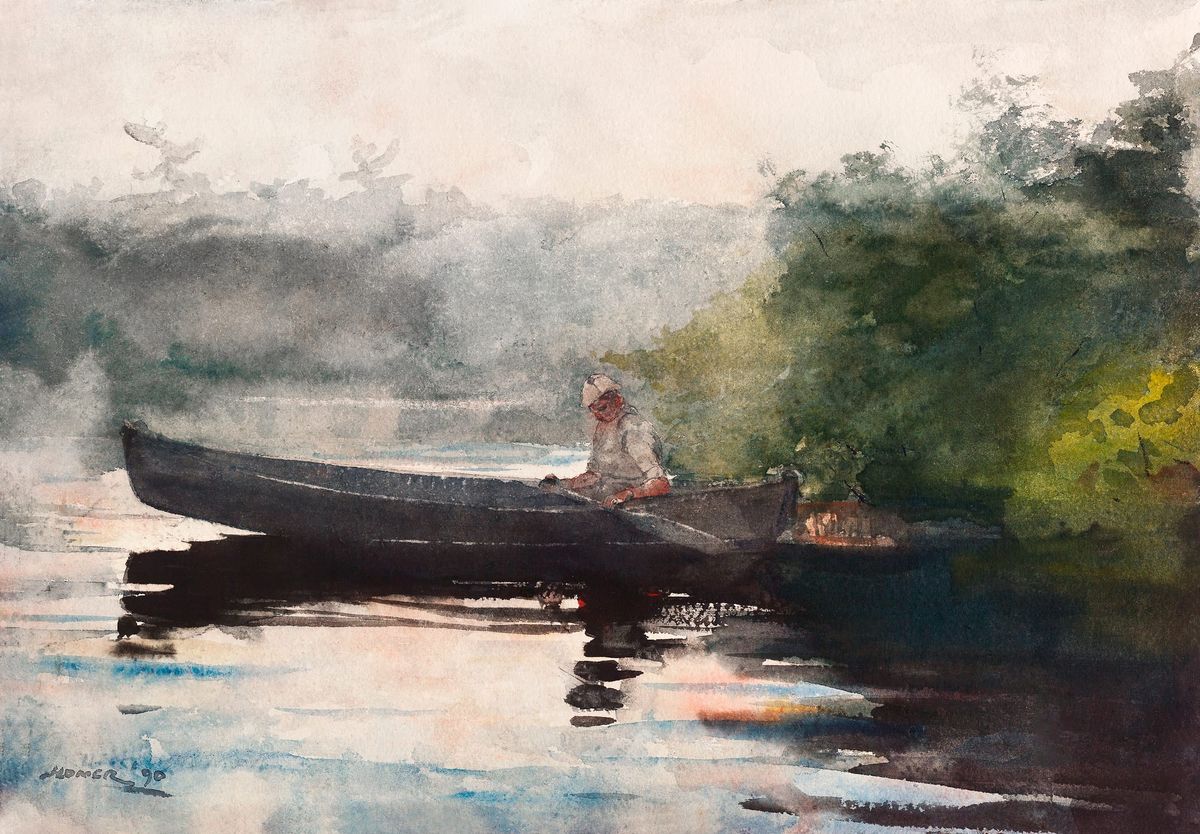
미국의 위대한 사실주의 거장 윈슬로 호머(Winslow Homer, 1836–1910)가 1890년에 완성한 수채화 걸작 <보트 안의 남자(Man in a Punt)>는 수채화라는 매체가 도달할 수 있는 가장 맑고 투명한 빛의 감각을 증명하는 대표작입니다.
이 작품은 가로 50.8cm, 세로 35.3cm 크기의 두툼한 고급 워브 종이 위에 투명 수채 물감을 겹겹이 스며들게 하는 웨트 온 웨트(wet-on-wet) 기법과 정교한 블로팅(blotting), 그리고 종이의 흰 여백을 그대로 살려 햇살을 표현하는 기법을 자유자재로 구사하여 제작되었습니다.
현재 미국 시카고 미술관(The Art Institute of Chicago)에 소장되어 있는 이 그림은 자욱한 아침 안개가 피어오르는 울창한 숲속 수면 위에서 평저선(Punt)에 앉아 조용히 노를 젓는 한 남자의 고요한 아침 풍경을 시적으로 담아내고 있습니다.
이 작품의 배경에는 대자연의 원시적인 순수함과 낚시를 지독하게 사랑했던 호머의 인간적인 열정이 깊숙이 배어 있습니다. 1870년대부터 뉴욕주 북부의 깊은 숲인 애디론댁(Adirondacks) 산맥을 자주 찾았던 호머는 1889년 노스 리버 낚시 클럽(North River Game and Trout Club)의 정식 회원이 되면서 본격적으로 이 야생의 호수와 숲을 화폭에 담기 시작했습니다.
호머는 유명세를 피해 인적이 드문 깊은 숲속에 머물며 현지 산림 가이드들과 함께 먹고 자는 생활을 즐겼습니다. 그의 낚시 가이드들은 호머가 한 손에는 낚싯대를 쥐고 다른 한 손에는 휴대용 수채화 도구를 든 채, 물고기가 입질을 멈춘 짧은 순간마다 맹렬하게 붓을 놀리던 기인으로 기억했습니다.
그는 날씨가 궂거나 안개가 짙게 깔린 날에도 주저 없이 작은 보트를 띄웠으며, 안개가 햇빛에 증발하며 공기 중에 흩어지는 찰나의 은은한 광채를 포착하기 위해 물기가 채 마르지 않은 종이 위에 과감하게 붓질을 이어갔습니다.
당대 평단에서는 호머의 유화보다도 애디론댁에서 탄생한 수채화들을 더욱 격찬했습니다. 정형화된 아카데미즘 미술의 틀에서 완전히 벗어나 물과 종이, 물감이 만들어내는 자연스러운 번짐을 통해 야생의 공기감과 빛을 완벽하게 재현했기 때문입니다.
후대의 미술사학자들은 이 작품을 호머의 원숙한 수채화 기교가 정점에 달한 순간으로 평가하며, 복잡한 인공적 장식을 걷어내고 자연과 인간이 나누는 가장 순수하고 사색적인 교감을 담아낸 미국 풍경화의 정수라고 찬사를 보냅니다.
작품을 마주할 때 관람자의 무의식적인 시선은 물결의 반짝임과 짙은 녹음 사이를 유영하며 깊은 안정의 궤적을 그립니다. 관람객의 눈길은 가장 먼저 화면 중앙에서 부드러운 아침 햇살을 받고 있는 보트 속 남자의 단정한 실루엣과 그가 쥐고 있는 노의 사선 구도에 머뭅니다.
이어 시선은 배 아래로 짙게 드리워진 묵직한 그림자와 그 곁으로 영롱하게 번져 나가는 푸른 수면의 반영을 따라 자연스럽게 내려갑니다. 물결을 타고 흐르던 시선은 이내 오른쪽 화면을 풍성하게 채우고 있는 짙은 초록빛의 수풀을 훑으며 피톤치드 가득한 숲의 생명력을 감각하게 합니다.
마지막으로 시선은 아득하게 번져 있는 배경의 은빛 안개와 숲의 능선으로 부드럽게 상승하며, 화면 전체를 감싸는 고요한 공기 속에 완전히 몰입하게 됩니다.
이러한 유려한 시선의 순환은 관람자의 내면에 깊은 심리적 해방감과 내적 평온을 선사합니다. 복잡한 소음과 시각적 자극에 지친 현대인의 무의식에 잔잔한 수면의 파동과 숲의 안개가 스며들며, 마치 깊은 숲속 호숫가에서 혼자 맑은 공기를 들이마시는 듯한 정서적 정화 작용을 일으킵니다.
배를 타고 잔잔한 물결 위를 미끄러져 가는 주인공의 흔들림 없는 침묵은 관람자에게 번잡한 일상을 잠시 멈추고 자신의 내면을 고요히 응시할 수 있는 따뜻한 쉼과 심리적 치유의 시간을 선물합니다.
Man in a Punt
Completed in 1890 by the legendary American realist master Winslow Homer (1836–1910), the watercolor masterpiece Man in a Punt stands as an extraordinary testament to the purity of light and fluidity achievable through the watercolor medium.
Measuring 50.8 cm wide by 35.3 cm high on heavy ivory wove paper, the work showcases Homer's virtuoso technical brilliance through saturated wet-on-wet washes, exquisite blotting, and the deliberate preservation of the bare white paper to capture dazzling reflections of morning light.
Currently housed in the prestigious permanent collection of The Art Institute of Chicago, this painting poetically portrays a solitary man gently maneuvering a punt across a tranquil Adirondack waterway shrouded in rising morning mist.
Behind this serene composition lies Homer's passionate love for untamed nature and his lifelong dedication to the art of fly-fishing. Having visited the pristine wilderness of the Adirondack Mountains in upstate New York since the 1870s, Homer became a charter member of the North River Game and Trout Club in 1889, immersing himself in the rugged beauty of secluded lakes and ancient forests.
Seeking refuge from metropolitan society, Homer lived alongside local woodsmen and fishing guides who fondly remembered him as an eccentric master holding a fishing rod in one hand and a portable watercolor box in the other, painting furiously whenever the trout ceased biting.
He frequently launched his small punt into the water during misty dawns and overcast mornings, eager to seize the fleeting atmospheric radiance as sunlight slowly dissolved the damp vapor across the lake.
Contemporary critics often celebrated Homer's Adirondack watercolors with even greater fervor than his grand oil canvases, admiring how his fluid washes transcended academic conventions to render the palpable atmosphere and moisture of the wilderness.
Modern art historians recognize this work as the absolute zenith of Homer's mature watercolor technique, praising it as an quintessential American landscape that captures the most intimate, contemplative harmony between mankind and the primeval natural world.
When engaging with the painting, the viewer's unconscious gaze follows an inherently restorative and rhythmic pathway across the luminous water. The eye is initially drawn to the poised figure of the boatman resting softly within the warm morning light, guided along the gentle diagonal slant of his paddle.
The gaze then descends into the rich, dark reflection beneath the hull and wanders through the rhythmic ribbons of transparent blue and coral washes dancing upon the water's surface. Moving organically from the water, the viewer's attention travels up through the lush, dense greens of the riverbank foliage, awakening a visceral sensation of wild forest vitality.
Finally, the eyes drift into the ethereal silver mist enveloping the distant tree line, settling into a state of expansive visual tranquility.
This fluid movement fosters a profound sense of psychological release and emotional restoration within the observer. The quiet ripples and atmospheric haze gently permeate the restless subconscious, offering a restorative pause akin to drawing a deep breath of crisp mountain air beside a silent lake.
The boatman's peaceful voyage across the placid water invites the viewer to step away from the relentless friction of daily existence, discovering a profound sanctuary of inner stillness, mindfulness, and enduring composure.
본 리뷰에서 작품을 제외한 컨텐츠의 저작권은 팔렛트제주에 있습니다.
"퍼블릭도메인 고전명화"를 제외한 모든 창작 콘텐츠는 저작권법 제4조 및 제10조에 의거하여 보호됩니다. 무단 도용시 저작권법 제136조(벌칙)에 의거, 당사의 사전 서면 승인 없는 저작권 침해 행위를 금지합니다.