베리 따는 아이들 - Berry Pickers
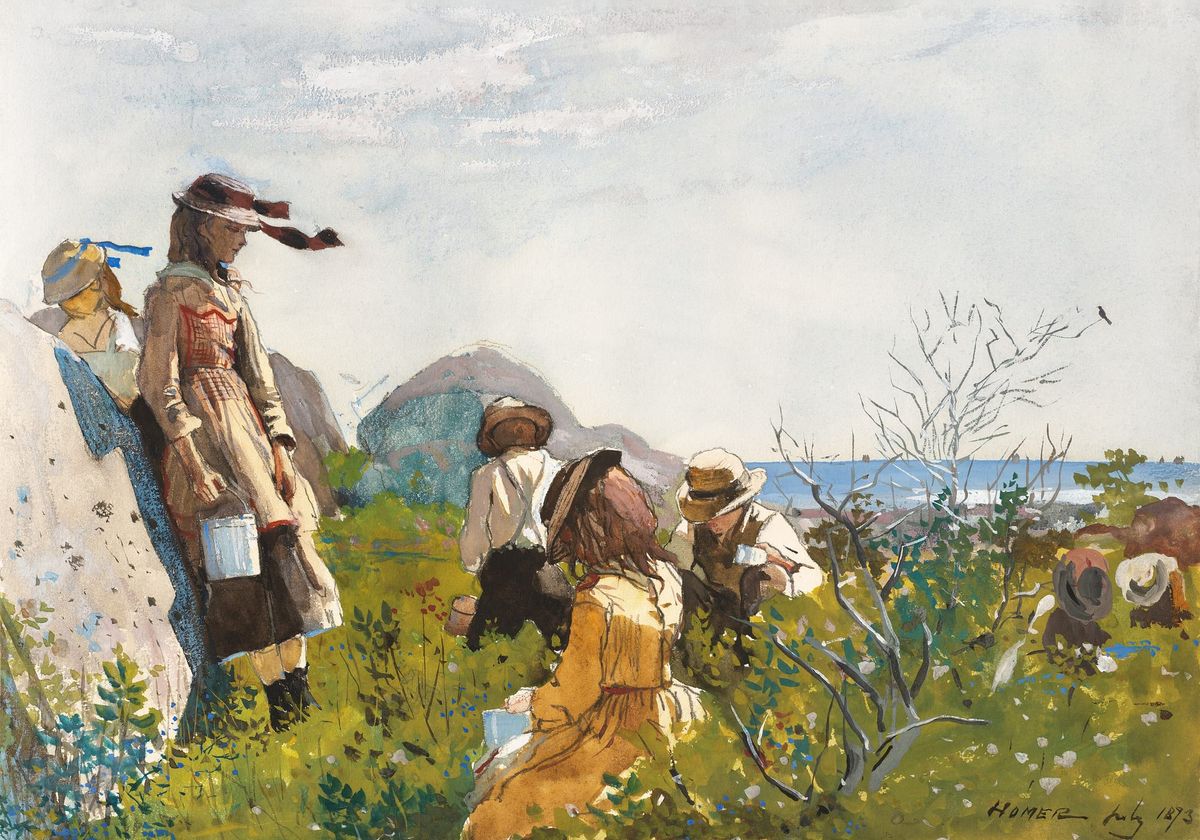
미국의 전설적인 사실주의 거장 윈슬로 호머(Winslow Homer, 1836–1910)가 1873년에 완성한 투명 수채화 명작 <베리 따는 아이들(Berry Pickers / Children on a Grassy Knoll)>은 19세기 미국 뉴잉글랜드 해안 언덕의 눈부신 여름 햇살과 순수한 유년 시절의 노스탤지어를 가장 생동감 넘치고 맑은 필치로 포착해 낸 수작입니다.
이 작품은 가로 약 35.0cm, 세로 약 24.0cm 크기의 고급 워브 종이 위에 흑연 연필로 윤곽을 섬세하게 구축한 후, 투명 수채 물감을 촉촉하게 스며들게 하는 웨트 온 웨트(wet-on-wet) 기법과 불투명한 흰색 구아슈 물감 터치, 그리고 종이 본연의 밝은 여백을 살려 야생 베리 덤불과 언덕 바위의 눈부신 하이라이트를 극대화하는 혼합 수채 기법으로 제작되었습니다.
현재 미국 매사추세츠주 콜비 대학교 미술관(Colby College Museum of Art) 및 유수 미술 아카이브에서 소중히 다루어지는 이 그림은 매사추세츠주 글로스터(Gloucester)의 바닷가 풀밭 언덕에서 양철 들통을 들고 야생 베리를 따며 여름 한때를 보내는 소년 소녀들의 한가롭고 다정한 순간을 담고 있습니다.
이 그림 뒤에는 호머가 수채화라는 매체에 본격적으로 눈을 뜨고 그 매력에 흠뻑 빠져들었던 1873년 여름의 결정적인 순간과 유쾌한 인간적 에피소드가 깃들어 있습니다. 당시 호머는 글로스터의 항구 마을에 머물며 생애 처음으로 본격적인 수채화 연작을 시도하고 있었습니다.
당시 호머는 바닷바람이 불어오는 언덕길에서 손에 작은 깡통과 들통을 쥐고 야생 블루베리와 산딸기를 따러 다니는 동네 아이들의 천진난만한 모습에 완전히 매료되었습니다. 호머는 아이들에게 포즈를 부탁하며 "통에 베리를 가득 채울 때까지 모델을 서주면 두 배로 사주겠다"고 제안했습니다.
하지만 포즈를 취하던 아이들은 통에 베리가 모이기가 무섭게 입안으로 집어넣어 입술과 손가락이 온통 보랏빛으로 물들기 일쑤였습니다. 들통이 채워지지 않자 호머는 "너희들은 베리를 통에 담는 게 아니라 배 속에 담고 있구나!"라며 껄껄 웃었고, 아이들의 장난기 어린 표정과 모자끈이 바람에 흩날리는 찰나를 놓칠세라 신나게 붓을 놀렸다는 따뜻한 일화가 전해집니다.
화면 좌측 커다란 바위에 기대어 선 소녀의 밀짚모자 리본과 손에 든 양철통의 반짝임, 그리고 풀밭에 엎드려 열매를 찾는 아이들의 뒷모습은 호머가 현장의 싱그러운 생명력을 얼마나 진솔하게 포착했는지를 증명합니다.
미술사학자들은 이 작품을 호머가 수채화 거장으로 도약하는 서막을 알린 기념비적 명작으로 평가합니다.
프랑스 인상주의 화가들이 본격적인 전시를 열기 전이었음에도 불구하고, 투명한 야외 자연광과 맑은 공기감, 그리고 대담한 원색의 조화를 수채화로 완벽히 구현하여 미국 근대 수채화의 독자적인 지평을 열었다는 극찬을 받습니다.
작품을 마주할 때 관람자의 무의식적인 시선은 매우 설레고 따스한 지그재그 나선형 궤적을 그리며 이동합니다. 관람객의 눈길은 가장 먼저 화면 좌측 전경에서 하얀 바위에 등을 기대고 햇살을 받으며 서 있는 소녀의 단아한 옆모습과 붉은 리본이 달린 밀짚모자에 머뭅니다.
이어 시선은 소녀의 손에 들린 반짝이는 양철통을 지나, 화면 중앙 풀밭에 앉아 노란 원피스를 입고 조심스레 손을 뻗는 소녀의 정겨운 뒷모습으로 자연스럽게 흘러갑니다.
이후 시선은 밀짚모자를 쓰고 덤불 속에 고개를 묻은 채 열매를 따는 소년들의 분주한 모습과 화면 우측의 바싹 마른 나뭇가지의 섬세한 선을 훑은 뒤, 저 멀리 푸른 바다의 수평선과 맑은 여름 하늘의 흰 구름으로 부드럽게 상승하며 탁 트인 시각적 해방감을 만끽하게 합니다.
이러한 유려한 시선의 순환은 관람자의 내면에 깊은 심리적 정화와 포근한 동심의 회복을 선사합니다. 풀잎 향기 가득한 언덕과 시원한 바닷바람이 어우러진 여름날의 정경은, 복잡한 일상의 긴장과 스트레스에 지친 현대인의 무의식에 마치 어린 시절 뛰어놀던 고향 언덕으로 돌아간 듯한 깊은 이완과 무장해제된 평온을 선물합니다.
세상의 번잡한 소란에서 벗어나 대지의 달콤한 결실을 함께 나누는 아이들의 순수한 모습은, 보는 이에게 번뇌를 내려놓고 삶의 가장 소박하고 맑은 행복과 따뜻한 생명력을 되찾아 주는 든든한 치유의 위로를 건넵니다.
Berry Pickers
Completed in 1873 by the legendary American realist master Winslow Homer (1836–1910), the watercolor masterpiece Berry Pickers (also celebrated as Children on a Grassy Knoll) stands as an extraordinary tour de force capturing the sun-drenched innocence, seaside breeze, and sweet nostalgia of nineteenth-century American youth.
Measuring approximately 35.0 cm wide by 24.0 cm high on fine wove paper, the work showcases Homer's breakthrough mastery of transparent watercolor, weaving delicate graphite underdrawing, luminous wet-on-wet washes across the sunlit knoll, and opaque gouache highlights that articulate the glittering tin pails, wildflower blooms, and wind-tossed ribbons.
Preserved and celebrated across major American fine art institutions including the Colby College Museum of Art, this painting portrays a group of children scattered across a coastal pasture in Gloucester, Massachusetts, leisurely gathering wild berries in tin pails against the blue expanse of the ocean.
Behind this delightful composition lies Homer's pivotal summer of 1873, when he first fully embraced watercolor as a primary expressive medium. Living among the fishermen and seaside families of Gloucester, Homer found endless inspiration in the uninhibited rhythms of local children playing upon the breezy bluffs.
Homer hired the local boys and girls to pose among the berry brambles, promising to buy their collected harvest once the painting session was finished.
However, the mischievous youngsters eagerly ate the berries as quickly as they picked them, staining their lips and fingers in deep violet hues.
Finding the pails half-empty, Homer laughed heartily, teasing the children that they were harvesting berries into their stomachs rather than their buckets, while swiftly dabbing vibrant colors onto the paper to capture their unposed laughter and fluttering straw hats.
The girl leaning gracefully against the pale boulder with her tin pail, alongside the seated figures nestled in the golden-green turf, reflects Homer's tender and observant eye for authentic childhood joy.
Art historians celebrate this painting as a monumental milestone that revolutionized American watercolor painting. Created even before French Impressionism gained widespread recognition, Homer's fresh handling of outdoor illumination, saturated tones, and crisp coastal atmosphere elevated everyday childhood recreation into a timeless visual monument of American pastoral purity.
When engaging with the painting, the viewer's unconscious gaze undertakes an inherently refreshing and uplifting visual journey. The eye is initially welcomed by the graceful silhouette of the standing girl on the left, lingering upon the fluttering crimson ribbons of her bonnet and the bright metallic gleam of her pail.
The gaze then travels downward into the rich green slope, meeting the seated girl in the warm ochre dress as she reaches into the berry patch, before wandering among the straw-hatted boys scattered through the brush.
Sweeping past the delicate, calligraphic branches of the dry shrub on the right, the viewer's attention expands across the deep cobalt horizon where the calm sea meets the soft, breezy clouds of the expansive summer sky.
This rhythmic visual journey fosters profound psychological reassurance, gentle nostalgia, and deep emotional clarity within the observer. The sensory immersion in coastal breezes, warm sunshine, and fragrant grasses acts as an intuitive emotional balm, dispelling modern stress and ambient fatigue.
By presenting an idyllic world where children and the fertile earth exist in unhurried, innocent harmony, Homer offers the observer a comforting sanctuary of mindfulness, inspiring a deep sense of renewal, sweet contentment, and enduring inner peace.
본 리뷰에서 작품을 제외한 컨텐츠의 저작권은 팔렛트제주에 있습니다.
"퍼블릭도메인 고전명화"를 제외한 모든 창작 콘텐츠는 저작권법 제4조 및 제10조에 의거하여 보호됩니다. 무단 도용시 저작권법 제136조(벌칙)에 의거, 당사의 사전 서면 승인 없는 저작권 침해 행위를 금지합니다.