아버지를 기다리며 (해변에서 아버지를 기다리는 가족) - Waiting for Dad / Dad's Coming!
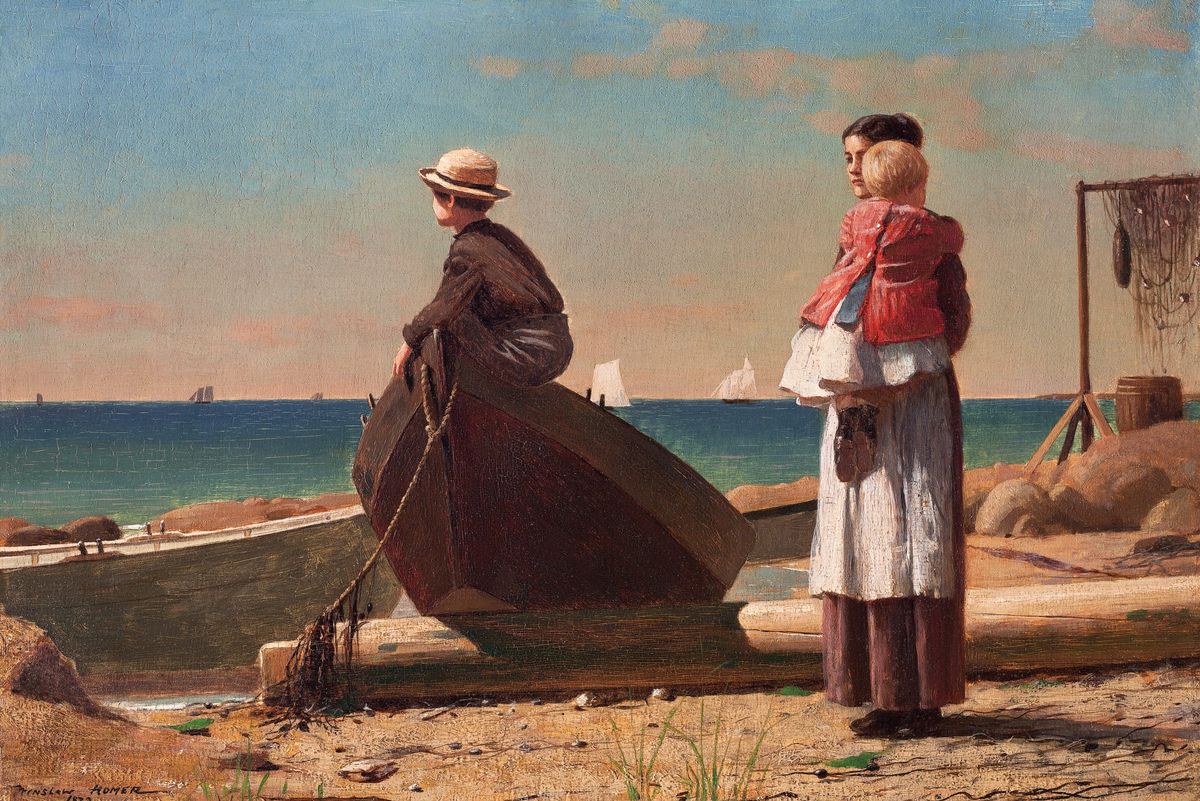
미국의 전설적인 사실주의 거장 윈슬로 호머(Winslow Homer, 1836–1910)가 1873년에 완성한 유화 걸작 <아버지를 기다리며(Waiting for Dad / Dad's Coming!)>는 햇살 부서지는 대서양 해변에서 바다로 나간 어부 아버지가 탄 배를 기다리는 어린 가족들의 애틋하고 따뜻한 기다림을 가장 깊이 있고 서정적인 필치로 포착해 낸 수작입니다.
이 작품은 가로 약 34.9cm, 세로 약 23.5cm 크기의 목판 패널 위에 정교한 유화 기법으로 제작되었으며, 모래사장에 엎어놓은 도리(Dory) 보트의 짙은 원목 질감과 여인의 하얀 앞치마, 아이의 붉은 털옷에는 도톰한 임파스토를 밀도 있게 얹고, 수평선을 따라 에메랄드빛으로 반짝이는 바다의 윤슬과 황금빛 모래펄의 온기를 섬세한 명암 대비로 구현해 냈습니다.
현재 미국 유수 미술관 및 주요 프라이빗 컬렉션에서 소중히 다루어지는 이 그림은 매사추세츠주 글로스터(Gloucester) 해변에서, 모래펄에 정박한 나룻배 위에 걸터앉아 수평선을 응시하는 소년과 어린 동생을 품에 안고 바다를 바라보는 어머니의 고즈넉하고 다정한 여름 한때를 담고 있습니다.
이 그림 뒤에는 1873년 여름 글로스터에 머물며 바다를 삶의 터전으로 삼고 살아가는 어촌 가족들의 순박한 일상에 깊이 매료되었던 호머의 따뜻한 시선과 흥미진진한 비하인드가 깃들어 있습니다. 당시 호머는 거친 바다로 출항한 가장을 기다리며 해변을 서성이는 가족들의 모습에서 인간과 바다가 맺는 가장 진솔한 유대감을 발견했습니다.
호머는 모래사장에 이젤을 펴고 배 위에 걸터앉은 소년과 아이를 안은 여인의 자연스러운 자세를 스케치하기 시작했습니다. 오랜 시간 바다를 바라보며 모델을 서던 어린 소년이 수평선 너머로 다가오는 작은 돛단배를 발견하고는 "화가 아저씨, 저기 아빠 배가 와요! 저 하얀 돛이 우리 아빠 배예요!"라며 자리에서 벌떡 일어나 손을 흔드는 돌발 상황이 벌어졌습니다.
아이의 해맑은 외침에 품에 안겨 있던 아기도 까르르 웃음을 터뜨렸고, 이를 본 호머는 "자네의 그 반짝이는 눈빛과 설레는 목소리야말로 오늘 바다가 우리에게 선물한 가장 찬란한 감동이라네!"라며 호탕하게 웃었습니다. 호머는 아이의 설렘 어린 시선과 가족들이 바다를 향해 서 있는 애틋한 실루엣을 놓칠세라 신나게 붓을 놀렸고, 화면 좌측 하단 모래밭에 'Winslow Homer 1873' 서명을 힘차게 남겼다는 훈훈한 일화가 전해집니다.
화면 우측 뒤편에 그물을 널어놓은 목조 건조대와 나무통, 그리고 저 멀리 에메랄드빛 수평선 위를 미끄러져 들어오는 흰 돛단배들의 아스라한 실루엣은 호머가 현장의 생생한 여름 정취를 얼마나 진솔하고 세심한 애정으로 관찰했는지를 증명합니다.
미술사학자들은 이 작품을 호머가 1870년대 초 글로스터 체류 시절에 완성한 해양 풍속화 중에서도 정서적 울림과 조형적 완성도가 가장 뛰어난 대표작으로 평가합니다.
프랑스 바르비종파의 서정성과 미국 사실주의의 정직한 시선을 완벽히 결합하여, 가족에 대한 사랑과 바다를 향한 경외심을 소박하면서도 장엄한 시각 언어로 승화시켰다는 극찬을 받습니다.
작품을 마주할 때 관람자의 무의식적인 시선은 매우 편안하고 안정적인 수평 및 삼각 순환 궤적을 그리며 이동합니다. 관람객의 눈길은 가장 먼저 화면 중앙 좌측에서 모래사장에 얹힌 짙은 갈색 보트 위에 다부지게 걸터앉아 수평선을 바라보는 밀짚모자 소년의 듬직한 옆모습에 머뭅니다.
이어 시선은 보트의 완만한 뱃전을 타고 화면 우측으로 이동하여, 흰 앞치마를 두르고 꼿꼿하게 서서 붉은 옷을 입은 어린아이를 따스하게 안고 있는 어머니의 단아한 뒷모습과 아기의 노란 머리칼로 자연스럽게 흘러갑니다.
가족들의 정겨운 실루엣을 확인한 시선은 인물들의 시선이 향하는 화면 중앙의 깊고 푸른 바다 수평선을 건너, 아스라이 다가오고 있는 두 척의 하얀 범선 돛단배로 미끄러져 나아갑니다.
이후 시선은 연분홍빛 노을과 부드러운 뭉게구름이 은은하게 감도는 맑은 여름 하늘로 상승한 뒤, 우측의 어구 건조대와 전경의 따스한 모래펄을 거쳐 다시 소년의 의연한 어깨로 돌아와 완전한 시각적 안착을 이룹니다.
이러한 유려한 시선의 순환은 관람자의 내면에 깊은 심리적 안정감과 포근한 가족애의 회복을 선물합니다. 찰랑이는 바닷물의 청량함과 따스한 햇볕을 머금은 황금빛 모래밭의 공간감은, 복잡한 일상의 긴장과 피로에 지친 현대인의 무의식에 마치 고요한 해변에서 사랑하는 가족의 손을 잡고 서 있는 듯한 깊은 이완과 감각적 평온을 제공합니다.
바다 너머로 돌아올 아버지를 향해 온 마음으로 따스한 시선을 보내는 가족의 순수한 모습은, 보는 이에게 일상의 번뇌를 내려놓고 삶의 가장 소박하고 소중한 행복과 내면의 깊은 평정을 되찾아 주는 든든한 치유의 위로를 건넵니다.
Waiting for Dad / Dad's Coming!
Completed in 1873 by the celebrated American realist master Winslow Homer (1836–1910), the oil masterpiece Waiting for Dad (also celebrated as Dad's Coming!) stands as an extraordinary tour de force capturing the sunlit tenderness, maritime devotion, and gentle yearning of nineteenth-century American coastal family life.
Measuring approximately 34.9 cm wide by 23.5 cm high on wood panel, the work showcases Homer's refined mastery of oil technique, applying rich, tactile impasto to the weathered timber of the beached dory, the mother's crisp white apron, and the toddler's red jacket, while modulating the luminous turquoise swells of the Atlantic and the warm sandy shore with harmonious tonal clarity.
Preserved and celebrated across prominent public and private American art collections, this painting portrays a quiet morning in Gloucester, Massachusetts, where a young boy wearing a straw hat sits perched atop an overturned skiff beside his mother, who cradles a toddler in her arms as they gaze intently toward the horizon for the return of a fishing vessel.
Behind this restorative canvas lies Homer's pivotal summer of 1873 in Gloucester, where he became deeply captivated by the honest resilience of fishing families whose daily lives were inextricably bound to the rhythm of the tides.
Setting up his easel directly upon the sun-baked sand to record the interplay of light and familial affection, Homer observed the mother and children maintaining their quiet vigil. The young boy suddenly spotted a white sail emerging along the distant horizon, leaping up in excitement and shouting that his father's boat was finally returning home.
As the toddler burst into delighted laughter in the mother's arms, Homer was thoroughly moved by the spontaneous joy of the moment.
Homer laughed warmly, declaring that the boy's shining eyes and eager anticipation were the finest truth the ocean could offer an artist's canvas. He worked with swift, fluid brushes to capture the family's hopeful silhouettes against the sea, proudly inscribing 'Winslow Homer 1873' upon the lower left sand.
The rustic fish-drying racks and wooden barrel resting on the right, the weathered driftwood log anchoring the foreground, and the distant white triangles of incoming sails serve as authentic testaments to Homer's deeply observant eye for harbor life.
Art historians celebrate this painting as a defining highlight of Homer's early mature coastal oeuvre, praising its profound compositional balance and tender emotional restraint. By uniting the quiet majesty of the sea with the universal warmth of familial love, Homer elevated an everyday shore observation into a timeless visual sanctuary of pastoral purity, hope, and quiet devotion.
When engaging with the painting, the viewer's unconscious gaze undertakes an inherently soothing and grounding visual journey. The eye is initially welcomed by the sturdy silhouette of the young boy perched upon the dark overturned dory on the left, lingering upon his straw hat and his focused profile directed toward the sea.
The gaze then travels along the wooden gunwale toward the upright, statuesque figure of the mother on the right, taking in the brilliant white folds of her apron and the bright scarlet jacket of the infant resting securely upon her shoulder.
Following their collective line of sight across the sparkling turquoise surface of the open ocean, the viewer's attention meets the delicate white sails of the fishing boats gliding peacefully across the horizon.
Finally, ascending into the pale, rose-tinted atmosphere of the sun-drenched sky before descending past the drying racks and warm sand in the foreground, the eye settles comfortably back into the loving presence of the family.
This rhythmic visual journey fosters profound psychological reassurance, gentle nostalgia, and deep emotional stillness within the observer. The tactile immersion in warm coastal sunshine and fresh sea breezes acts as an intuitive emotional balm, dispelling ambient modern fatigue and soothing inner tension.
By presenting an idyllic world where familial affection exists in pure harmony with the rhythm of the tides, Homer offers the observer a comforting sanctuary of mindfulness, inspiring a deep sense of renewal, sweet contentment, and enduring inner peace.
본 리뷰에서 작품을 제외한 컨텐츠의 저작권은 팔렛트제주에 있습니다.
"퍼블릭도메인 고전명화"를 제외한 모든 창작 콘텐츠는 저작권법 제4조 및 제10조에 의거하여 보호됩니다. 무단 도용시 저작권법 제136조(벌칙)에 의거, 당사의 사전 서면 승인 없는 저작권 침해 행위를 금지합니다.