황금빛 관능 아래 박제된 죽음과 쾌락의 미소, 유디트 I Judith I
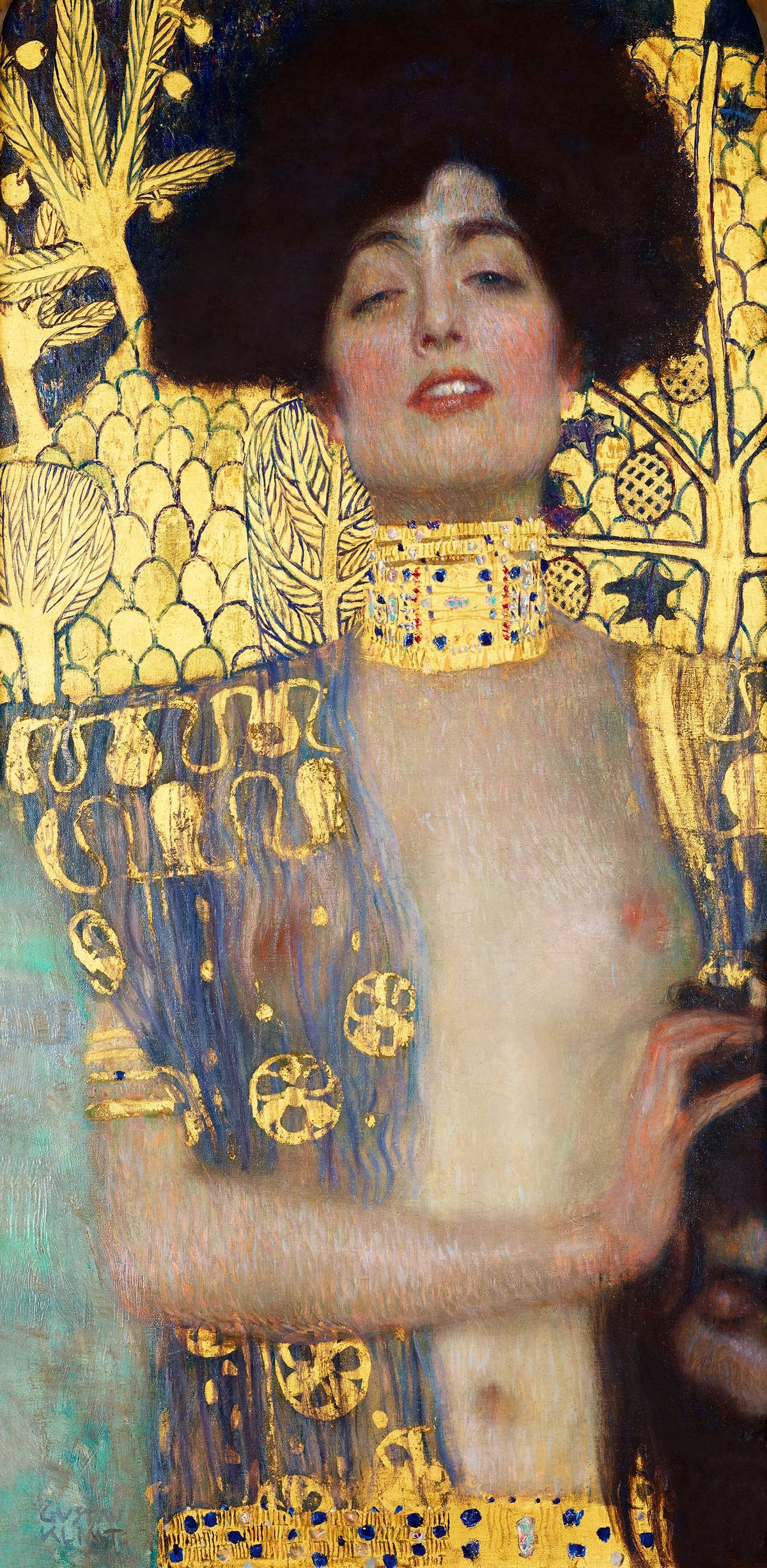
오스트리아 상징주의와 아르누보(빈 분리파)의 거장 구스타프 클림트(Gustav Klimt, 1862–1918)가 1901년에 완성한 유화 유디트 I(Judith I, 또는 홀로페르네스의 머리를 든 유디트)은 84.0 cm × 42.0 cm 크기의 캔버스에 유채와 금박으로 그린 대표작입니다. 현재 오스트리아 빈의 벨베데레 궁전 미술관(Österreichische Galerie Belvedere, Vienna)에 소장되어 있습니다.
빈 사교계를 뒤흔든 스캔들과 팜 파탈의 탄생
19세기 말에서 20세기 초, 세기말(Fin de siècle)의 불안과 퇴폐적 분위기가 감돌던 오스트리아 빈에서 클림트는 종교적 도상을 완전히 파괴하는 충격적인 작품을 내놓았습니다. 성경 속 유디트는 민족을 구하기 위해 적장의 목을 벤 경건하고 숭고한 구국의 영웅이었으나, 클림트의 붓끝에서 그녀는 살인 직후의 치명적인 성적 절정감(황홀경)에 도취된 관능적인 여인으로 다시 태어났습니다.
이 그림의 모델은 당대 빈 최고의 부유한 금융가 페르디난트 블로흐-바우어의 아내이자 클림트의 평생 뮤즈였던 '아델레 블로흐-바우어(Adele Bloch-Bauer)'였습니다. 반쯤 감긴 나른한 눈동자, 붉게 상기된 뺨, 벌어진 입술 사이로 살짝 드러난 하얀 치아는 적장을 처단한 정의의 승리자가 아니라 관능적 쾌락에 빠져든 팜 파탈의 전형을 보여줍니다. 그녀의 목에 걸린 두꺼운 황금 초커는 당대 최신 유행 보석이자 유디트의 관능성을 극대화하는 동시에, 잘려 나간 홀로페르네스의 목과 겹쳐지며 참수라는 죽음의 테마를 시각적으로 암시합니다.
당시 보수적인 빈의 대중과 비평가들은 이 도발적인 그림을 보고 경악을 금치 못했습니다. 거룩한 성녀를 천박하고 위험한 요부로 전락시켰다는 비난이 쏟아졌고, 사람들은 이 그림을 차마 유디트라 부르지 못하고 성경 속 또 다른 요부인 '살로메(Salome)'라고 왜곡해 부르기도 했습니다. 화가의 동생인 에른스트 클림트가 제작한 금속 액자 상단에 ‘JUDITH UND HOLOFERNES’라는 글자가 뚜렷하게 새겨져 있음에도 불구하고 일어난 해프닝이었습니다.
나른하게 감긴 눈동자와 잘려 나간 머리, 시선의 심리적 여정
그림을 마주하는 순간 관람객의 무의식적 시선은 화면 상단을 가득 채운 화려한 황금빛 배경 속에서 도발적으로 반쯤 풀린 유디트의 몽환적인 눈동자로 가장 먼저 빨려 들어갑니다. 관람객을 정면으로 내려다보는 그녀의 오만하면서도 매혹적인 표정은 감상자에게 거부할 수 없는 시각적 매혹과 서늘한 긴장감을 동시에 선사합니다.
이어 시선은 속살이 훤히 비치는 얇은 비단 옷자락 사이로 드러난 풍만한 가슴과 목을 단단히 감싸 쥔 황금 초커를 훑고 지나갑니다. 에로티시즘의 절정을 지나 화면 오른쪽 맨 아래 구석으로 시선이 떨어지는 순간, 관람객은 그녀의 손에 무심하게 잡혀 있는 적장 홀로페르네스의 반쯤 잘려 나간 흉측한 검은 머리통을 마주하며 거대한 시각적 충격을 경험합니다.
마지막으로 시선은 배경에 섬세하게 새겨진 고대 아시리아 양식의 양식화된 황금 나무와 물결무늬 장식으로 돌아옵니다. 성과 죽음(에로스와 타나토스)이 황금빛 장식성 속에서 완벽하게 하나로 결합되었음을 깨닫는 순간, 관람객은 세기말 빈을 뒤흔들었던 클림트 특유의 파격적이고 유혹적인 미학의 본질을 전율과 함께 체감하게 됩니다.
황금 양식의 서막이자 현대적 여성상의 재정의, 미술계의 평가
미술계는 유디트 I을 클림트의 독보적인 트레이드마크인 '황금 양식(Golden Phase)'을 공식적으로 알린 역사적인 신호탄이자, 서양 회화사에서 에로티시즘과 장식 예술을 회화의 최정상으로 끌어올린 걸작으로 평가합니다.
전통적인 도덕주의적 틀을 과감히 벗어던지고 지그문트 프로이트의 정신분석학이 태동하던 빈의 시대정신을 선명하게 포착했기 때문입니다. 성적 주체성을 당당하게 드러내며 남성을 파멸로 이끄는 클림트의 매혹적인 유디트는 오늘날 아르누보 시대를 상징하는 가장 독보적이고 강렬한 아이콘으로 자리 잡고 있습니다.
The Golden Ecstasy of Sex and Decapitation, Judith I
Painted in 1901 by the celebrated leader of the Vienna Secession, Gustav Klimt (1862–1918), Judith I (also known as Judith and the Head of Holofernes) is an oil and gold leaf on canvas measuring 84.0 cm × 42.0 cm (33.1 in × 16.5 in), housed in the permanent collection of the Österreichische Galerie Belvedere in Vienna, Austria.
Scandal in Fin-de-Siècle Vienna and the Genesis of the Femme Fatale
In the decadent, anxious atmosphere of turn-of-the-century Vienna, Gustav Klimt completely subverted traditional biblical iconography. The pious Hebrew heroine Judith—historically venerated for her chastity and patriotic sacrifice—was transformed under Klimt’s brush into the ultimate modern femme fatale, consumed by the post-climactic ecstasy of murder.
The model for this provocative icon was Adele Bloch-Bauer, the prominent Viennese salon hostess and wife of sugar magnate Ferdinand Bloch-Bauer. Portrayed with heavy-lidded, half-closed eyes, flushed cheeks, and slightly parted lips revealing a glimpse of white teeth, Judith exudes carnal seduction rather than virtuous devotion. The opulent, jeweled golden choker encircling her slender throat reflects the height of contemporary Parisian fashion while acting as a macabre visual echo of the severed neck of Holofernes below.
The work ignited a ferocious scandal among conservative Viennese critics, who condemned Klimt for reducing a sacred martyr to a predatory seductress. The public discomfort was so intense that audiences frequently misidentified the canvas as Salome, despite the title JUDITH UND HOLOFERNES stamped in bold relief across the metal frame crafted by the artist’s brother, Georg Klimt.
Subconscious Trajectory of the Gaze: Heavy Eyelids to the Severed Relic
The observer's subconscious gaze is immediately snared by Judith’s hypnotic, half-veiled gaze piercing through the shimmering gilded background. Looking down at the spectator with a mixture of aristocratic haughtiness and sensual languor, her expression commands instant visual surrender.
The visual trajectory descends past the heavy golden collar and the diaphanous, semi-transparent gown revealing the soft contour of her bare breast, before dropping abruptly to the lower right corner. There, half-hidden in darkness, rests the lifeless, cropped profile of Holofernes’ severed head, held effortlessly in her manicured hand—delivering a sudden, chilling shock that shatters the purely erotic illusion.
Finally, the gaze re-ascends into the ornate, two-dimensional decorative background featuring stylized golden trees and relief motifs inspired by ancient Assyrian friezes. Realizing how seamlessly Klimt fused Eros and Thanatos (sex and death) within a shimmering matrix of applied gold leaf, the viewer grasps the profound psychological undercurrents of the Freudian era.
The Dawn of the Golden Phase: Critical Legacy
Art historians revere Judith I as the triumphant launch of Klimt’s world-renowned Golden Phase (Goldene Periode) and an indispensable monument of Art Nouveau and Symbolism.
By aligning the female subject with autonomous sexual agency and unapologetic power, Klimt shattered academic moralism and bridged painting with decorative applied arts. This shimmering masterpiece endures as one of Western art’s most mesmerizing explorations of desire, danger, and aesthetic ecstasy.
본 컨텐트의 저작권은 팔렛트제주에 있습니다. 허가없는 무단전제를 금지합니다.
Copyright © Palette Jeju. All rights reserved. Unauthorized reproduction or redistribution is strictly prohibited.