의사의 진료실 The Surgeon
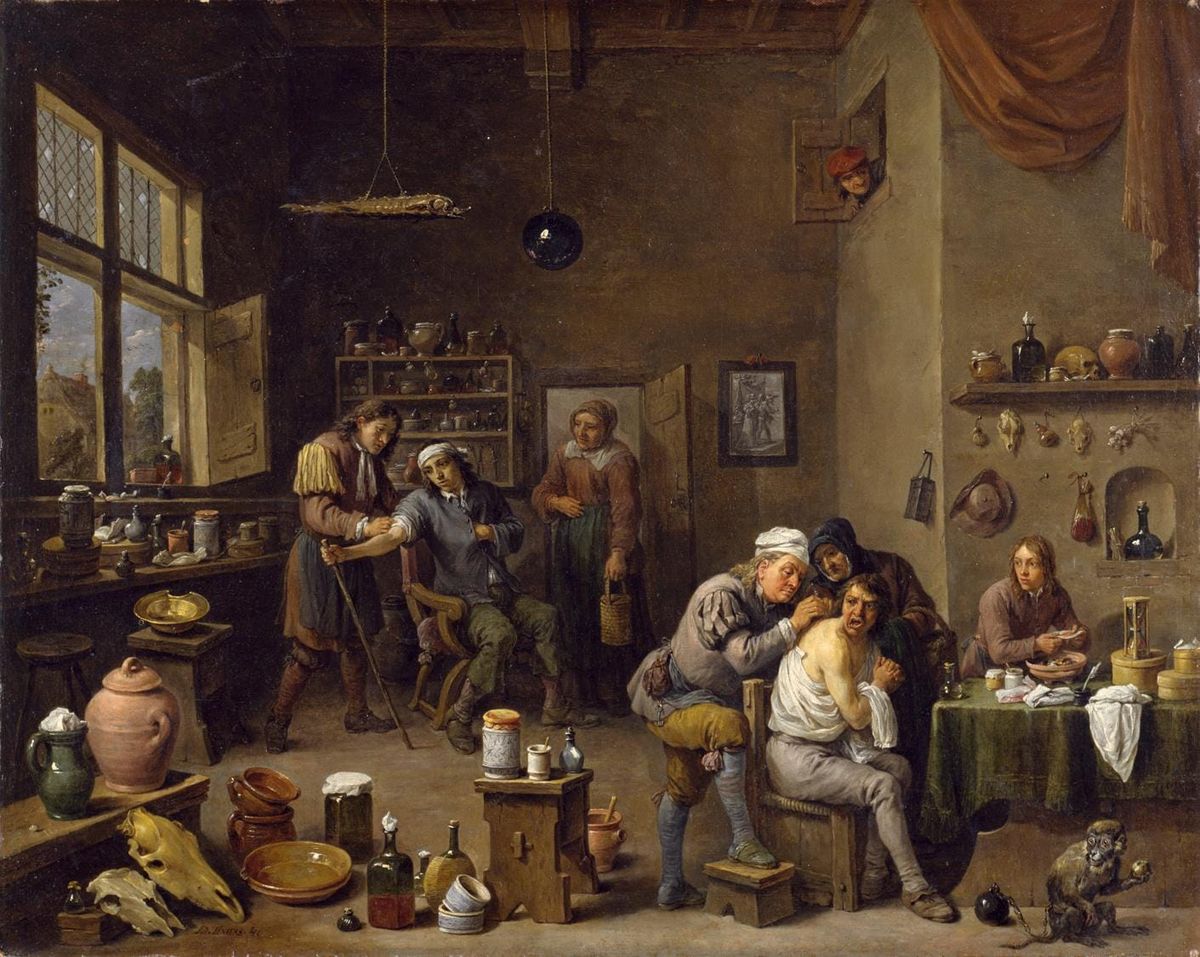
17세기 플랑드르 바로크 풍속화 및 풍자화의 거장 소 다비드 테니어르스(David Teniers le Jeune, 1610–1690)가 1670년대 말년에 완성한 기념비적 실내 풍속 유화 의사의 진료실(The Surgeon, 또는 이발사 외과의사의 진료소, 네덜란드어: De chirurgijn, 공식 소장품 등록번호: 71.480)은 57.2 cm × 73.7 cm 크기의 가로형 캔버스에 유채로 그린 대표적인 북유럽 풍속 회화 최고 걸작입니다.
미국의 유명 미술품 컬렉터인 월터 P. 크라이슬러 주니어(Walter P. Chrysler, Jr.)의 유서 깊은 기증을 통해 현재 미국 버지니아주의 크라이슬러 미술관(Chrysler Museum of Art, Norfolk, Virginia)에 영구 소장되어 보존되어 오고 있습니다.
17세기 돌팔이 외과의사와 연금술적 허황함을 향한 화가의 고뇌
1670년대 말년에 접어든 노장의 테니어르스는, 당대 북유럽 사회에서 가난하고 무지한 서민들을 상대로 성행하던 야만적인 돌팔이 이발사 외과의사(Barber-surgeon)들의 허황된 의료 행위를 날카로운 풍자로 화폭에 담고자 깊이 몰두했습니다.
화가는 단순한 의술의 현장을 넘어, 온갖 약병과 해골, 매달린 물고기 뼈 등 연금술의 미신적 도구들에 둘러싸인 진료실 속에서 고통스러워하는 환자의 신음과 이를 방관하는 어수룩한 조조들의 모습을 어떻게 유머러스하면서도 비판적인 은빛 대기(Silvery manner) 속에 담아낼지 치열하게 번민했습니다.
크라이슬러 미술관의 공식 소장 도록에 따르면, 화면 오른쪽 아래에 쇠사슬에 묶인 채 사과를 쥐고 환자의 자세를 그대로 흉내 내는 원숭이는 인간의 어리석음과 맹목적인 믿음을 상징하는 도상학적 핵심 장치로 분석되며, 화면 왼쪽 아래의 정교한 약병 정물과 함께 화가의 정품 서명(D. TENIERS. FEC.)이 선명하게 남아 있습니다.
화가는 어두운 실내 진료실에서, 의사가 환자의 등에 난 종기를 치료하며 진료를 벌이는 북유럽 서민들의 떠들썩한 일상을 화폭에 담았습니다.
화면 오른쪽 전면에는 고통으로 일그러진 표정을 지으며 두 손을 모은 환자가 의자에 앉아 있고, 외과의사는 그의 상처를 세심하게 살피며 치료에 집중하고 있으며, 바로 옆 조수는 숯불에 약을 데우고 있습니다.
화면 왼쪽 배경의 진료실 안쪽에서는 또 다른 조수가 상처 입은 환자의 팔을 붙잡고 피를 뽑거나 치료를 준비하는 모습이 보이며, 열린 창문 틈으로는 구경하는 이의 얼굴이 살짝 내다보고 있습니다.
진료실 바닥과 선반 위에 가득 어지럽게 널린 도자기 항아리와 약병, 동물 해골과 말 뼈, 천장에 매달린 박제 물고기와 둥근 마법의 공, 그리고 사슬에 묶인 원숭이의 모습은 인간의 무지와 허황된 치료 행위를 손에 잡힐 듯 생생하게 웅변합니다.
고통스러운 환자의 표정에서 도자기 약병 정물과 사슬에 묶인 원숭이로, 시선의 심리적 여정
그림을 마주하는 순간 관람객의 무의식적 시선은 화면 오른쪽에서 치료를 받으며 고통으로 일그러진 환자의 찡그린 얼굴과 절박하게 모아쥔 두 손으로 가장 먼저 빨려 들어갑니다.
돌팔이 의사의 거친 손길에 몸서리치는 환자의 실감 나는 표정은 보는 이에게 깊한 시각적 몰입감과 함께 씁쓸한 웃음을 자아내는 해학을 선사합니다.
이어 시선은 화면 중앙의 숯불 화로와 의사가 사용하는 다양한 도구들을 지나, 바닥에 놓인 다채로운 도자기 항아리, 유리병, 그리고 동물 뼈들이 빚어내는 정교한 정물의 영역으로 이동합니다.
의술이라기보다는 미신적인 연금술 실험실에 가까운 진료실의 잡다한 소품들을 확인하는 순간, 관람객은 쌉싸름한 약재 냄새와 환자의 신음 소리가 울려 퍼지는 17세기 플랑드르 진료실 한복판 속으로 온몸이 빨려 들어가게 됩니다.
마지막으로 시선은 화면 오른쪽 구석 바닥에서 사슬에 묶인 채 환자의 포즈를 우스꽝스럽게 따라 하는 원숭이의 모습과 천장에 매달린 둥근 유리 공, 그리고 왼쪽 창밖의 풍경에 멈춥니다.
전면 환자의 생생한 고통과 후면 풍자적 장치가 빚어내는 완벽한 심리적 대비를 마주하며, 관람객은 인간의 어리석음을 꿰뚫어 보는 거장 테니어르스의 깊은 통찰과 유쾌한 풍자의 진수를 가슴 깊이 마주하게 됩니다.
17세기 플랑드르 풍자 풍속화의 정점과 조형미, 미술계의 평가
미술계와 크라이슬러 미술관 공식 도록은 의사의 진료실을 테니어르스가 말년에 도달한 탁월한 관찰력과 정교한 정물 묘사 능력을 가장 완벽한 풍자적 서사 속에 녹여낸 대표적인 최고봉 마스터피스로 평가합니다.
단순한 의학 풍경을 넘어 당대 사회의 세태와 미신적인 의료 행위를 도상학적 상징들 속에 완벽하게 우화화했을 뿐만 아니라, 낡은 목재 가구의 질감, 도자기와 유리병의 반사광, 동물의 털과 뼈의 세밀한 묘사, 실내를 감싸는 은은한 명암법을 극도로 섬세한 북유럽 사실주의 유화 기법으로 완벽하게 구현했기 때문입니다.
인간의 나약함과 허영심을 가장 격조 높은 시각 희로드라마로 승화시킨 테니어르스의 이 걸작 화폭은, 오늘날까지도 전 세계 수많은 감상자들에게 깊은 깨달음과 잊을 수 없는 시각적 재미를 전해주는 불멸의 명작으로 손꼽히고 있습니다.
The Surgeon
Painted in the late 1670s by the master of Flemish Baroque genre and satirical painting David Teniers the Younger (1610–1690), The Surgeon (also titled The Country Barber-Surgeon, Accession No. 71.480) is an exceptional interior genre masterpiece in oil on canvas measuring 57.2 cm × 73.7 cm (22 1/2 in × 29 in).
Acquired through the generous gift of Walter P. Chrysler, Jr., it is preserved today in the distinguished permanent collection of the Chrysler Museum of Art in Norfolk, Virginia, United States.
Quackery, Alchemy, and the Satire of Early Modern Medicine
During the late 1670s, David Teniers the Younger turned his keen observational wit toward the widespread phenomenon of itinerant barber-surgeons in seventeenth-century Northern Europe, satirizing the dubious medical practices that preyed upon the rural poor.
Moving beyond straightforward genre documentation, the master meditated deeply on how to expose the pseudo-scientific quackery of the era, surrounding his clumsy practitioner with alchemical paraphernalia, animal bones, and suffering patients, all unified beneath his celebrated silvery atmosphere and sharp chiaroscuro.
According to curatorial records in the Chrysler Museum of Art collection catalogue, the chained monkey in the lower right holding an apple serves as a brilliant satiric emblem of human foolishness and the Fall of Man, while the artist's signature (D. TENIERS. FEC.) anchors the lower-left corner.
Teniers staged the crowded interior scene within a rustic surgeon's workshop.
In the right foreground, a grimacing patient claps his hands in pain as the barber-surgeon digs into his back to treat a boil, while an assistant warms a mustard plaster over glowing coals nearby.
In the left background, another assistant prepares a second patient for bloodletting, while an inquisitive onlooker peers through a small upper window.
A jumble of ceramic jars, glass bottles, animal skulls, a hanging fish skeleton, and a spherical glass globe suspended from the ceiling create a brilliantly rendered backdrop of medical quackery and false science.
Subconscious Trajectory of the Gaze: From the Grimacing Patient to the Chained Monkey
The observer's subconscious gaze is immediately magnetized by the right foreground, drawn to the distressed expression of the seated patient wincing in pain as the surgeon attends to his back.
His clenched hands, tortured posture, and the intense focus of the practitioner establish an instant focal point of physical drama, dark humor, and narrative tension.
The visual path then shifts toward the central cluster of apothecary jars, mixing bowls, and glowing coals, marveling at the meticulous still-life precision of the medical equipment scattered across the floor and stools.
Taking in the bizarre assortment of animal bones and magical apparatus, the viewer directly experiences the pungent atmosphere and skeptical absurdity of a 17th-century village medical consultation.
Finally, the visual trajectory moves toward the lower-right corner to observe the chained monkey holding an apple—an animal whose posture directly "apes" the suffering patient behind him—before lifting toward the suspended glass globe and the window above.
Observing the harmonious equilibrium between foreground human folly, meticulous still-life detail, and precise Netherlandish draftsmanship, the spectator perceives the timeless moral satire and profound aesthetic brilliance Teniers embedded within the canvas.
The Monument of Flemish Satirical Genre: Critical Legacy
Art historians revere the Chrysler Surgeon as a supreme achievement in Teniers’s late oeuvre, illustrating his consummate ability to unite biting social satire with virtuosic interior still-life painting on an expansive canvas.
By orchestrating delicate textural contrasts between weathered wooden furniture, glazed ceramic jars, translucent glass flasks, animal pelts, and shifting indoor light within a unified perspectival space, Teniers transformed a disreputable medical scene into an exquisite aesthetic treatise on human ignorance and moral truth.
This magnificent historical canvas endures as an inspiring testament to the master's creative fortitude, celebrating the quiet poetry of everyday existence and the transformative grace of living art.
본 컨텐트의 저작권은 팔렛트제주에 있습니다. 허가없는 무단전제를 금지합니다.
Copyright © Palette Jeju. All rights reserved. Unauthorized reproduction or redistribution is strictly prohibited.