연금술사 Alchemist
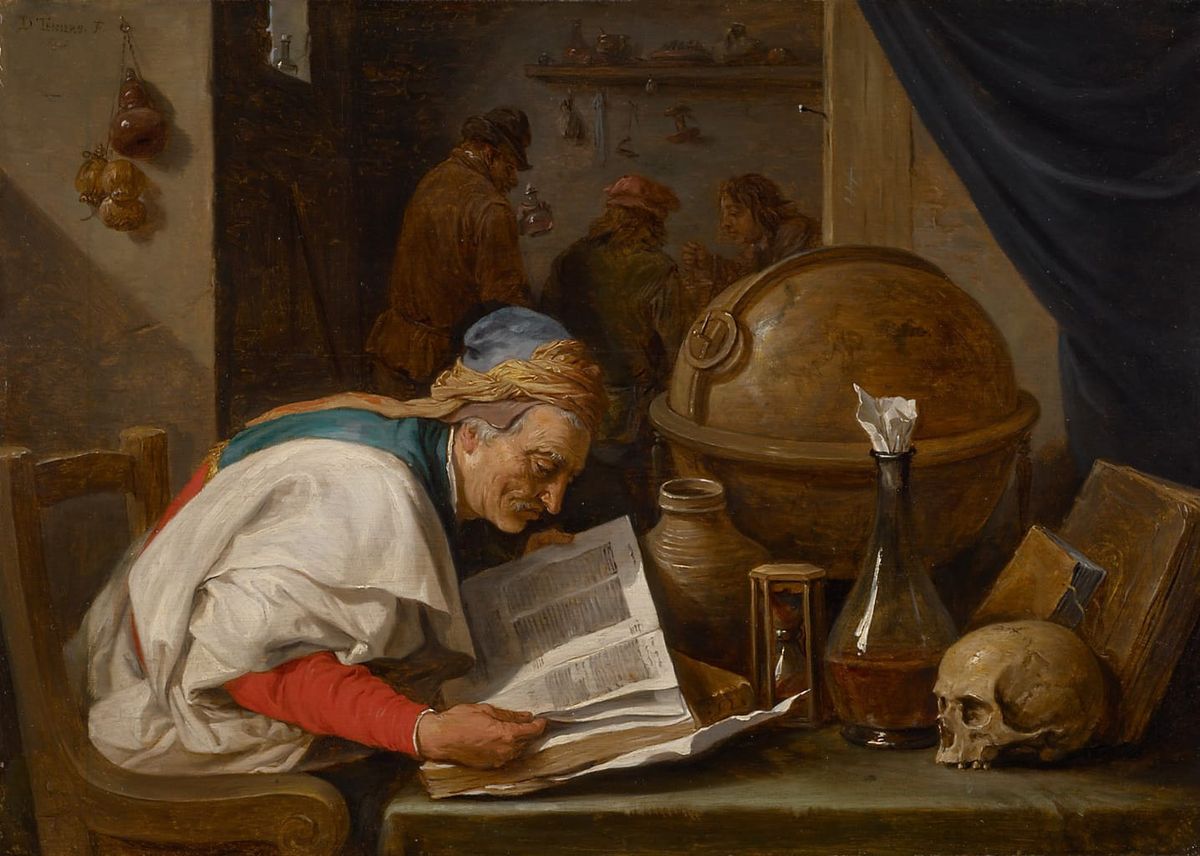
17세기 플랑드르 바로크 풍속화 및 실내 정물화의 거장 소 다비드 테니어르스(David Teniers le Jeune, 1610–1690)가 1645년에서 1650년경 완성한 기념비적 학자 작업실 유화 연금술사(The Alchemist, 독일어: Alchemist, 프랑스어: L'Alchimiste, 소장품 번호: GG 9802)는 34.5 cm × 45.0 cm 크기의 가로형 패널(목판)에 유채로 그린 대표적인 북유럽 과학 서사화 최고 걸작입니다.
오스트리아 합스부르크 왕가의 황실 컬렉션을 거쳐 현재 오스트리아 빈의 빈 미술사 박물관(Kunsthistorisches Museum, Vienna)에 소장되어 있습니다.
납을 황금으로 바꾸려는 헛된 열망과 덧없는 인생의 진실을 향한 화가의 고뇌
17세기 플랑드르와 유럽 궁정에서는 비금속을 귀금속으로 바꾸고 불로불사의 영약을 찾기 위해 전 재산을 쏟아붓는 연금술 열풍이 뜨거웠습니다.
화가는 자연의 신비를 탐구하려는 인간의 순수한 학문적 호기심과, 그 이면에 자리 잡은 일확천금의 헛된 환상 및 시간의 덧없음(바니타스)을 어떻게 품격 높은 정물과 인물의 심리로 담아낼지 치열하게 번민했습니다.
당시 북유럽 미술에서 연금술사는 헛된 탐욕에 빠진 어리석은 인물로 자주 풍자되었지만, 테니어르스는 그들을 단순히 비웃기보다는 고독하게 지식을 탐구하는 학자의 엄숙한 집중력과 정교한 연구실의 풍경으로 재해석했습니다.
화가는 책상 가득 펼쳐진 고서적과 실험 도구들 앞에서 돋보기를 보듯 고서에 몰두하는 늙은 연금술사와 뒤편 조수들의 작업 광경을 화폭에 담았습니다.
화면 왼쪽 앞에는 화려한 터번을 머리에 두르고 붉은 소매와 흰 숄을 걸친 나이 든 연금술사가 나무 의자에 앉아 거대한 양장본 고문서를 손으로 넘기며 글자를 한 자 한 자 정독하고 있습니다.
그의 앞 책상 위에는 거대한 황동 천구의(지구본)와 종이마개가 꽂힌 투명한 유리 플라스크, 흙빛 도자기 항아리와 모래시계, 그리고 시간의 유한함을 경고하는 해골이 놓여 있습니다.
화면 뒤편 어두운 방 안에서는 모자를 쓴 조수들이 옹기종기 모여 약병을 들고 실험에 열중하고 있으며, 책상 위의 정물들과 어우러져 자연의 진리를 찾고자 밤낮없이 매달리는 인간의 지적 열망을 손에 잡힐 듯 생생하게 웅변합니다.
펼쳐진 고문서의 글줄에서 책상 위 해골과 황동 지구본으로, 시선의 심리적 여정
그림을 마주하는 순간 관람객의 무의식적 시선은 화면 왼쪽 아래에서 밝은 빛을 받아 눈부시게 빛나는 연금술사의 흰 어깨 숄과 책상 위에 펼쳐진 두꺼운 고문서의 빼곡한 글줄로 가장 먼저 빨려 들어갑니다.
터번 아래로 드러난 노학자의 깊게 파인 이마 주름과 책 속으로 빨려 들어갈 듯 집중된 눈빛, 그리고 책장을 조심스레 넘기는 손끝은 보는 이에게 깊은 시각적 몰입감과 함께 학문적 비밀을 파헤치는 순간의 긴장감을 선사합니다.
이어 시선은 책상 오른쪽에 놓인 윤기 나는 투명 유리 플라스크와 붉은 모래가 담긴 모래시계, 그리고 묵직한 인간의 해골로 이동합니다.
영원한 부와 생명을 좇는 인간의 열망 바로 곁에 자리 잡은 죽음의 상징을 확인하는 순간, 관람객은 헛된 탐욕을 경계하고 덧없는 인생의 진실을 묵상하는 철학적 성찰 한복판 속으로 온몸이 빨려 들어가게 됩니다.
마지막으로 시선은 책상 한가운데를 묵직하게 차지하고 있는 거대한 황동 천구의를 지나, 어두운 배경 속에서 플라스크를 들고 불빛을 살피는 조수들의 분주한 실루엣과 벽에 걸린 마늘 다발에 멈춥니다.
빛과 어둠의 절묘한 명암 대비와 붉은색, 흰색, 황토색이 빚어내는 완벽한 색채의 조화를 마주하며, 관람객은 자연의 법칙 앞에 겸허해지는 인간의 운명과 거장 테니어르스가 건네는 묵직한 지적 울림을 가슴 깊이 마주하게 됩니다.
17세기 플랑드르 학자 실내 정물화의 정점과 조형미, 미술계의 평가
미술계는 빈 미술사 박물관의 연금술사를 테니어르스가 정교한 바니타스(Vanitas) 정물과 인물 풍속화를 가장 완벽한 밀도로 결합해 낸 최고봉의 명작으로 평가합니다.
단순한 실험실 묘사를 넘어 고문서의 낡은 종이 질감, 플라스크 속 액체의 투명한 굴절광, 천구의와 해골의 사실적인 양감을 완벽한 대각선 구도 속에 배치했을 뿐만 아니라, 어두운 실내를 가르는 부드러운 자연광을 극도로 섬세한 북유럽 사실주의 유화 기법으로 완벽하게 구현했기 때문입니다.
인간의 지적 탐구와 삶의 유한성을 가장 품격 높은 시각 교향곡으로 승화시킨 테니어르스의 이 걸작 화폭은, 오늘날까지도 전 세계 수많은 감상자들에게 깊은 감탄과 잊을 수 없는 시각적 전율을 전해주는 불멸의 명작으로 손꼽히고 있습니다.
The Alchemist
Painted between 1645 and 1650 by the master of Flemish Baroque genre and interior painting David Teniers the Younger (1610–1690), The Alchemist (German: Alchemist, French: L'Alchimiste, Inventory No. GG 9802) is a scholarly genre masterpiece in oil on panel measuring 34.5 cm × 45.0 cm (13.6 in × 17.7 in).
Originally preserved in the imperial collection of Archduke Leopold Wilhelm, it is housed today in the distinguished permanent collection of the Kunsthistorisches Museum in Vienna, Austria.
The Search for the Philosopher's Stone, the Vanitas Still Life, and the Scholar's Solace
Throughout the 17th century, the elusive quest to transmute base metals into gold and discover the elixir of life fascinated European royalty while leading many practitioners into financial ruin.
Rather than dismissing the alchemist as a laughable figure of pure delusion, David Teniers the Younger chose to portray the solitary dignity of scholarly research, weaving intricate vanitas still life motifs into a profound meditation on the limits of human knowledge and the fleeting nature of mortal time.
The master staged an atmospheric laboratory interior where an elderly, turbaned scholar immerses himself in the close study of ancient treatises.
Seated at a sturdy wooden table, the aged alchemist wears a vibrant crimson sleeve, a blue undercap, and a broad white linen mantle, turning the parchment pages of a massive manuscript with acute concentration.
Upon the table before him rest a monumental brass celestial globe, a sealed glass flask containing chemical elixir, an earthenware jug, an hourglass, and a weathered human skull alongside leather-bound volumes.
In the shadowy background, three assistants gather around small phials and furnace apparatus, perfectly capturing the quiet tension between terrestrial ambition and cosmic truth.
Subconscious Trajectory of the Gaze: From the Open Folio to the Weathered Skull
The observer's subconscious gaze is immediately magnetized by the lower-left register, drawn to the radiant white linen drape and the crisp, sunlit pages of the open manuscript held in the alchemist’s hands.
His furrowed brow, intense analytical stare, and weathered fingers turning the leaf establish an instant focal point of intellectual immersion, concentrated silence, and narrative gravity.
The visual path then moves along the tabletop to the luminous glass flask fitted with a paper stopper and the memento mori skull resting beside the hourglass.
Taking in these powerful symbols of mortal transience situated beside instruments of scientific ambition, the viewer directly experiences the profound philosophical paradox of earthly knowledge.
Finally, the visual trajectory sweeps past the gleaming curvature of the brass celestial globe toward the shadowy recess where assistants examine chemical preparations, before coming to rest on the draped curtain framing the upper-right corner.
Observing the harmonious equilibrium between warm tonal chiaroscuro, spatial recession, and crisp Netherlandish draftsmanship, the spectator perceives the timeless nobility of intellectual inquiry and the profound aesthetic solace Teniers embedded within the panel.
The Monument of Flemish Cabinet Mastery: Critical Legacy
Art historians revere the Vienna Alchemist as an exemplary tour de force of Teniers’s intimate cabinet style, illustrating his consummate mastery of still-life orchestration and human psychology.
By orchestrating delicate textural contrasts between weathered paper leaves, translucent glass reflections, cold brass, dry bone, and coarse woolen fabric within a unified tonal space, Teniers elevated a laboratory scene into an exquisite aesthetic treatise on philosophical introspection.
This intimate historical panel endures as an inspiring testament to the master's creative fortitude, celebrating the quiet poetry of scientific devotion and the transformative grace of living art.
본 컨텐트의 저작권은 팔렛트제주에 있습니다. 허가없는 무단전제를 금지합니다.
Copyright © Palette Jeju. All rights reserved. Unauthorized reproduction or redistribution is strictly prohibited.