양떼와 목동 Shepherd with a Flock of Sheep
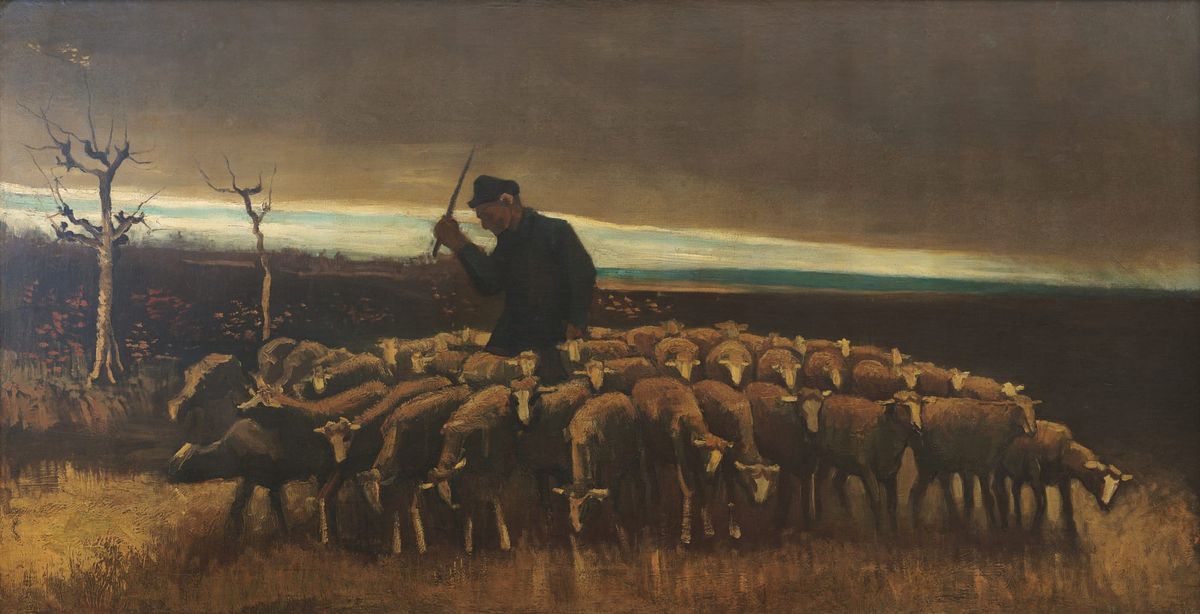
빈센트 반 고흐(Vincent van Gogh, 1853–1890)는 1884년 네덜란드 북브라반트 주의 뉘넨에 체류하던 시기에 소박한 농촌의 일상과 노동하는 인간의 모습을 깊이 있는 시선으로 담아내는 작업에 몰두했습니다.
이 작품은 그가 뉘넨에 머물던 1884년 9월에 제작한 유채화로, 야콥 바르트 드 라 파이유의 전작 도록 기준 공식 등록번호는 F42이며 실제 작품의 실측 규격은 67.0 × 126.0 cm입니다.
현재 멕시코 시티에 위치한 소마야 미술관에서 소장하고 있습니다.
작가의 고뇌와 비하인드
작품을 제작할 당시 고흐는 뉘넨의 차갑고 스산한 가을바람이 들이치는 좁은 작업실에서 마을 주민들과의 갈등, 그리고 아버지와의 심리적 대립이라는 가혹한 현실적 고립 속에 파묻혀 있었습니다.
매서운 추위와 누적된 생활고가 온몸을 짓누르는 물리적 환경 속에서도 그는 브라반트 농민들의 원초적인 삶과 대지의 묵직한 숨결을 화폭에 붙잡아두고자 치열하게 붓을 들었습니다.
화면 전면에는 어두운 대지 위를 빼곡하게 채우며 나아가는 양떼의 묵직한 무리와 그 중심에서 막대기를 치켜들고 양들을 이끄는 목동의 실루엣이 거친 질감으로 거칠게 표현되어 있습니다.
중경에는 앙상한 나가지와 스산한 뉘넨의 들판이 가로로 길게 이어져 있어 차갑고 적막한 농촌의 정취를 극대화합니다.
원경의 지평선 위로는 낮게 깔린 어두운 먹구름과 희미하게 밝아오는 수평선의 빛이 어우러져 고단한 노동의 끝에 찾아오는 묵묵한 대기의 깊이감을 완성합니다.
무의식 속 시선 및 심리 흐름
관람객의 시선은 가장 먼저 화면 중앙에서 목을 숙인 채 무리지어 이동하는 양떼의 거친 질감과 어두운 톤의 털빛에 닿으며 묵직한 전율을 느끼게 됩니다.
이어지는 시선은 그들 사이에 우뚝 서서 양들을 통솔하는 목동의 단호한 팔 동작과 모자쓴 실루엣을 거쳐 수평으로 펼쳐진 들판으로 차분하게 이동합니다.
마지막으로 화면 상단을 짓누르는 어두운 하늘과 희미한 빛의 대기감 속으로 시선이 넓게 퍼져나가며, 거칠고 차가운 현실 속에서도 묵묵히 자신의 길을 걸어가는 인간의 숙명적인 고독과 깊은 내면의 울림을 체감하게 됩니다.
미술계의 평가와 조형미
미술사학계에서는 이 작품을 두고 고흐가 초기 네덜란드 시기에 어두운 대지의 색채와 투박한 필치를 사용하여 농촌의 리얼리티와 인간의 고단한 실존을 가장 진중하게 시각화한 수작으로 평가합니다.
화면 전체를 지배하는 암갈색 톤과 수평으로 길게 뻗은 파노라마 구도는 뉘넨 평야의 광활함과 쓸쓸한 정취를 완벽하게 결합합니다.
눈에 보이는 풍경의 재현을 넘어, 화가가 혹독한 고립 속에서 삶의 무게를 견디며 빚어낸 영혼의 깊이를 캔버스 위에 영원히 아로새긴 위대한 미술사적 성취입니다.
Shepherd with a Flock of Sheep
Vincent van Gogh captured the austere beauty of rural labor and the quiet dignity of peasant life after settling in Nuenen during his formative Dutch period in September 1884.
Created in September 1884, this oil on canvas is cataloged as F42 in J.B. de la Faille's catalogue raisonné and measures 67.0 × 126.0 cm.
The painting is currently housed in the Museo Soumaya in Mexico City.
During the period of its creation, Van Gogh was enduring a harsh physical and emotional environment, confined to his modest studio amidst the bitter autumnal chill of Nuenen while grappling with deep isolation following local community tensions and friction with his family.
Despite the biting cold and the crushing weight of poverty that narrowed his physical world, he sought profound spiritual resilience by channeling the raw, unvarnished existence of the Brabant peasants onto the canvas.
The foreground is dominated by a dense, moving mass of sheep navigating the dark terrain, led by a solitary shepherd whose silhouette stands resolutely at the center with a raised staff.
In the middle ground, bare trees and a stark, flat horizon stretch horizontally across the desolate landscape, intensifying the somber mood of the Dutch countryside.
In the distant background, heavy, low-hanging clouds press against a pale streak of light along the horizon, establishing an oppressive yet solemn atmospheric depth.
The viewer's gaze is initially drawn toward the textured, densely packed forms of the sheep moving across the lower register.
The perspective then follows the upright figure of the shepherd holding his staff upward, before moving horizontally across the expansive, quiet fields.
Finally, the eye ascends into the heavy, brooding sky at the upper register, allowing the observer to experience a tranquil psychological transition from physical observation to a profound sense of existential endurance.
Art historians regard this canvas as a powerful milestone of Van Gogh's Nuenen period, where his dark, earthy palette and rugged brushwork successfully convey the harsh reality and quiet nobility of rural labor.
The striking horizontal panorama and monochromatic intensity generate an uncompromising visual rhythm and emotional resonance.
It stands as an enduring artistic monument that immortalizes the artist's deep empathy for the marginalized and his steadfast communion with the toil of the earth.
본 컨텐트의 저작권은 팔렛트제주에 있습니다. 허가없는 무단전제를 금지합니다.
Copyright © Palette Jeju. All rights reserved. Unauthorized reproduction or redistribution is strictly prohibited.