우뢰구름 아래의 밀밭 Wheatfield under Thunderclouds
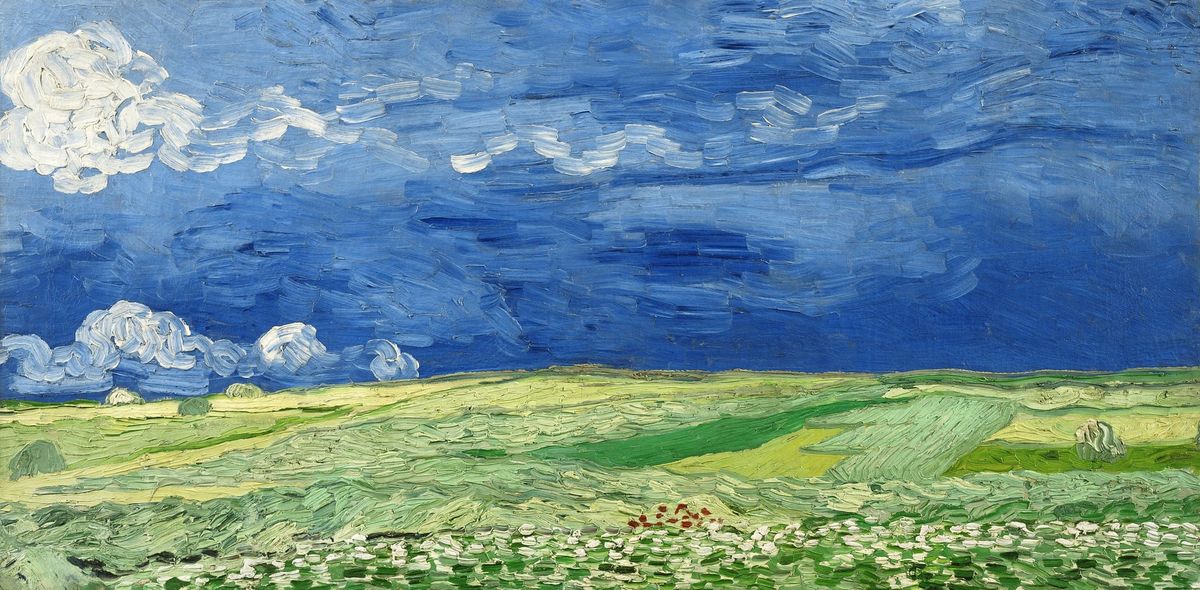
빈센트 반 고흐가 1890년 7월 프랑스 파리 근교의 오베르쉬르우아즈에서 완성한 《우뢰구름 아래의 밀밭》은 그의 파란만장했던 예술적 여정의 종착지에서 탄생한 거대한 유산입니다.
이 작품은 전작 도록 번호 F778과 JH2097로 등재되어 있으며, 세로 50.4 센티미터, 가로 101.3 센티미터의 좌우로 길게 확장된 이중 정사각형 파노라마 구성을 지니고 있습니다.
현재 네덜란드 암스테르담 반 고흐 미술관에 영구 소장되어 있으며, 작가가 생애 마지막 시기에 마주한 격렬한 내면의 풍경을 증명하는 대표적인 걸작으로 전 세계 관람객을 맞이하고 있습니다.
작가의 고뇌와 비하인드
1890년 여름, 생의 마지막 불안과 창작의 열정이 극으로 치달았던 오베르쉬르우아즈에서 반 고흐는 연이어 드넓은 밀밭 풍경을 화폭에 담아냈습니다. 그가 동생 테오에게 보낸 편지에서 고백했듯이, 이 거대하고 폭풍우가 몰아치는 밀밭과 성난 하늘은 그가 마주한 절대적인 고독과 설명할 수 없는 슬픔, 그리고 동시에 자연 속에서 찾으려 했던 실존적 치유의 의지를 온전히 투영한 결과물이었습니다.
화면은 낮게 깔린 수평선을 경계로 완전히 대조되는 두 개의 세계로 분할됩니다. 상단부에는 시시각각 모양을 바꾸며 몰려드는 짙고 무거운 남색과 코발트블루의 천둥구름이 화면 전체를 압도하듯 소용돌이치고 있으며, 왼쪽 구석에 외롭게 부서지는 하얀 뭉게구름은 다가올 파국과 긴장감을 극대화합니다. 반면 하단부에는 눈부시게 펼쳐진 연둣빛과 초록빛의 밀밭이 가로지르며 대지의 생명력을 호흡하고 있고, 들판의 맨 앞쪽에는 핏빛처럼 선명한 붉은 야생화 무리가 점멸하듯 피어올라 황량함 속에서도 꺾이지 않는 생의 의지를 조용히 속삭입니다.
무의식 속 시선 및 심리 흐름
이 작품 앞에 선 관람객의 시선은 가장 먼저 화면 왼쪽 상단에 불안하게 떠 있는 하얀 구름과, 그 뒤편을 집어삼킬 듯 짓누르는 거대한 남색 폭풍의 소용돌이로 빨려 들어가듯 향합니다. 대기를 짓누르는 시각적 압박감 속에서 무거워진 마음은, 이어 수평선을 가로지르며 드넓게 펼쳐진 연두빛 밀밭의 결을 따라 자연스럽게 아래로 시선을 옮기게 됩니다.
거칠고 두껍게 쌓아 올린 붓놀림 사이로 흐르는 묵직한 평온함은 보는 이로 하여금 깊은 사색에 잠기게 만듭니다. 화면 전경의 붉은 꽃 무리가 시선을 마지막으로 붙잡으며, 쓸쓸한 폭풍 속에서도 꺼지지 않는 인간 내면의 미세한 온기와 묘한 안도감이 가슴 깊은 곳에서 교차하는 심리적 울림을 선사합니다.
미술계의 평가와 조형미
미술사학계와 평단은 이 작품을 반 고흐가 생의 마감을 불과 몇 주 앞두고 도달한 회화적 정점, 즉 감정의 완전한 투신이 이뤄낸 극적인 성취로 평가합니다. 특히 물감을 튜브에서 짜낸 그대로 캔버스 위에 짓이기듯 두껍게 얹는 임파스토 기법은, 구름의 역동적인 파괴력과 대지의 묵직한 정적을 물체로서의 질감으로 승화시키며 시각적 쾌감을 넘어선 촉각적 전율을 전달합니다.
어둠과 빛, 불안과 생명, 그리고 파멸과 구원이 하나의 화폭 안에서 팽팽한 긴장감으로 공존하는 이 독특한 풍경은, 자연의 거울을 통해 인간의 가장 깊은 내면을 들여다보게 만드는 영원한 예술적 감동의 원천으로 남아 있습니다.
Wheatfield under Thunderclouds
Completed in July 1890 in Auvers-sur-Oise near Paris, Vincent van Gogh’s Wheatfield under Thunderclouds represents a monumental legacy born at the terminus of his tumultuous artistic journey.
Cataloged under numbers F778 and JH2097, the oil painting measures 50.4 centimeters by 101.3 centimeters, utilizing an unusual double-square horizontal panoramic format.
Permanently housed in the Van Gogh Museum in Amsterdam, this profound work serves as a powerful testament to the artist's final creative burst and emotional intensity during his last weeks in Auvers.
Behind the Canvas and Artistic Vision
During the summer of 1890, amidst mounting personal anxiety and an intense burst of creative urgency in Auvers-sur-Oise, Van Gogh produced a series of expansive wheat field landscapes. As he explicitly described in his correspondence with his brother Theo, these immense fields under stormy skies were crafted to express an overwhelming sense of absolute loneliness and melancholy, while simultaneously seeking a profound, existential solace through the raw energy of nature.
The composition is dramatically bisected by a low horizon line into two contrasting realms. The upper register is dominated by turbulent, heavy indigo and cobalt thunderclouds that swirl across the atmosphere with crushing weight, while a patch of brilliant white clouds breaking in the upper left corner amplifies the underlying tension. Conversely, the lower register features a sweeping expanse of vibrant green and yellowish-green wheat fields that pulse with terrestrial life, punctuated near the foreground by clusters of striking red poppies that flicker like tiny flames, whispering an unyielding will to endure.
Visual Flow and Psychological Resonance
When encountering this work, the viewer's gaze is immediately drawn toward the ominous white clouds hovering in the upper left and the deep, swirling blue vortex of the impending storm that threatens to consume the sky. Underneath this heavy atmospheric pressure, the eye naturally descends across the horizon to follow the rhythmic texture of the rolling green meadows below.
The thick, vigorous brushstrokes convey a heavy yet grounding sense of tranquility that invites profound introspection. As the gaze settles upon the dashes of red flowers in the immediate foreground, a quiet emotional tension takes hold, bridging the gap between the stormy turmoil above and the resilient heartbeat of the earth below to create a deeply resonant psychological experience.
Art Historical Significance and Aesthetics
Art historians and critics regard this late work as one of Van Gogh's supreme psychological landscapes—a breathtaking climax where raw emotion and painterly technique fuse completely. The heavy impasto technique, where thick layers of paint are aggressively applied to the canvas, transforms the visual elements into tactile realities, capturing both the violent dynamism of the clouds and the solemn stillness of the soil.
By balancing darkness and light, anxiety and vitality, and destruction and redemption within a single frame, Van Gogh transformed a simple rural view into an enduring mirror of the human soul, securing its place as an immortal masterpiece of Post-Impressionist art.
본 컨텐트의 저작권은 팔렛트제주에 있습니다. 허가없는 무단전제를 금지합니다.
Copyright © Palette Jeju. All rights reserved. Unauthorized reproduction or redistribution is strictly prohibited.