우물가 근처 마을에서 휴식을 취하는 사람들 (Personnages se reposant dans un village près d'un puits, 1856)
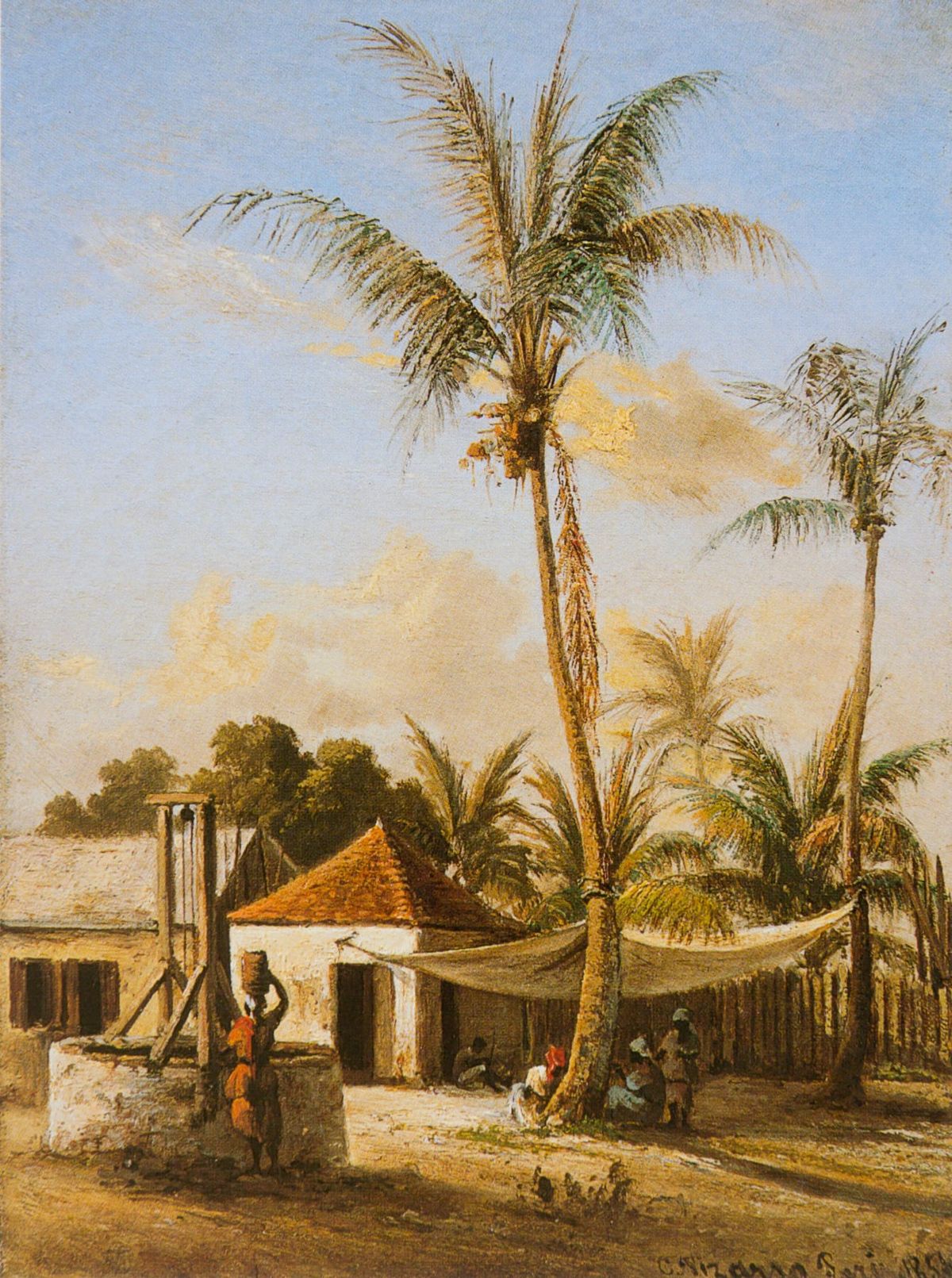
카리브해의 덴마크령 세인트토머스 섬에서 태어나 유년기를 보낸 카미유 피사로는 1855년 예술에 대한 열정을 품고 프랑스 파리로 영구 이주한 직후, 고향과 베네수엘라 여행 시절의 스케치를 바탕으로 이국적인 열대의 일상을 화폭에 복원했습니다. 가족의 반대를 무릅쓰고 전업 화가의 길을 선택했던 청년 피사로는 파리의 아틀리에에서 고향의 눈부신 태양광과 서민들의 삶을 진솔하게 되새겼습니다. 가로 22cm, 세로 30.5cm 크기의 캔버스에 유채로 완성된 이 초기 희귀작은, 훗날 인상주의 운동의 든든한 지주가 될 거장의 섬세한 빛 관찰력과 대지에 기반한 인간주의적 시선이 청년기부터 뚜렷하게 발현되고 있었음을 증명하는 역사적인 작품입니다.
관람자의 시각 인지 체계는 화면 중앙을 압도하며 하늘 높이 솟아오른 야자나무의 우아한 수직 기둥과, 그 아래 하얀 차양 그늘에 옹기종기 모여 앉은 마을 주민들의 정다운 형태감에 가장 먼저 도달합니다. 타오르는 듯한 열대의 황토색 대지와 그늘진 차양 아래 인물들의 짙은 실루엣이 형성하는 뚜렷한 명암 대비는 시각 피질의 중심와를 즉각 포획하며 시각적 탐색의 안정적인 출발점을 확립합니다.
이어서 시선은 차양 아래에서 담소를 나누는 주민들의 나른한 쉼을 거쳐, 화면 좌측 전경에 자리한 원형 우물과 그 곁에서 머리에 물동이를 인 채 홀로 서 있는 여인의 조형적 균형감으로 자연스러운 도약 안구 운동을 진행합니다.
하얀 석조 우물의 견고한 질감을 확인한 시선은 우물 뒤편의 주황빛 삼각 지붕 가옥을 지나, 푸른 하늘을 배경으로 시원하게 펼쳐진 야자나무 잎사귀들의 섬세한 결과 은은한 황금빛 구름의 대기감으로 부드럽게 상승합니다.
작열하는 햇살의 온기와 나무 그늘이 전하는 시원한 쉼의 감각이 망막 위에서 하나의 평화로운 풍경으로 통합되는 순간, 관조자는 일상의 번잡한 긴장을 내려놓고 따뜻한 남국의 바람이 불어오는 고즈넉한 마을 어귀에 머무는 듯한 깊은 심리적 안도감과 내면의 평온을 마주하게 됩니다.
이 작품을 완성할 당시 피사로는 카미유 코로의 서정적인 자연 풍경과 외광 묘사에 깊은 영향을 받으면서도, 당대 유럽 살롱이 선호하던 과장되고 낭만화된 오리엔탈리즘의 관습을 단호히 거부했습니다. 그는 세인트토머스 섬의 주민들과 열대 풍경을 단순한 이국적 구경거리로 전락시키지 않고, 맑은 자연광 아래에서 살아 숨 쉬는 건강한 삶의 터전으로 진실하게 포착했습니다.
작품 하단에 서명된 초기 표기인 'C. Pizarro'는 화가로서의 독자적인 정체성을 확립해 나가던 청년 시절의 결의를 드러내며, 미술계에서는 이 작품을 두고 "피사로 특유의 정직한 리얼리즘과 빛에 대한 천부적인 직관이 응축된 초기 명작"으로 높이 평가하고 있습니다.
열대의 눈부신 햇살과 그 속에서 살아가는 민중의 소박한 휴식을 단단한 구성미로 녹여낸 피사로의 이 우물가 풍경은, 현대 미술사에서 인상주의 대가가 지닌 빛의 원천과 인간에 대한 깊은 애정을 증언하는 소중한 유산으로 확고하게 자리매김하고 있습니다.
Figures Resting in a Village near a Well (Personnages se reposant dans un village près d'un puits, 1856)
Born on the Caribbean island of Saint Thomas, Camille Pissarro departed his native land in 1855 to settle permanently in Paris, reconstructing memories of his tropical homeland and earlier Venezuelan travels from on-site sketches. Defying his family's mercantile aspirations to dedicate his life to painting, the young master recreated the blazing southern daylight and the humble rhythms of village existence within his Parisian studio. Measuring 30.5 by 22 cm, this rare early oil on canvas demonstrates that the future patriarch of Impressionism already possessed an innate sensitivity to ambient illumination and an unpretentious humanist empathy that would permanently define his artistic trajectory.
The observer’s perceptual framework instantly grounds itself upon the soaring vertical column of the central palm tree, descending to the small gathering of figures resting beneath the improvised canvas awning. The sharp contrast between the sun-drenched earth and the cool, shaded shelter arrests the fovea, establishing an intuitive foundation of tectonic balance and spatial navigation.
From this communal core, the ocular trajectory glides across to the left foreground, where the textured masonry of the circular well frames the upright figure of a woman gracefully balancing a water vessel upon her head.
Ascending past the terracotta roof of the small cottage, the gaze sweeps through the feathered fronds of the palm canopies, dissolving into the luminous, pale azure expanse of the sky warmed by golden cumulus clouds.
As the physical presence of the sunlit soil and the restorative calm of the shaded courtyard integrate into a cohesive visual continuum within the visual cortex, active visual inspection dissolves into profound contemplative stillness, immersed in the tranquil warmth of the tropical sanctuary.
While executing this work, Pissarro was deeply inspired by the lyrical naturalism of Camille Corot, yet he firmly refused the sensationalized exotica typical of conventional European salon orientalism. Instead of treating Caribbean life as mere ornamental spectacle, the artist depicted the unvarnished dignity and organic routine of the local people beneath the crystalline clarity of native light.
Inscribed with his early surname spelling as 'C. Pizarro', this piece remains celebrated across art history as a vital foundational milestone, reflecting the uncompromised realism and luminous truth that laid the groundwork for the modern landscape tradition.
Masterfully uniting classical spatial structure with authentic atmospheric warmth, Pissarro's depiction of the village well stands as an enduring testament to the humanist origins of his revolutionary vision.
본 콘텐츠의 저작권은 저작권자에게 있으며, 무단 전재 및 재배포를 금합니다.