울타리 (La Clôture, 1872)
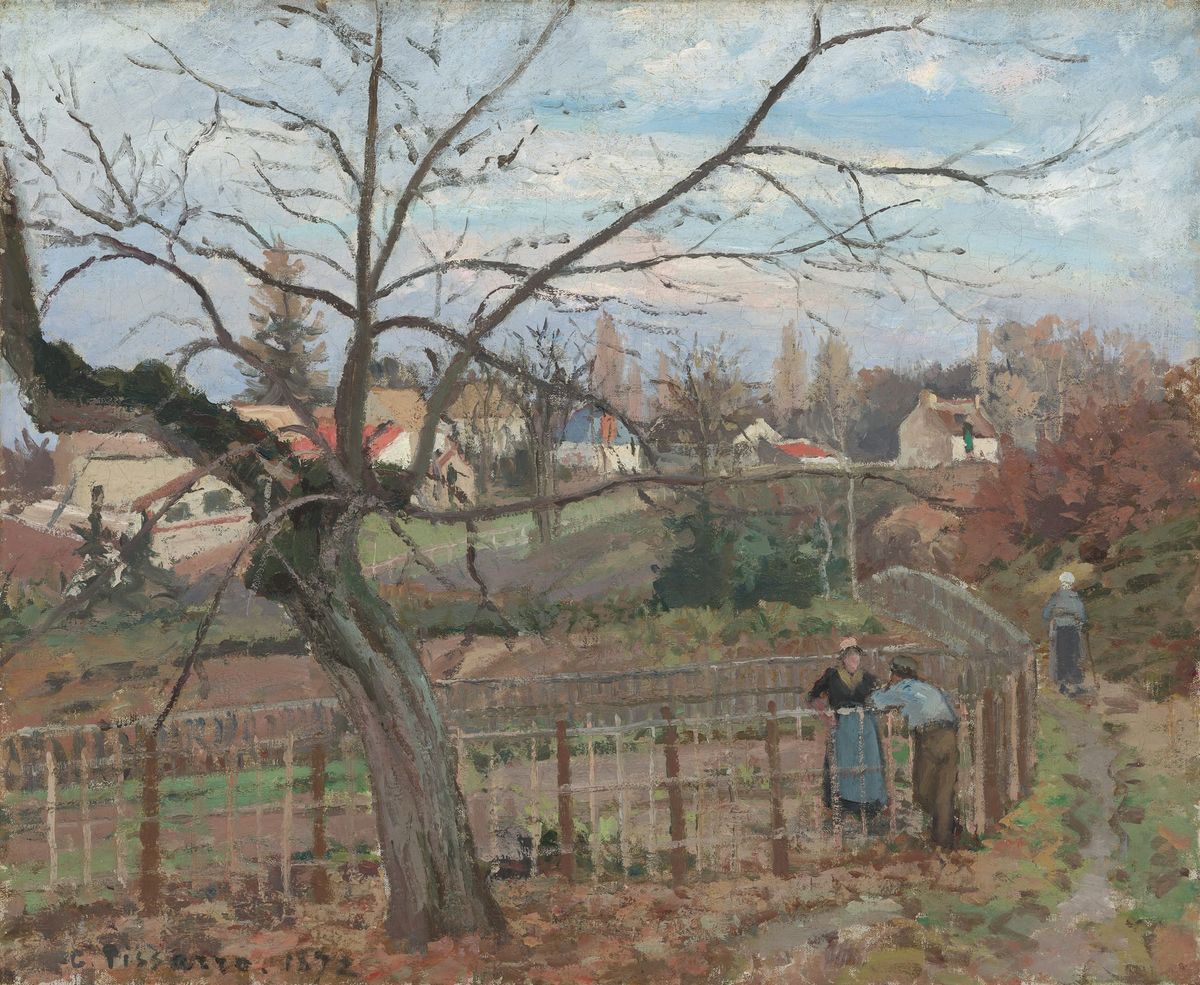
1872년 보불전쟁의 상흔을 뒤로하고 퐁투아즈에 정착한 카미유 피사로는 텃밭을 둘러싼 소박한 나무 울타리와 그 곁에서 나누는 이웃들의 정겨운 대화를 캔버스에 담아냈습니다.
이 시기 피사로는 자연의 찰나적인 빛을 기록하는 것에 머물지 않고, 전원 풍경의 공간 구조를 격자형 울타리와 고목의 앙상한 가지들을 통해 엄격하면서도 서정적으로 구획하는 독창적인 조형 실험에 몰두하고 있었습니다. 가로 46cm, 세로 37.8cm 크기의 캔버스에 유채로 완성되어 현재 미국 워싱턴 국립 미술관(National Gallery of Art)에 소장된 이 작품은, 피사로의 퐁투아즈 초기 전성기를 알리는 수작으로 나뭇가지 사이로 비쳐드는 은은한 초봄의 햇살과 대지의 진솔한 정취를 완벽한 균형감으로 직조해 냈습니다.
관람자의 시각 인지 체계는 화면 좌측 전경에 우람하게 버티고 선 고목의 굵은 기둥과 사방으로 뻗어나간 날카로운 가지들의 그물망 구조에 가장 먼저 닻을 내립니다. 겨울을 이겨낸 거친 나무껍질의 짙은 음영과 푸른 하늘의 밝은 명도 대비는 시각 피질의 중심와를 즉각 포획하며 화면 전면에 단단한 시각적 문턱을 구축합니다.
이어서 시선은 나뭇가지의 선율을 타고 우측 하단으로 하강하여, 반원형으로 완만하게 굽어 돌아가는 울타리 곁에 기대어 정답게 대화를 나누는 남녀의 인물 군상으로 자연스러운 도약 안구 운동을 진행합니다.
푸른 앞치마를 두른 여인과 울타리에 팔을 괸 남성의 다정한 모습을 확인한 눈길은, 그 뒤편 오솔길을 따라 지팡이를 짚고 언덕을 올라가는 또 다른 노파의 점경을 지나, 중경에 늘어선 붉은 기와지붕 가옥들과 은은한 은회색 구름이 흐르는 하늘의 대기감 속으로 시원하게 확장됩니다.
대지의 촉각적인 흙빛과 나뭇가지 사이로 스며드는 온화한 자연광이 망막 위에서 하나의 완성된 전원 풍경으로 통합되는 순간, 관조자는 번잡한 일상의 긴장을 내려놓고 한적한 시골 마을의 평화로운 오후를 거니는 듯한 깊은 심리적 안도감과 내면의 평온을 마주하게 됩니다.
이 그림을 그릴 당시 피사로는 폴 세잔과 퐁투아즈에서 함께 작업하며, 전경에 나무나 울타리 같은 구조물을 전면에 배치하여 화면 너머의 공간을 들여다보게 만드는 '격자형 시각 스크린' 구성을 발전시키고 있었습니다.
그는 평범한 시골 마을의 텃밭과 울타리를 결코 하찮은 소재로 보지 않고, 흙을 일구며 살아가는 서민들의 정직한 노동과 삶의 쉼터로서 화면 전체에 묵직한 조형적 질서를 부여했습니다.
동시대의 동료 예술가들과 진보적 비평가들은 화려한 이상화 없이 시골의 진솔한 공기를 담아낸 피사로의 화폭을 두고 "대지의 뼈대와 자연의 진실한 숨결을 가장 지혜롭고 따뜻하게 결합한 거장의 눈"이라며 깊은 찬사를 보냈습니다.
소박한 울타리 너머로 피어나는 이웃 간의 온기와 대지의 영속성을 견고한 조형미와 섬세한 빛의 조화로 승화시킨 피사로의 '울타리'는, 현대 미술사에서 초기 인상주의가 성취한 가장 단단하고 정직한 풍경화의 모범으로 확고하게 평가받고 있습니다.
The Fence (La Clôture, 1872)
In 1872, having re-established his life and studio in Pontoise after the Franco-Prussian War, Camille Pissarro captured the rustic charm of a garden enclosed by a wooden fence, where local villagers pause for an unhurried conversation.
During this pivotal period, the master looked beyond fleeting optical impressions, passionately exploring how to structure pictorial space through geometric palings and the intricate tracery of bare branches. Measuring 37.8 by 46 cm and preserved in the National Gallery of Art in Washington, D.C., this exquisite oil on canvas stands as a foundational milestone of Pissarro's classical Pontoise years, harmonizing the crisp daylight of early spring with rigorous spatial clarity.
The observer’s perceptual framework instantly grounds itself upon the robust trunk of the weathered tree rising along the left foreground, its calligraphic branches fanning outward across the upper sheet. This dark, textured network of bare wood set against the pale blue sky arrests the fovea, establishing an intuitive and resolute architectural threshold.
From this foreground anchor, the ocular trajectory glides downward along the curving wooden fence in the lower right, pausing upon the intimate pair leaning against the palings in quiet conversation.
Tracking past the woman’s bright apron and the man’s rustic attire, the gaze ascends the sunlit footpath where an elderly villager walks with a cane, before sweeping across the terracotta-roofed cottages nestled along the ridge and expanding into the cloud-dappled sky above.
As the physical permanence of the tilled soil and the gentle breath of the cool afternoon air integrate into a unified visual harmony within the visual cortex, active visual scanning dissolves into profound contemplative stillness, attuned to the timeless serenity of the French countryside.
While executing this canvas, Pissarro was working in close artistic dialogue with Paul Cézanne, pioneering the use of foreground screens to build depth and geometric mass within open-air painting.
Rather than treating the enclosure as a mere barrier, Pissarro transformed the fence and garden plots into an enduring testament to the quiet dignity and harmonious routine of agrarian life.
Contemporary peers and progressive critics widely revered his unvarnished integrity, celebrating his extraordinary gift for uncovering tectonic strength, moral gravity, and poetic truth within the most unadorned corners of rural existence.
Masterfully harmonizing structural weight with delicate atmospheric poetry, Pissarro's view of the fence remains celebrated across art history as an enduring cornerstone of early Impressionist landscape painting.
본 콘텐츠의 저작권은 저작권자에게 있으며, 무단 전재 및 재배포를 금합니다.