트루빌의 별장 Villas at Trouville
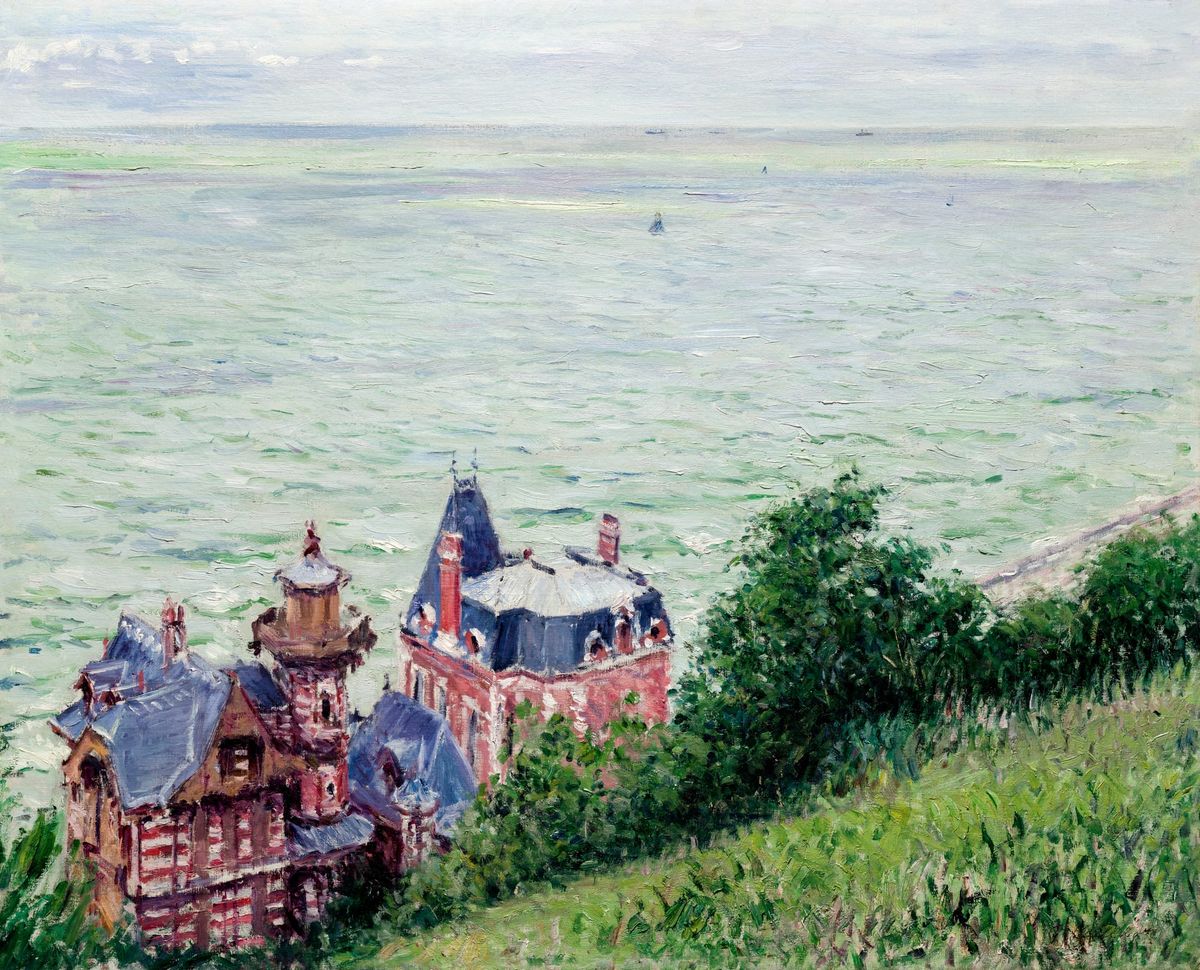
가파른 절벽 아래로 아스라히 펼쳐진 옥빛 바다 위에서 시원한 바람이 불어오는 듯한 이 작품은 귀스타브 카유보트가 1884년에 캔버스에 유채로 완성한 명작입니다. 세로 66cm, 가로 81.3cm의 실제 크기를 지니고 있으며, 당시 부르주아들의 휴양지였던 프랑스 노르망디 해안의 눈부신 풍광을 생생하게 담아내고 있습니다.
그림을 마주한 관람자의 시선은 가장 먼저 화면 왼쪽 하단에 굳건히 자리 잡은 붉은 벽돌의 화려한 별장에 안착합니다. 인간이 치밀하게 쌓아 올린 이 단단하고 무거운 건축물은 우리가 매일 발을 딛고 살아가는 이성적이고 통제 가능한 의식의 세계, 혹은 현실의 묵직한 무게감을 상징합니다.
하지만 이내 카유보트 특유의 과감하게 내려다보는 구도를 따라 우리의 눈길은 녹음이 우거진 비탈진 절벽을 미끄러지듯 타고 내려갑니다. 그리고 마침내 화면의 절반 이상을 가득 채우고 있는 아득한 바다의 수평선으로 빠르게 빨려 들어갑니다.
화면 앞쪽 별장과 언덕에 사용된 두텁고 거친 붓 터치가 먼바다로 나아갈수록 섬세하고 얇게 부서지듯 표현된 점은 매우 의도적입니다. 이는 감상자로 하여금 팍팍한 현실의 짐을 훌훌 벗어던지고, 한없이 넓고 푸른 무의식과 자유의 공간으로 해방되는 듯한 짙은 심리적 카타르시스를 경험하게 합니다.
카유보트는 인상파 화가이기도 했지만, 다른 동료들과 구별되는 아주 독특한 이력을 지니고 있었습니다. 1880년대 초반 트루빌 등 노르망디 해안에서 여름을 보냈던 그는 단순한 휴양객이나 관찰자가 아니었습니다. 카유보트는 자신이 직접 배를 설계할 정도로 전문적인 요트 제작자였으며, 수많은 요트 경주에 출전해 여러 차례 우승을 차지했던 열정적이고 뛰어난 항해사였습니다.
육지의 별장에서 바다를 굽어보는 이 그림의 구도 속에는 단순히 아름다운 풍경을 화폭에 담으려는 목적 그 이상의 것이 담겨 있습니다. 물결의 흐름과 바람의 방향을 누구보다 깊이 이해했던 항해사로서, 곧 저 넓은 바다 위로 직접 배를 띄워 대자연의 흐름과 하나가 되고자 했던 카유보트의 역동적인 숨결과 설렘이 고스란히 배어 있는 것입니다.
오늘날 미술사학자들은 이 작품을 비롯한 카유보트의 풍경화들에 매우 특별한 의미를 부여하고 있습니다. 생전의 그는 막대한 유산을 물려받은 부유한 환경 탓에, 화가 본연의 뛰어난 재능보다는 경제적으로 어려웠던 인상파 동료들의 그림을 사주는 든든한 후원자로서의 역할이 훨씬 더 부각되곤 했습니다.
그러나 후대의 평가를 통해 그가 파리 도심 풍경을 그릴 때 즐겨 썼던, 마치 사진기 렌즈로 내려다보는 듯한 파격적이고 깊은 원근법을 자연 풍경에도 완벽하게 적용했다는 사실이 재조명받게 되었습니다. 사진적인 구도와 인상주의의 빛나는 색채를 과감하게 결합시킨 그의 선구적인 시도는, 전통적인 풍경화에서 현대적인 시각 예술로 넘어가는 아주 중요한 연결 고리가 되었다고 평가받고 있습니다.
Looking as if a refreshing breeze is blowing over the faintly stretching jade-green sea below a steep cliff, this artwork is the masterpiece completed in oil on canvas by Gustave Caillebotte in 1884. The painting has actual dimensions of 66 by 81.3 centimeters and vividly captures the dazzling scenery of the Normandy coast in France, which was a highly popular resort destination for the bourgeoisie at the time.
Upon facing the painting, the viewer's gaze first lands firmly on the ornate, red brick villa situated solidly in the lower left corner of the canvas. This dense and heavy architectural structure, meticulously built by human hands, symbolizes the rational, controllable world of consciousness—the heavy reality where our daily lives are grounded.
However, following Caillebotte's signature bold, plunging perspective, our eyes soon glide down the sloping, lush green cliff. Finally, the gaze is rapidly drawn into the distant horizon of the sea, which occupies more than half of the entire canvas.
The way the thick, rough brushstrokes used for the villa and the hill in the foreground intentionally transition into delicate, fragmenting, and wispy touches toward the distant water is remarkable. This brilliant technique allows the viewer to experience a profound psychological catharsis, as if effortlessly casting off the heavy burdens of stark reality and being liberated into an infinitely vast, blue space of unconsciousness and true freedom.
While Caillebotte was an Impressionist painter, he possessed a highly unique background that distinguished him from his peers. Spending his summers on the Normandy coast, including Trouville, in the early 1880s, he was not merely a vacationer or a passive observer. Caillebotte was an expert yacht builder who even designed his own boats, and an impassioned, award-winning sailor who competed in numerous regattas.
The composition of this painting, looking down at the ocean from a coastal villa, contains much more than just an intention to capture a beautiful landscape. As a sailor who understood the flow of the currents and the direction of the wind more deeply than anyone else, the painting is thoroughly imbued with the dynamic breath and excitement of Caillebotte, who yearned to soon launch his boat onto that vast sea and become entirely one with the forces of mother nature.
Today, art historians assign very special significance to this piece and Caillebotte's other landscape paintings. During his lifetime, due to the immense fortune he inherited, his role as a generous patron who financially supported and purchased the works of struggling Impressionist colleagues was often highlighted far more than his own outstanding talent as an artist.
However, through later evaluations, his work has been re-examined, focusing on the fact that he perfectly applied the unconventional, deeply plunging perspective—much like looking through a camera lens—that he favored in his Parisian cityscapes to natural landscapes as well. His pioneering attempt to boldly combine a photographic composition with the luminous colors of Impressionism is now widely acclaimed as a crucial missing link that transitioned traditional landscape painting into modern visual art.
ⓒ 본 리뷰의 저작권은 "팔렛트제주"에 있으며, 무단 전재 및 재배포를 엄격히 금합니다. / Copyright 2026 by Palette Jeju. All rights reserved. Unauthorized reproduction or distribution is strictly prohibited.