숲속의 작은 다리 (The Little Bridge, Pontoise, 1875)
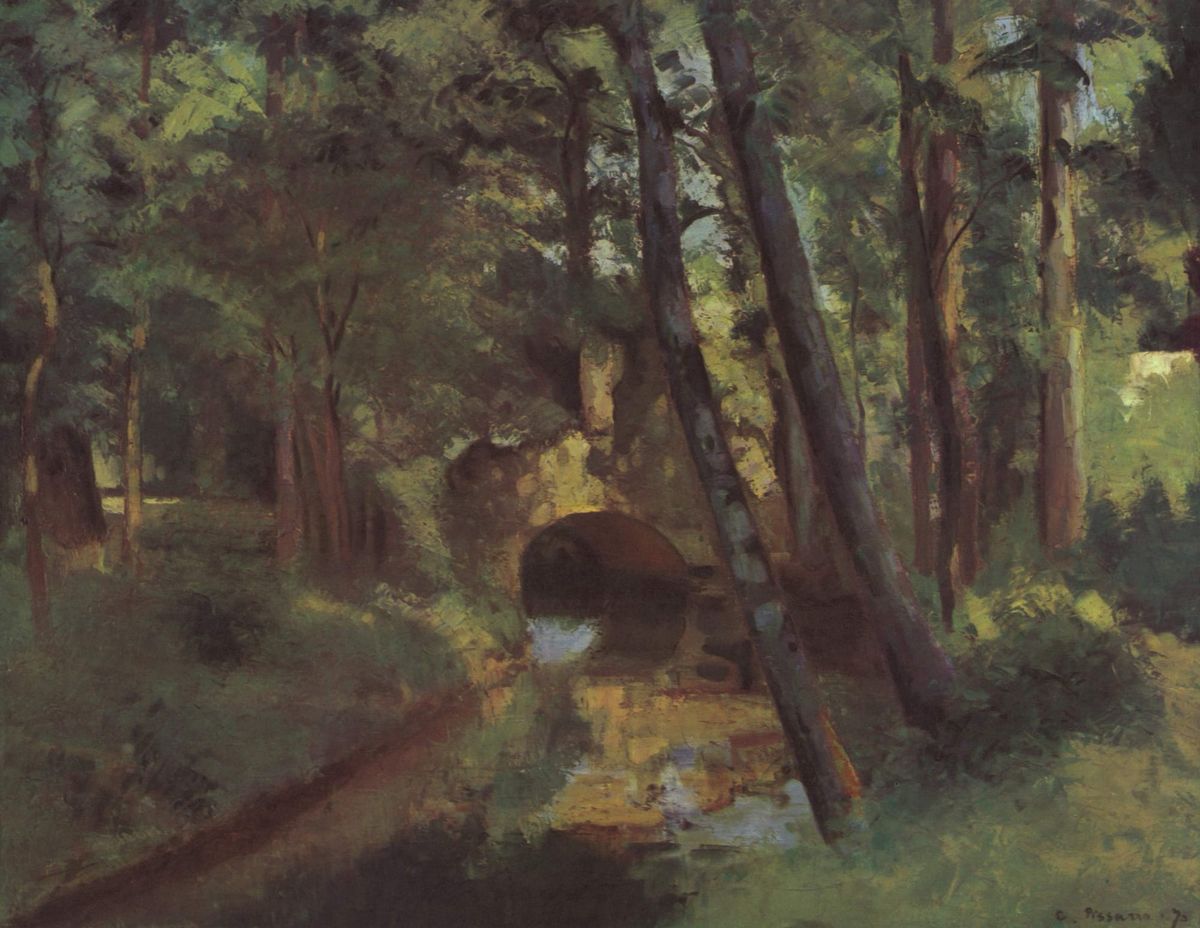
1870년대 중반 퐁투아즈에 머물던 카미유 피사로는 햇살이 쏟아지는 너른 들판뿐만 아니라 울창한 수풀이 우거진 깊은 숲의 내밀한 정취에도 깊은 관심을 기울였습니다. 동료 인상주의 화가들이 화사하고 눈부신 빛의 순간적인 떨림에 집중하던 시기에도 피사로는 자연의 뼈대를 이루는 나무와 흙, 물의 촉각적 질감과 구조적 양감을 놓치지 않았습니다.
가로 81cm, 세로 65.5cm 크기의 캔버스에 유채로 완성된 이 작품은 숲의 짙은 그늘 속으로 스며드는 은은한 빛과 고요한 물길을 가로지르는 아치형 석교의 조화를 묵직하면서도 서정적인 필치로 담아낸 퐁투아즈 전성기의 대표작입니다.
관람자의 시지각 체계는 화면 중앙에서 약간 오른쪽에 비스듬히 기울어진 굵은 나무 둥치들과 그 아래 흐르는 수면 위 황금빛 반사광에 가장 먼저 닻을 내립니다. 어두운 숲의 짙푸른 녹음과 수면에 투영된 따스한 햇살의 명암 대비는 시각 피질의 중심와를 즉각적으로 자극하며 화면의 중심축을 형성합니다.
이어서 시선은 물길을 거슬러 올라가며 화면 깊숙한 곳에 자리 잡은 아치형 돌다리의 어두운 터널 입구로 자연스럽게 이동합니다. 다리 위로 쏟아지는 한 줄기 햇살을 지나 좌우로 뻗은 울창한 나뭇가지들의 수직적 율동감을 훑어내는 시선의 궤적은, 2차원의 평면을 신비롭고 아늑한 3차원의 숲속 공간으로 확장합니다.
빛과 그림자가 교차하는 은밀한 숲의 침묵이 망막 위에서 하나의 완성된 풍경으로 결합하는 순간, 관람자는 일상의 번잡한 소음에서 벗어나 깊은 숲길에 오롯이 서 있는 듯한 고요한 공간적 안도감과 내면의 평온을 마주하게 됩니다.
이 그림이 그려진 1875년은 피사로가 폴 세잔과 거의 매일 야외 이젤을 나란히 세우고 예술적 교감을 나누던 결정적인 해였습니다. 피사로는 세잔에게 빛을 색채로 분할하여 다루는 부드러운 감각을 가르쳐주었고, 동시에 세잔이 가진 형태의 견고함과 양감에 대한 집념에 깊은 영향을 받았습니다.
특히 숲의 구조를 건축물처럼 단단하게 지탱하는 이 작품의 구도와 색채 배치는 세잔이 훗날 에스타크와 빅투아르 산을 그리며 현대 입체주의의 초석을 놓는 데 결정적인 영감을 제공했습니다. 당시 비평가들은 그의 숲 풍경을 두고 "자연의 뼈대와 침묵을 가장 진실하게 이해한 화가"라며 찬사를 아끼지 않았습니다.
자연의 거칠고 투박한 결을 인위적으로 다듬지 않고 대지의 묵직한 호흡과 빛의 신비로움을 담아낸 피사로의 숲 풍경화는, 오늘날 현대 미술사에서 인상주의가 지닌 조형적 깊이와 서정적 울림을 극한으로 끌어올린 걸작으로 확고하게 평가받고 있습니다.
The Little Bridge, Pontoise (Le Petit Pont, Pontoise, 1875)
During the mid-1870s in Pontoise, Camille Pissarro frequently ventured beyond sun-drenched fields into the intimate, shaded depths of secluded woodlands. While his Impressionist contemporaries often favored the dazzling, ephemeral shimmer of bright daylight, Pissarro maintained an enduring reverence for the tectonic weight of earth, timber, and reflective water.
Measuring 65.5 by 81 cm, this commanding oil on canvas represents a masterwork from his quintessential Pontoise period, capturing the quiet communion between ancient forest growth and a humble arched stone bridge crossing a tranquil stream.
The viewer's perceptual apparatus naturally anchors upon the dark, diagonally tilted tree trunks in the right-center foreground and the golden light reflected upon the water below. This striking chiaroscuro contrast immediately stimulates the fovea, establishing a steady compositional equilibrium amid the lush, shadowed foliage.
From this luminous water surface, the ocular trajectory glides inward along the stream toward the shadowed archway of the stone bridge nestled deep within the grove. Scanning through the textured vertical rhythms of surrounding trunks and the gentle patches of sunlight filtering through the canopy, the visual cortex synthesizes these loose, layered brushstrokes into an expansive three-dimensional sanctuary.
As the mysterious balance of deep shade and filtered daylight integrates into a harmonious sensory whole, the observer moves from active visual exploration into a state of profound contemplative stillness, wrapped in the restorative quietude of the secluded woods.
Created during the peak of Pissarro's intensive working partnership with Paul Cézanne, this piece embodies a fertile moment of mutual artistic evolution. While Pissarro guided Cézanne toward a lighter, more vibrant palette, he simultaneously absorbed Cézanne's instinct for structural solidity and mass.
The robust architectural weight of this forested composition directly nourished Cézanne's journey toward the structural principles that would later anchor modern Cubism. Contemporary observers and fellow painters universally revered Pissarro's rare ability to render the authentic, silent dignity of nature without sentimental distortion.
By preserving the raw, unvarnished integrity of the landscape while capturing the nuanced poetry of filtered light, Pissarro's woodland masterwork stands celebrated across art history as a timeless pinnacle of structural Impressionism.
본 콘텐츠의 저작권은 저작권자에게 있으며, 무단 전재 및 재배포를 금합니다.