수확 The Harvest
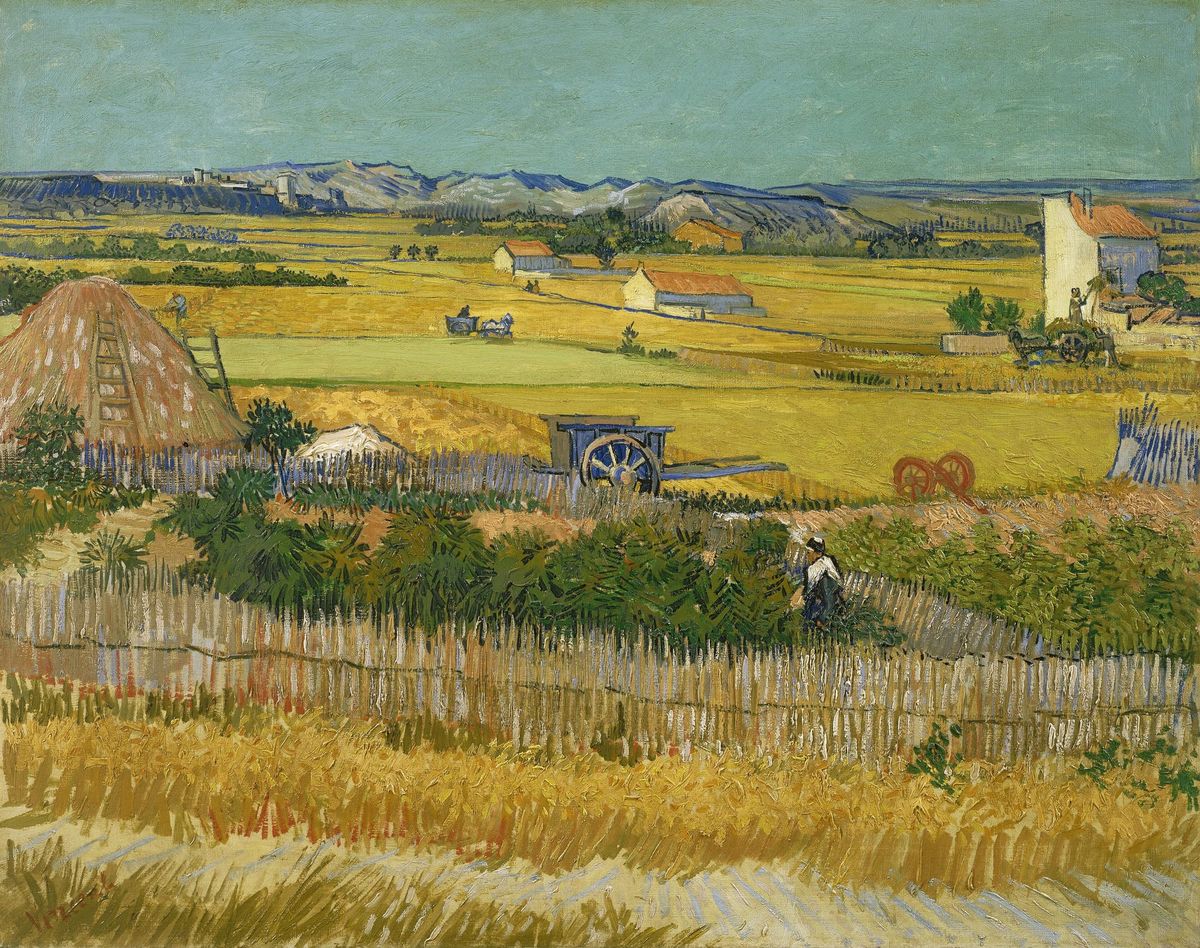
빈센트 반 고흐(Vincent van Gogh, 1853–1890)는 1888년 6월 프랑스 남부 아를에 체류하던 시기에 라 크로 평원의 눈부신 여름 풍경과 농부들의 대규모 수확 작업을 주제로 삼아 이 기념비적인 작품을 제작했습니다.
이 작품은 1888년 6월에 그려진 유채화로, 야콥 바르트 드 라 파이유의 전작 도록 기준 공식 등록번호는 F558이며 실제 작품의 실측 규격은 73.4 × 93.3 cm입니다.
현재 네덜란드 암스테르담에 위치한 반 고흐 미술관에서 소장하고 있습니다.
작가의 고뇌와 비하인드
아를 시기에 고흐는 눈부신 태양 아래 펼쳐진 광활한 평원과 밀밭의 풍요로움에 깊이 매료되었으며, 특히 동생 테오에게 보낸 편지에서 이 작품을 자신의 가장 뛰어난 회화적 성취 중 하나로 꼽으며 큰 애정을 드러냈습니다.
화면 전면에는 촘촘하게 세워진 나무 울타리와 그 너머로 무성하게 자라난 초록빛 농작물들, 그리고 파란색 마차와 붉은색 농기구가 묵직한 질감으로 배치되어 있습니다.
중경에는 황금빛으로 물든 광활한 밀밭 사이에 거대한 건초더미가 쌓여 있고, 그 주변에서 사다리를 오르며 바쁘게 일하는 농부들과 수레를 끄는 말들의 활기찬 일상이 펼쳐집니다.
원경의 지평선 너머에는 붉은 지붕의 농가들과 함께 아스라이 펼쳐진 보랏빛 아르 몽블 산맥이 수평으로 길게 이어져 남프랑스의 드넓은 공간감을 완성합니다.
무의식 속 시선 및 심리 흐름
관람객의 시선은 가장 먼저 화면 하단을 가득 채운 황금빛 밀밭과 전면의 나뭇가지 울타리 질감에 안정적으로 닿게 됩니다.
이어지는 시선은 화면 중앙의 파란색 마차와 거대한 건초더미, 그리고 바쁘게 움직이는 농부들의 역동적인 중경 공간으로 자연스럽게 흘러갑니다.
마지막으로 원경의 지평선과 평온한 하늘빛 대기감으로 시선이 넓게 퍼져나가며, 찬란한 여름 햇살 아래 펼쳐진 대지의 거대한 생명력과 평화로운 노동이 안겨주는 깊은 심리적 해방감을 경험하게 됩니다.
미술계의 평가와 조형미
미술사학계에서는 이 작품을 두고 고흐가 일본 목판화의 평면적 구도와 후기 인상주의의 대담한 색채를 결합하여 자연의 광활함과 노동의 신성함을 완벽하게 구현한 최고 걸작으로 평가합니다.
황금빛 밀밭과 대조를 이루는 청색 계열의 마차, 그리고 푸른 하늘이 자아내는 색채의 조화는 화면 전체에 눈부신 리듬감을 부여합니다.
눈에 보이는 풍경의 재현을 넘어, 태양 아래 익어가는 대지의 뜨거운 호흡과 인간의 묵묵한 삶을 캔버스 위에 영원히 아로새긴 위대한 미술사적 성취입니다.
The Harvest
Vincent van Gogh captured the brilliant summer radiance and vast agricultural expanse of the plain of La Crau near Arles in June 1888, creating one of the most ambitious and celebrated masterpieces of his career.
Created in June 1888, this oil on canvas is cataloged as F558 in J.B. de la Faille's catalogue raisonné and measures 73.4 × 93.3 cm.
The painting is currently housed in the Van Gogh Museum in Amsterdam.
During his prolific period in Arles, deeply inspired by the blazing southern sun and the golden abundance of the harvest, Van Gogh considered this landscape to be among his finest achievements, writing enthusiastically about it to his brother Theo.
The foreground is anchored by a rustic wooden fence, lush green vegetation, a blue cart, and farm equipment rendered with tactile brushwork.
In the middle ground, expansive golden wheat fields unfold alongside a massive haystack, dotted with farmworkers climbing ladders and horses pulling carts in the midst of their seasonal labor.
In the distant background, red-roofed farmhouses and the faint, rolling blue-purple silhouette of the Alpilles mountains stretch across the horizon, establishing a monumental sense of spatial depth.
The viewer's gaze is initially drawn toward the textured golden foreground and the structural lines of the fence.
The perspective then follows the sweeping expanse of the wheat fields inward toward the busy activity around the haystack and the blue cart in the middle ground.
Finally, the eye ascends toward the distant horizon and the tranquil sky, allowing the observer to experience a profound psychological transition from earthly industriousness to a radiant, expansive peace.
Art historians regard this canvas as a defining masterpiece where Van Gogh synthesized Japanese print aesthetics with Post-Impressionist color harmonies to celebrate the sacred dignity of rural labor.
The vibrant interplay between brilliant golden fields, striking blue accents, and a luminous sky generates an unmatched optical resonance.
It stands as an enduring artistic monument that immortalizes the sun-drenched vitality of the earth and the enduring rhythm of human existence.
본 컨텐트의 저작권은 팔렛트제주에 있습니다. 허가없는 무단전제를 금지합니다.
Copyright © Palette Jeju. All rights reserved. Unauthorized reproduction or redistribution is strictly prohibited.