씨 뿌리는 사람 The Sower
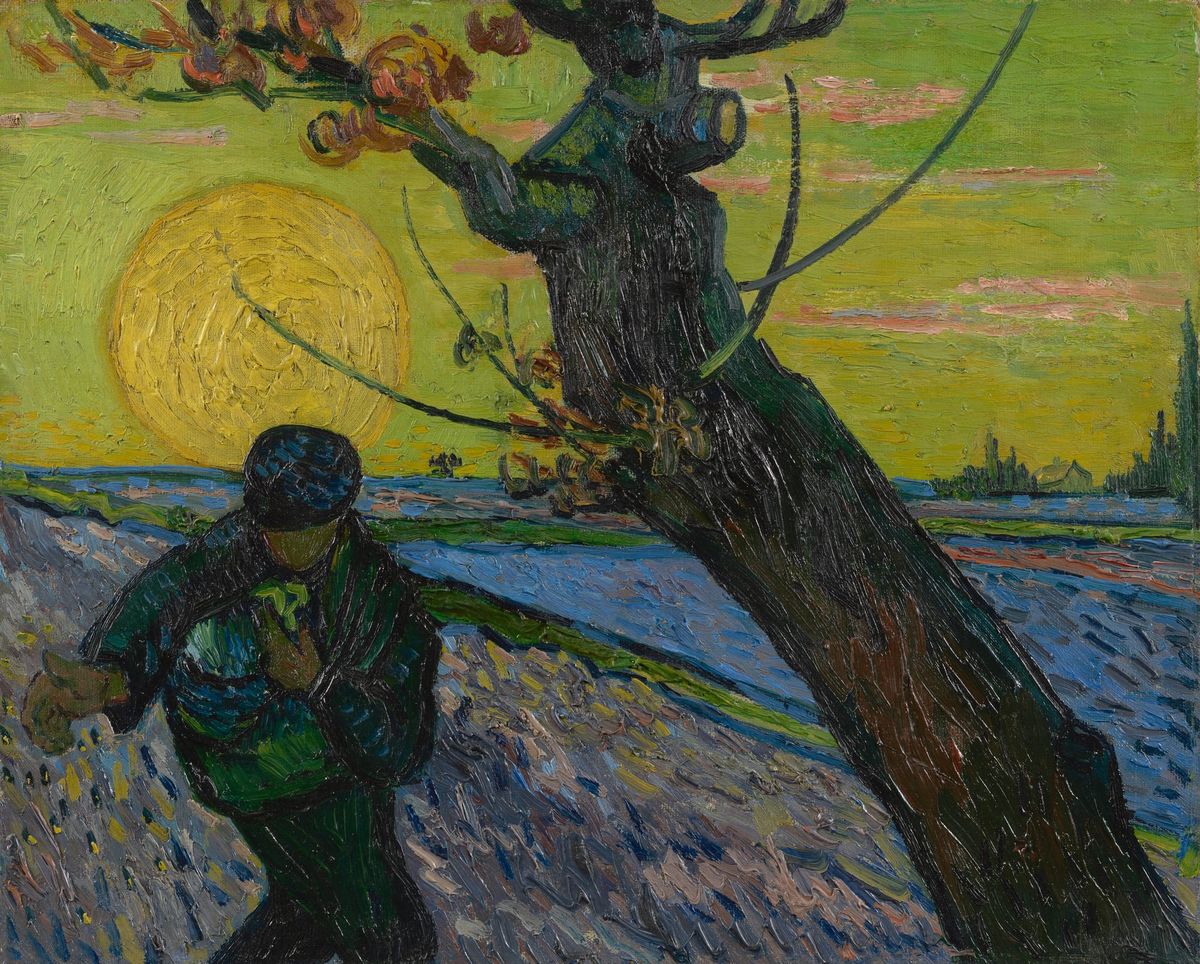
이 작품은 네덜란드의 후기 인상주의 거장 빈센트 반 고흐가 1888년 11월 프랑스 아를 체류 시기에 제작한 유화입니다. 공식 소장품 등록번호는 F450이며, 캔버스 위에 유채로 그려진 실제 실측 규격은 32 x 40.3 cm입니다. 현재 이 작품은 네덜란드 암스테르담에 위치한 반 고흐 미술관에 공식적으로 소장되어 있으며, 빈센트 반 고흐 재단의 관리 아래 전 세계 관람객들을 만나고 있습니다.
작가의 고뇌와 창작 비하인드
아를의 노란 집에서 폴 고갱과 머물며 예술적 교류를 이어가던 반 고흐는, 밀레의 회화적 전통을 잇는 동시에 일본 우키요에 판화의 파격적인 구도를 접목하여 완전히 새로운 종교적 상징화를 창조하고자 했습니다. 그는 대자연 속에서 생명을 일구는 씨 뿌리는 농부의 모습을 인류의 구원과 영원한 생명의 순환으로 여겼으며, 눈에 보이는 현실을 넘어 내면의 감정을 과감한 색채로 분출하는 실험에 몰두했습니다.
작품 전경에는 화면 오른쪽을 대각선으로 과감하게 가로지르는 짙은 갈색의 커다란 나무 기둥이 묵직하게 솟아 있으며, 그 아래로 푸른 작업복을 입은 농부가 묵묵히 발걸음을 옮기며 씨앗을 뿌리고 있습니다. 중경에는 푸른색과 보랏빛 붓터치가 물결치듯 교차하는 밭고랑이 대지의 깊은 질감을 형성하며 끝없이 펼쳐집니다.
배경으로는 왼쪽 하늘 높이 둥근 황금빛 태양이 거대한 후광처럼 눈부신 광채를 뿜어내며 자리 잡고 있고, 분홍빛 구름이 흩날리는 연두색 하늘이 어우러져 신비롭고 영적인 대기감을 자아냅니다.
무의식 속 시선 및 심리 흐름
관람객의 시선은 가장 먼저 화면 왼쪽 상단에서 거대한 원형으로 타오르는 황금빛 태양과 그 앞을 대각선으로 가로지르는 굵은 나무 기둥의 실루엣으로 향하며, 화면이 뿜어내는 강렬한 시각적 충격에 압도당합니다. 이어지는 시선은 나무 줄기를 타고 아래로 내려와 밭을 딛고 묵묵히 걷는 농부의 역동적인 손짓과 어두운 옷자락의 중경으로 닿으며, 고단한 삶 속에서도 멈추지 않는 노동의 숭고함을 체감하게 됩니다.
시선이 다시 보랏빛과 청색의 밭이랑을 거쳐 연두빛 하늘의 신비로운 배경으로 확장될 때, 관람객은 일상의 풍경을 초월한 거대한 생명의 숨결과 마주하며 깊은 정서적 몰입을 경험합니다. 이 일련의 시선 이동은 한 편의 농촌 풍경을 넘어, 가혹한 현실 속에서도 영원한 빛을 향해 씨앗을 뿌리고자 했던 화가의 숭고한 영혼의 외침을 고스란히 느끼게 만듭니다.
미술계의 평가 및 조형미
미술사학계와 평단은 본 작품을 고흐가 아를 시기에 달성한 종합주의적 조형 혁신의 정점이자, 서양 유화에 동양 판화의 대담한 시각을 완벽하게 녹여낸 걸작으로 평가합니다. 캔버스를 사선으로 가로지르는 비스듬한 나무 배치는 화면에 파격적인 긴장감을 불어넣으며, 두껍고 거친 붓질의 질감은 흙과 나무의 실재감을 손에 잡힐 듯 생생하게 전달합니다.
노란색 태양과 보랏빛 대지, 그리고 초록빛 하늘이 이루는 극적인 보색 대비는 시각적 울림을 극대화하며 회화의 순수한 표현력을 절정으로 끌어올립니다. 대자연의 순환과 인간의 실존을 독창적인 색채와 구도로 승화시킨 이 작품은, 시대를 초월해 관람객의 마음에 깊은 감동을 전하는 불멸의 예술적 가치를 증명합니다.
The Sower
Executed in late November 1888 during his stay in Arles, France, this oil painting is a groundbreaking masterpiece by the Dutch Post-Impressionist master Vincent van Gogh. Officially cataloged under inventory number F450 and measuring 32 x 40.3 cm on canvas, the work is preserved in the permanent collection of the Van Gogh Museum in Amsterdam under the auspices of the Vincent van Gogh Foundation.
The Artist's Turmoil and Creative Background
Created during his intense shared residency with Paul Gauguin at the Yellow House, this work represents Van Gogh's ambitious attempt to reinvent Jean-François Millet's agrarian iconography through the bold aesthetic principles of Japanese ukiyo-e woodblock prints. Viewing the figure of the sower as a sacred embodiment of resurrection and the cyclical rhythm of nature, the artist moved beyond conventional naturalism to create an intensely expressive visual language dominated by symbolic color and stylized forms.
The foreground is dramatically bisected by the dark, diagonal trunk of a pollarded tree that stretches aggressively across the right side of the canvas, framing the striding peasant who scatters seed across the furrows. In the middle ground, rich bands of violet and deep blue animate the plowed soil with rhythmic, heavy brushstrokes that evoke the primordial fertility of the earth.
The background is dominated by an immense, halo-like yellow-green sun hovering low on the horizon, illuminating an evocative chartreuse sky accented with delicate pink clouds to charge the atmosphere with transcendent spiritual resonance.
Psychological Flow and the Unconscious Gaze
The viewer's gaze is immediately arrested by the monumental solar disc and the stark, silhouetted tree trunk that boldly divides the pictorial plane, creating a sense of dynamic visual dissonance. The eye then glides downward along the leaning trunk to the middle-ground figure of the sower, whose rhythmic stride and focused labor anchor the composition in human perseverance.
As the gaze expands across the undulating violet field and recedes into the luminous, spectral sky, the observer is enveloped in a profound contemplation of cosmic scale and renewed hope. This calculated optical path guides the viewer from a startling compositional confrontation into an empathetic resonance with the artist's yearning for spiritual renewal amid worldly suffering.
Critical Acclaim and Formal Analysis
Art historians and critics celebrate this painting as one of the definitive achievements of Van Gogh's Synthetist experiments in Arles, underscoring his brilliant assimilation of Japanese cropping techniques into Western oil painting. The deliberate flattening of space combined with heavy, tactile impasto lends sculptural weight to the soil and vegetative matter while sustaining a modern graphic immediacy.
The radical complementary orchestration of brilliant yellows against deep violets and glowing greens elevates chromatic harmony to an emotional and symbolic height. Fusing reverence for agrarian life with visionary pictorial daring, this masterwork stands as an enduring testament to Van Gogh's transcendent genius.
본 컨텐트의 저작권은 팔렛트제주에 있습니다. 허가없는 무단전제를 금지합니다.
Copyright © Palette Jeju. All rights reserved. Unauthorized reproduction or redistribution is strictly prohibited.