쓸쓸한 가을 숲에 울려 퍼진 신앙과 가족의 기억, 뉘에넌의 개혁교회에서 나오는 신도들 Congregation Leaving the Reformed Church in Nuenen
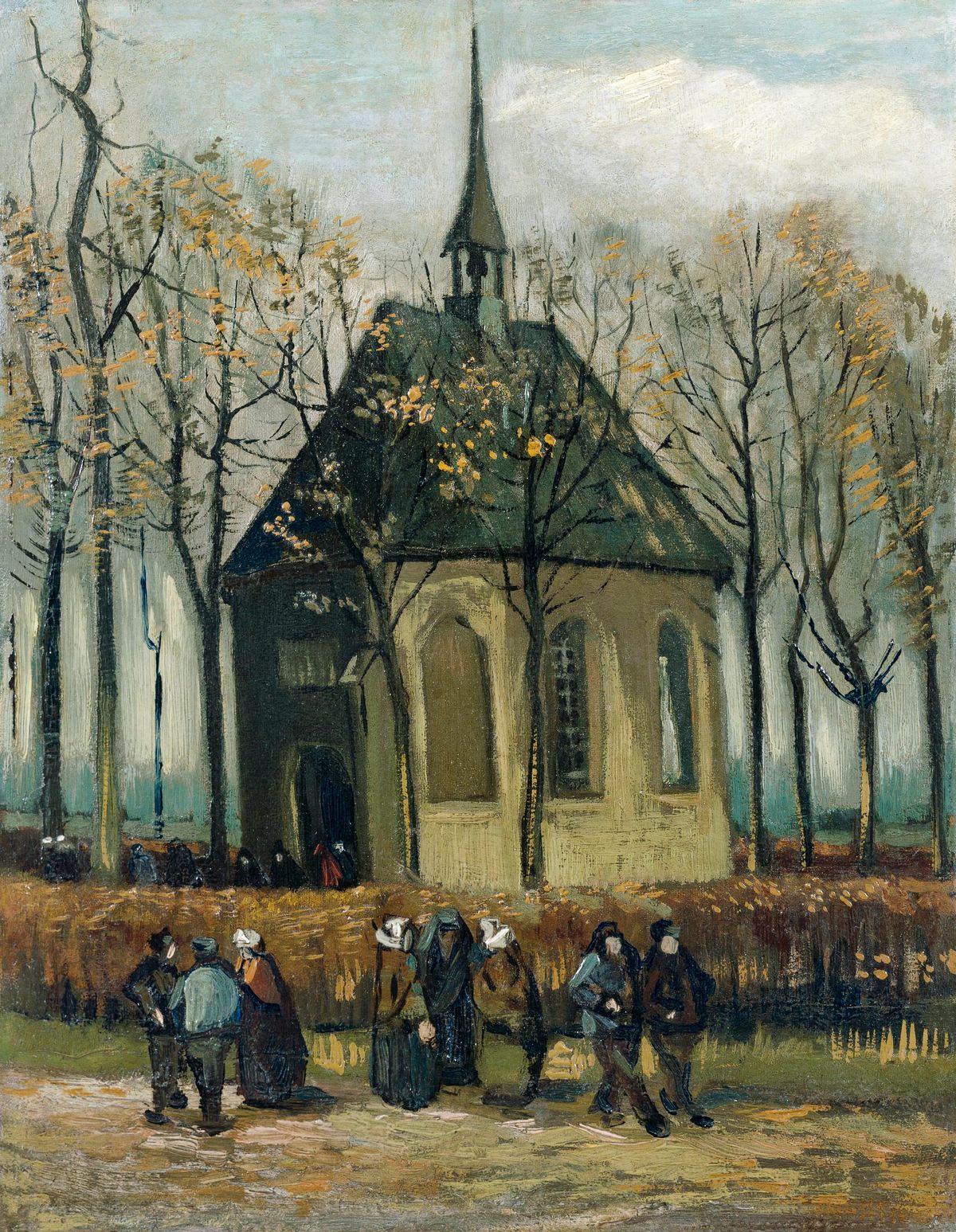
네덜란드의 후기 인상주의 거장 빈센트 반 고흐(Vincent van Gogh, 1853–1890)가 1884년 초에 완성하고 1885년 가을에 다시 덧칠하여 수정한 유화 《뉘에넌의 개혁교회에서 나오는 신도들(Congregation Leaving the Reformed Church in Nuenen)》은 41.5 cm × 32.2 cm 크기의 캔버스에 유채로 그린 대표작으로, 현재 네덜란드 암스테르담의 반 고흐 미술관(Van Gogh Museum)에 영구 소장되어 있습니다.
어머니를 향한 위로와 아버지의 사후에 더해진 애도의 붓질
1883년 말, 부모님이 머물던 네덜란드 남부 브라반트의 시골 마을 뉘에넌으로 돌아온 고흐는 대퇴골 골절 부상으로 병상에 누워 있던 어머니를 위해 정성을 다해 붓을 잡았습니다. 목사였던 아버지가 설교하던 작은 개혁교회의 소박한 모습을 담아 어머니의 빠른 쾌유를 빌고자 완성한 이 그림은, 1885년 초 아버지가 뇌졸중으로 갑작스럽게 세상을 떠나면서 깊은 비통의 상징으로 변모했습니다.
고흐는 1885년 가을, 원래 푸른 잎이 무성하던 여름 풍경의 캔버스를 다시 꺼내어 잎이 다 떨어진 앙상한 가을 나뭇가지로 덧그렸습니다. 또한 교회 문을 나서는 마을 사람들의 옷차림을 검은색 상복과 애도의 망토로 고쳐 칠하며 아버지의 죽음을 추모하는 비장한 장례의 분위기를 불어넣었습니다. 2002년 도난당했다가 2016년 기적적으로 회수된 드라마틱한 역사를 지닌 이 작품은, 가족과의 갈등과 사랑, 그리고 이별의 아픔이 고스란히 층위를 이루며 굳어진 고흐 청년기의 가장 내밀한 가족사적 기록입니다.
무의식 속 시선의 순환과 고요한 엄숙함
감상자의 시선은 화폭 전면에 무리 지어 교회 밖으로 걸어 나오는 신도들의 짙은 검은색과 회갈색 옷자락으로 가장 먼저 이끌립니다. 흰색 보닛과 짙은 망토를 두른 여인들과 모자를 쓴 남성들의 엄숙한 행렬은 보는 이의 무의식 속에 경건하면서도 쓸쓸한 정적을 불러일으킵니다.
이어 시선은 신도들의 발걸음을 지나, 화면 중앙에 단단하게 자리 잡은 소박한 벽돌조 교회의 뾰족한 첨탑과 지붕으로 자연스럽게 상승합니다.
그 후 시선은 잎을 떨군 앙상한 포플러나무들의 메마른 가지들을 타고 화면 상단의 잿빛 하늘로 흩어졌다가, 땅바닥에 융단처럼 깔린 붉은빛 갈색 낙엽들의 흙길로 완만하게 하강합니다. 브라반트 특유의 묵직한 흙빛과 엄숙한 검은색이 자아내는 톤의 일치 속에서, 관람자는 의식하지 못하는 사이 늦가을의 서늘한 공기와 화가가 가슴에 품었던 아버지에 대한 회한과 애틋한 추모의 정서에 깊이 젖어들게 됩니다.
네덜란드 시기 리얼리즘의 완숙과 영적 상징성, 미술사적 평가
미술계는 이 작품을 반 고흐가 헤이그와 뉘에넌을 거치며 완성한 네덜란드 초기 리얼리즘 화풍의 정점을 보여주는 수작으로 평가합니다.
프랑스 바르비종파와 헤이그파의 영향을 짙게 받은 어둡고 묵직한 톤 속에서도, 건축물의 비례와 인물 군상의 배치, 그리고 계절의 정취를 섬세하게 포착한 조형 감각은 훗날 《감자 먹는 사람들》로 이어지는 리얼리즘의 든든한 토대가 되었습니다. 종교적 제도권에 안주하지 않고 가난한 이웃과 가족의 진솔한 삶을 담아내려 했던 초기 반 고흐의 진지한 탐구 정신이 오롯이 새겨진 명작으로 미술사에 기록되어 있습니다.
Faith, Memory, and Solitary Mourning in Autumn, Congregation Leaving the Reformed Church in Nuenen
Painted in early 1884 and reworked in the autumn of 1885 in Nuenen by Vincent van Gogh (1853–1890), Congregation Leaving the Reformed Church in Nuenen is an oil on canvas measuring 41.5 cm × 32.2 cm (16.3 in × 12.7 in), preserved in the permanent collection of the Van Gogh Museum in Amsterdam, Netherlands.
A Gift for a Convalescing Mother Transformed into an Elegy for a Father
Returning to his parents' parsonage in the rural Brabant village of Nuenen in late 1883, Vincent originally conceived this delicate canvas as an affectionate gift for his bedridden mother, who was recovering from a broken thigh bone. Depicting the modest Reformed church where his father preached, the painting was intended as a soothing token of familial comfort; however, following his father’s sudden death from a stroke in March 1885, the canvas took on an entirely new and sorrowful dimension.
In the autumn of 1885, Van Gogh returned to the composition, stripping the summer foliage from the surrounding trees and replacing them with bare, autumnal branches adorned with sparse yellow leaves. Furthermore, he repainted the congregants emerging from the portal, outfitting them in black shawls and mourning attire to commemorate his father's passing. Famously stolen in a daring heist in 2002 and recovered in 2016, this masterpiece preserves the emotional layers of filial grief and familial reconciliation etched into the very pigments of Vincent’s early career.
Psychological Trajectory of the Gaze and Unconscious Solemnity
The observer’s subconscious gaze is immediately welcomed by the cluster of churchgoers in the foreground. The dignified contrast between the bright white bonnets and the heavy black mourning cloaks creates an immediate aura of quiet reverence and communal solidarity.
From this grounded procession, visual perception ascends along the warm masonry of the nave toward the slender bell tower pointing into the overcast Brabant sky.
The eye then sweeps across the delicate, skeletal branches of the bordering poplars before settling back down upon the rust-colored carpet of fallen leaves covering the foreground road. Navigating the harmonious sobriety of deep earth tones and mournful blacks, the viewer subconsciously internalizes the crisp chill of late autumn and the profound, silent elegy woven into the fabric of the rustic sanctuary.
Brabant Realism and Spiritual Resonance: Critical Legacy
Art historians celebrate this canvas as an exceptional milestone of Van Gogh’s early Dutch period, marking the full maturity of his tone-oriented realism before his departure for France.
Deeply indebted to the Hague School and the Barbizon tradition, Vincent’s austere palette and disciplined handling of light imbue the modest village structure with psychological weight and timeless dignity. Foretelling the profound humanism of The Potato Eaters, this work stands as a poignant testament to Van Gogh’s early artistic convictions, documenting both the unadorned truth of provincial life and the intimate depths of his family history.
Copyright © Palette Jeju. All rights reserved. Unauthorized reproduction or redistribution is strictly prohibited.
본 컨텐트의 저작권은 팔렛트제주에 있습니다. 허가없는 무단전제를 금지합니다.