시인의 정원 - The Poet's Garden (The Public Garden with a Couple and a Blue Fir Tree)
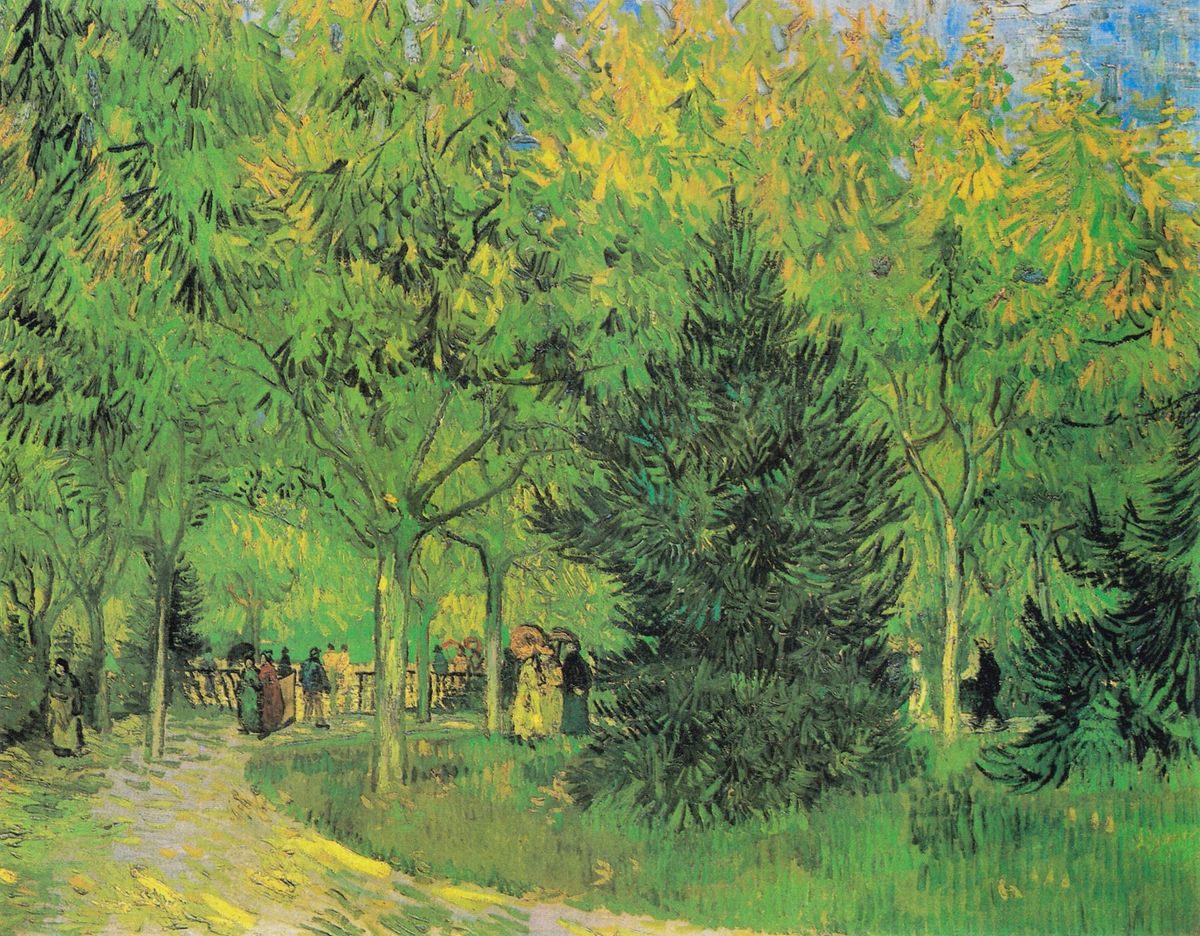
빈센트 반 고흐(Vincent van Gogh, 1853–1890)가 1888년 9월 프랑스 남부 아를(Arles)에서 완성한 '시인의 정원(The Poet's Garden)'은 캔버스에 유채(Oil on canvas)로 제작된 풍경화입니다. 작품의 실제 규격은 세로 73.0cm, 가로 92.1cm이며, 현재 개인 소장(Private Collection) 처에 보존되어 있습니다.
고흐는 이 작품에서 화면을 압도하는 짙푸른 전나무와 황금빛으로 물들어가는 수목의 잎사귀들을 조각하듯 두텁게 얹어 올리는 특유의 임파스토(Impasto) 기법으로 표현했습니다. 캔버스 전면을 메운 싱그러운 에메랄드 그린과 옐로 오커, 그리고 하늘과 나무줄기 사이에 스며든 코발트 블루의 다채로운 색채 층위는 지중해의 따스한 가을 햇살 아래 생동하는 공기의 흐름을 시각화합니다. 특히 중앙의 빽빽한 전나무 덤불은 짧고 단단한 필치로 응축된 양감을 부여하고, 주변의 버드나무와 잔디밭은 물결치듯 유려한 터치로 대조시켜 정원에 풍성한 공간적 리듬을 불어넣었습니다.
이 그림에는 반 고흐가 새로운 예술가 공동체를 꿈꾸며 동료 화가 폴 고갱(Paul Gauguin)의 도착을 손꼽아 기다리던 시기의 가슴 뭉클한 인간적 에피소드가 깃들어 있습니다. 1888년 가을, 고흐는 아를의 라마르틴 광장 앞에 위치한 공공 정원을 매일같이 산책하며 이곳에 '시인의 정원'이라는 이름을 붙였습니다. 그는 중세 이탈리아의 위대한 시인 페트라르카와 보카치오가 거닐며 영감을 얻었을 법한 르네상스의 시적 이상향을 남프랑스의 정원 속에서 발견하고자 했습니다.
당시 고흐는 파리에서 곧 내려올 고갱의 침실 벽을 장식하기 위해 이 연작을 정성스럽게 그렸습니다. 그는 동생 테오에게 보낸 편지에서 "고갱이 도착했을 때 그의 방에 걸린 이 정원 그림들을 보고 진정한 시적 감흥과 환대를 느끼기를 바란다. 이곳은 위대한 시인들이 사색을 즐기던 거룩한 숲과 같다"며 친구를 맞이할 설렘과 기쁨을 고백했습니다.
작업 당시 고흐는 극심한 재정난 속에서도 식비를 아껴가며 고갱을 위해 최고급 안료를 구입해 캔버스에 아낌없이 쏟아부었습니다. 정원 벤치와 산책로를 따라 양산을 쓰고 다정하게 걸어가는 연인들의 모습은, 평생 지독한 고독과 애정 결핍에 시달리던 고흐가 마음속 깊이 갈망했던 따뜻한 인간적 유대와 영혼의 안식처를 투영한 애틋한 장면입니다.
후대의 미술사학자들과 평단은 이 작품을 반 고흐가 아를 시대에 도달한 가장 찬란하고 서정적인 자연 찬가이자, 색채를 통해 문학적 상상력과 인간애를 회화적으로 구현한 걸작으로 평가합니다. 대상의 표면적 모사를 넘어 공간 전체에 낭만적인 온기와 시적 숨결을 불어넣은 이 조형적 성취는 훗날 20세기 야수파와 표현주의 화가들에게 감정 표현의 무한한 가능성을 열어준 불멸의 이정표로 인정받고 있습니다.
관람자의 시선은 가장 먼저 화면 중앙에서 피라미드 형태로 웅장하게 솟아오른 짙푸른 전나무의 밀도 높은 질감에 머뭅니다. 이어 나무 뒤편 오솔길에서 노란 양산을 받쳐 들고 거니는 연인들의 다정한 실루엣을 지나, 좌측 하단으로 완만하게 굽어 내려오는 햇살 비치는 산책로와 단아한 나무 울타리를 따라 이동합니다. 마지막으로 화면 상단을 황금빛으로 가득 채운 버드나무 잎사귀들의 물결치는 리듬을 타고 화면 전체로 유려하게 확산됩니다.
심리적으로 관람자는 캔버스 전체를 포근하게 감싸는 싱그러운 녹색과 따스한 황금빛 햇살의 조화 속에서 일상의 긴장이 부드럽게 풀리는 깊은 정서적 이완을 경험하게 됩니다. 소중한 벗을 기다리며 정성껏 빚어낸 화가의 따뜻한 시선과 정원의 고요한 풍경은 현대인의 메마른 내면에 깊은 낭만적 위안과 마음의 평온, 그리고 삶을 향한 따뜻한 온기를 풍성하게 채워줍니다.
The Poet's Garden (The Public Garden with a Couple and a Blue Fir Tree)
Painted by Vincent van Gogh (1853–1890) in Arles in September 1888, The Poet's Garden is an iconic oil on canvas landscape measuring 73.0 cm in height and 92.1 cm in width. This masterwork is preserved within a distinguished Private Collection.
Van Gogh built the composition through an opulent interplay of tactile impasto and vibrant tonal gradations. The dense emerald greens, glowing ochres, and subtle blue undertones capture the luminous southern sunlight filtering through the canopy. The prominent central fir tree is constructed with thick, concentrated strokes that establish architectural weight, while the surrounding willows and sunlit paths are articulated with undulating, lyrical brushwork that animates the entire park setting.
The painting holds a deeply poignant history of artistic longing and human devotion. In the autumn of 1888, while preparing the Yellow House for the long-awaited arrival of Paul Gauguin, Van Gogh frequently visited the public park on Place Lamartine. Envisioning the setting as an earthly paradise where great Renaissance poets like Petrarch and Boccaccio might have walked, he christened the location "The Poet's Garden."
Van Gogh created this canvas specifically as a welcoming decoration for Gauguin's bedroom. Writing to his brother Theo, he expressed his tender anticipation: "I wanted to paint the garden in such a way that one would think of the old poet from these parts, the good Petrarch, and the new poet from these parts, Paul Gauguin." Despite skipping meals to afford expensive oil paints, Van Gogh poured his remaining resources into the canvas. The gentle couple strolling arm-in-arm beneath a yellow parasol reflects the artist's profound yearning for enduring companionship and domestic solace amidst his solitary existence.
Modern art historians celebrate this painting as a lyrical pinnacle of Van Gogh's Arles period. By elevating an urban park into a timeless sanctuary of poetic reverence, Van Gogh transcended literal documentation, achieving a profound synthesis of color, structural rhythm, and emotional truth that profoundly shaped early twentieth-century Expressionism.
A viewer’s gaze instinctively settles upon the dense, pyramidal mass of the dark blue-green fir tree at the center of the canvas. The eyes then journey past the intimate silhouettes of the strolling lovers and the rustic park fence, before following the sun-dappled gravel path downward toward the foreground. Finally, the gaze ascends through the shimmering golden willow leaves framing the upper composition, effortlessly circulating through the radiant landscape.
Psychologically, immersion in this verdant and amber palette induces an immediate sense of emotional openness, safety, and grounded tranquility. The gentle narrative of friendship and poetic sanctuary woven into the scenery eases modern anxieties and mental fatigue, enveloping the observer in an enduring atmosphere of nostalgic warmth, quiet reflection, and restorative peace.
본 리뷰에서 작품을 제외한 컨텐츠의 저작권은 팔렛트제주에 있습니다.
"퍼블릭도메인 고전명화"를 제외한 모든 창작 콘텐츠는 저작권법 제4조 및 제10조에 의거하여 보호됩니다. 무단 도용시 저작권법 제136조(벌칙)에 의거, 당사의 사전 서면 승인 없는 저작권 침해 행위를 금지합니다.