시엔의 어머니의 집 Sien's Mother's House
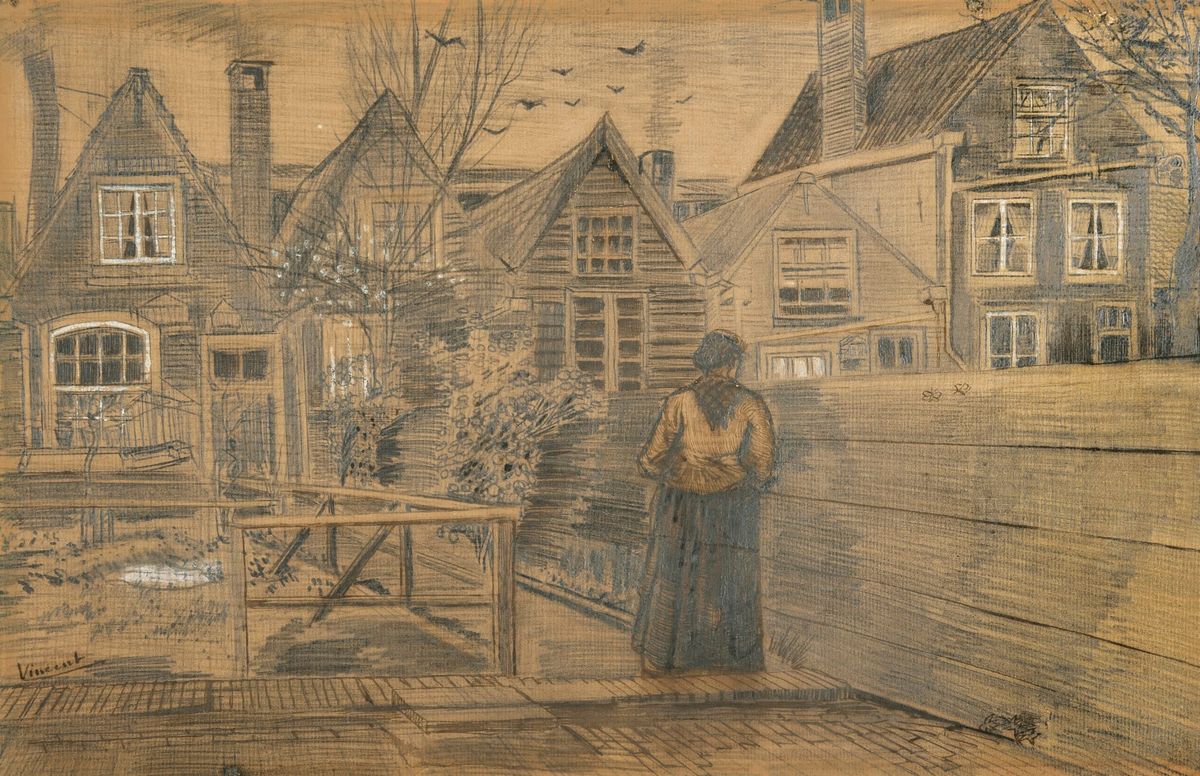
빈센트 반 고흐(Vincent van Gogh, 1853–1890)는 1882년 네덜란드 헤이그에 체류하던 시기에 도시 빈민가의 소박하고 쓸쓸한 풍경과 그곳에 사는 사람들의 일상을 기록하는 드로잉 작업을 진행했습니다.
이 작품은 그가 헤이그에 머물던 1882년 11월에 제작된 연필, 목탁, 흑백 분필을 활용한 드로잉으로, 야콥 바르트 드 라 파이유의 전작 도록 기준 공식 등록번호는 F957이며 실제 작품의 실측 규격은 37.5 × 58.5 cm입니다.
현재 네덜란드 암스테르담에 위치한 반 고흐 미술관에서 소장하고 있습니다.
작가의 고뇌와 비하인드
작품을 제작할 당시 헤이그의 거리는 차가운 가을비와 매서운 해풍이 몰아치며 빈민들의 고단한 삶을 더욱 짓누르고 있었고, 고흐 자신 역시 가난과 사회적 냉대 속에서 깊은 고독에 시달리고 있었습니다.
특히 당시 그는 전직 매춘부이자 알코올 중독자였던 시엔 호른과 함께 동거하며 거처를 제공받고 깊은 연민과 삶의 위안을 나누는 연인이자 모델 관계로 지내고 있었기에, 그녀의 어머니가 살던 이 골목의 풍경은 그에게 단순한 도시 변두리가 아닌 사랑과 고통이 뒤엉킨 삶의 현장이었습니다.
스산하고 쓸쓸한 공기가 온 도시를 감싸 안는 물리적 환경 속에서도 그는 소외된 이들의 삶의 터전을 정직하게 담아내고자 비바람을 견디며 이 풍경을 화폭에 담았습니다.
화면 전면에는 바닥의 벽돌 질감과 함께 담장에 기대어 서서 건너편을 바라보는 여인의 뒷모습이 묵직한 선으로 표현되어 있습니다.
중경에는 나무 판자로 세워진 높은 울타리와 작은 마당, 그리고 앙상한 나뭇가지들이 얽혀 소박하면서도 폐쇄적인 공간감을 형성합니다.
원경의 배경에는 뾰족한 지붕을 인 다락방 창문들과 굴뚝이 늘어선 네덜란드 전통 가옥들이 빽빽하게 이어져 있어 도시 변두리 특유의 적막하고 쓸쓸한 대기의 깊이감을 완성합니다.
무의식 속 시선 및 심리 흐름
관람객의 시선은 가장 먼저 화면 오른쪽 아래에서 담장에 기대어 선 여인의 어두운 실루엣과 정면의 묵직한 목재 울타리 질감에 닿으며 차분한 고요함을 느끼게 됩니다.
이어지는 시선은 울타리 너머의 작은 마당과 앙상한 나뭇가지를 거쳐, 왼쪽 아래에 새겨진 작가의 서명과 벽돌 바닥의 결을 따라 부드럽게 이동합니다.
마지막으로 멀리 배경을 채운 네덜란드 전통 가옥들의 뾰족한 지붕과 하늘을 나는 새들의 실루엣 속으로 시선이 넓게 퍼져나가며, 도시 변두리의 적막한 풍경 속에서 마주하는 아련한 그리움과 고독한 정서적 몰입을 체감하게 됩니다.
미술계의 평가와 조형미
미술사학계에서는 이 작품을 두고 고흐가 초기 네덜란드 시기에 연필과 목탄, 분필의 세밀한 명암 조화를 활용하여 도시 빈민가의 일상을 품격 있는 공간 예술로 승화시킨 수작으로 평가합니다.
화면 전체를 지배하는 차분한 갈색 톤과 흑백의 섬세한 선묘는 가난한 이들의 거주지가 지닌 독특한 서정과 시적 완성도를 높여줍니다.
눈에 보이는 풍경의 단순한 재현을 넘어, 화가가 가혹한 현실 속에서도 잃지 않았던 인간을 향한 따뜻한 시선과 예술적 진정성을 캔버스 위에 영원히 아로새긴 위대한 미술사적 성취입니다.
Sien's Mother's House
Vincent van Gogh captured the somber and unpretentious atmosphere of the working-class districts in The Hague through expressive works on paper during his formative Dutch period in November 1882.
Created in November 1882, this mixed-media drawing utilizing pencil, charcoal, and black and white chalk is cataloged as F957 in J.B. de la Faille's catalogue raisonné and measures 37.5 × 58.5 cm.
The artwork is currently housed in the Van Gogh Museum in Amsterdam.
During the period of its creation, a biting chill and damp autumn winds swept through the impoverished neighborhoods of The Hague, while Van Gogh himself endured crushing poverty, social isolation, and the heavy emotional burden of his difficult circumstances. At this crucial time, he was living with Sien Hoornik—a former prostitute and recovering alcoholic who had become his companion, primary source of domestic refuge, and artistic model—sharing a deep bond of mutual empathy and solace. Because Sien anchored his chaotic emotional world, her mother's neighborhood held a deeply personal and poignant significance for him, transforming a mere urban alleyway into a landscape charged with raw human attachment amidst a bleak physical environment. The foreground is anchored by the textured brick pavement and the quiet silhouette of a woman standing near a wooden fence, viewed from behind. In the middle ground, wooden barriers, a small courtyard, and bare, tangled branches establish a closed yet intimate spatial boundary. In the distant background, a row of traditional Dutch gabled houses with sharp rooftops and chimneys stretches across the upper register, establishing a quiet and melancholy urban atmosphere.
The viewer's gaze is initially drawn toward the woman leaning against the fence and the heavy texture of the wooden barrier in the lower right.
The perspective then follows the horizontal lines of the courtyard inward toward the houses, before drifting toward the artist's signature in the lower left corner.
Finally, the eye ascends into the distant rooftops and the faint silhouettes of birds in the sky, allowing the observer to experience a tranquil psychological transition from urban observation to a profound sense of solitude.
Art historians regard this drawing as a masterwork of Van Gogh's early Dutch period, where the delicate interplay of charcoal, chalk, and pencil elevates a humble neighborhood scene into a poignant architectural study.
The sophisticated tonal harmony and sensitive draftsmanship generate an exceptional visual rhythm and emotional depth.
It stands as an enduring artistic monument that immortalizes the artist's empathetic eye and his unwavering commitment to recording the quiet poetry of ordinary life.
본 컨텐트의 저작권은 팔렛트제주에 있습니다. 허가없는 무단전제를 금지합니다.
Copyright © Palette Jeju. All rights reserved. Unauthorized reproduction or redistribution is strictly prohibited.