스카프를 매는 시골 여인 (Paysanne nouant son foulard, c. 1880–1882)
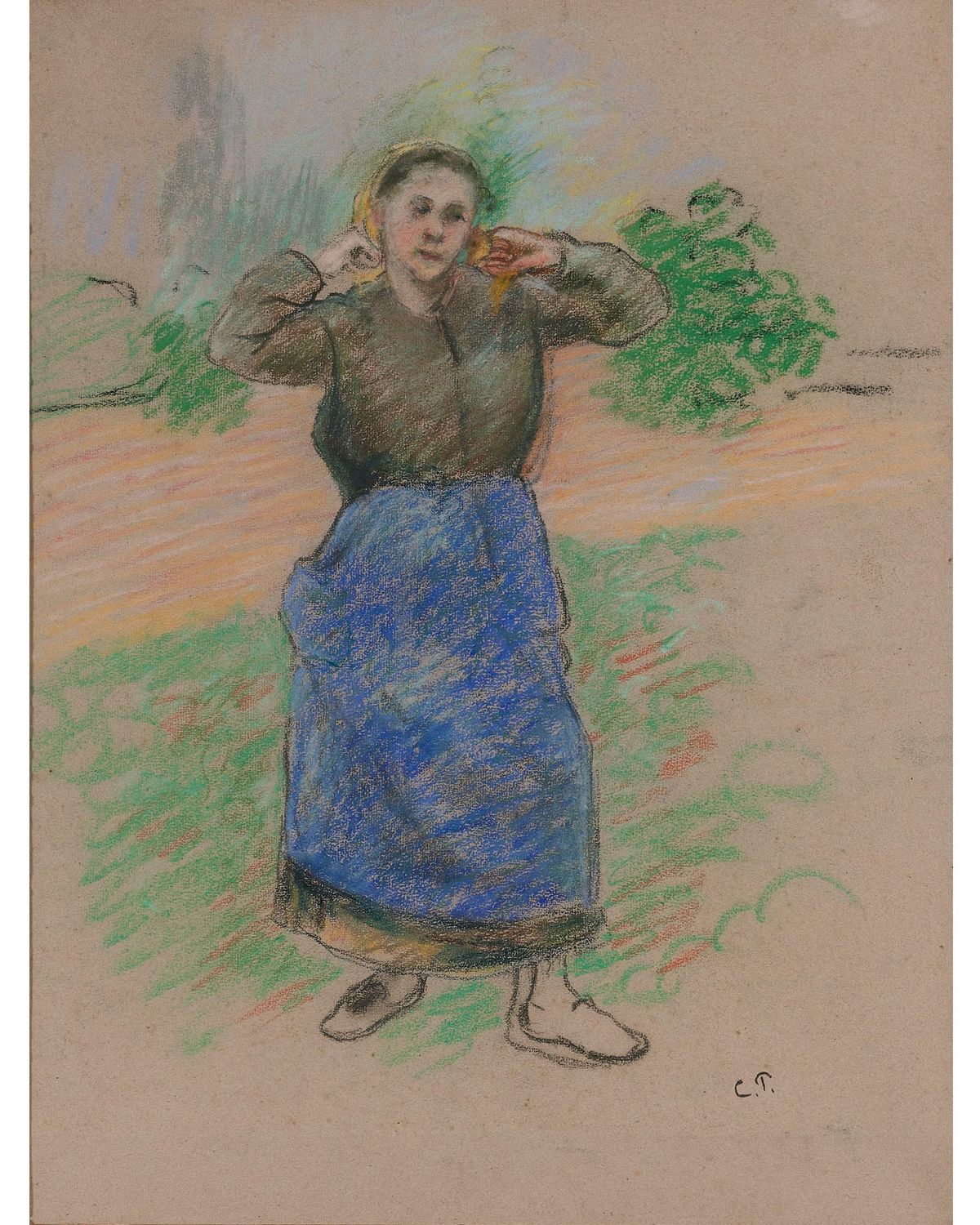
1880년대 초반 퐁투아즈에서 농촌 인물화의 새로운 조형적 가능성을 모색하던 카미유 피사로는 밭으로 나가기 전 머리수건을 매만지는 시골 여인의 찰나적인 몸짓을 화폭에 포착했습니다.
그는 유채 물감의 묵직함 대신 종이 위에 부드러운 목탄과 화사한 파스텔을 사용하여, 노동을 시작하는 순간의 활기와 소박한 일상의 아름다움을 경쾌하고도 즉흥적인 필치로 구현했습니다. 가로 31cm, 세로 47.5cm 크기의 종이 위에 완성된 이 파스텔 드로잉은, 피사로가 에드가 드가와 깊이 교류하며 매체의 표현력을 극한으로 끌어올렸던 시기의 뛰어난 관찰력과 형태 감각을 생생하게 증언하는 수작입니다.
관람자의 시각 인지 체계는 화면 중앙에서 가장 강렬한 채도를 뿜어내는 맑은 코발트 블루빛 앞치마와 그 위로 올라간 여인의 두 팔이 만드는 안정적인 삼각형 구도에 가장 먼저 닻을 내립니다. 짙은 푸른색 직물의 부드러운 파스텔 질감과 상의의 차분한 흙빛 톤이 자아내는 색채 대비는 시각 피질의 중심와를 즉각 포획하며 화면의 든든한 조형적 중심을 확립합니다.
이어서 시선은 수건 끝을 묶기 위해 머리 뒤로 들어 올린 여인의 투박한 손과 팔의 자연스러운 곡선을 따라 상승하여, 일터로 향하기 전 마음을 가다듬는 듯 담담하고 차분한 여인의 얼굴과 눈매로 자연스러운 도약 안구 운동을 진행합니다.
인물의 진솔한 표정을 확인한 시선은 목탄의 굵은 윤곽선으로 처리된 나막신과 발치 아래의 연둣빛 풀밭을 훑은 뒤, 배경에 연분홍빛과 살구빛 톤으로 가볍게 스케치된 시골길과 푸른 관목의 은은한 여백으로 부드럽게 확장됩니다.
종이 본연의 따스한 질감과 파스텔 가루의 보드라운 색채 입자가 망막 위에서 하나의 싱그러운 아침 공기로 통합되는 순간, 관조자는 대상의 화려한 겉치레를 걷어낸 순박한 일상의 순간과 마주하며 깊은 정서적 교감과 편안한 내면의 평온을 체험하게 됩니다.
이 작품을 구상할 당시 피사로는 드가와 함께 판화와 파스텔 기법을 공유하며, 인위적인 포즈가 아닌 생활 속에서 무의식적으로 드러나는 인간 신체의 자연스러운 율동을 포착하는 데 열정을 쏟고 있었습니다.
그는 고전적인 아카데미즘이 추구하던 비현실적인 여신이나 귀족의 자태 대신, 대지 위에서 살아가는 평범한 농촌 여성의 건강한 실존을 꾸밈없이 기록함으로써 근대 회화의 인간주의적 지평을 넓혔습니다.
동시대 미술계와 평론가들은 파스텔의 경쾌한 물질성을 살려 순간의 동작에 영구적인 생명력을 불어넣은 피사로의 솜씨를 두고 "순간의 몸짓 속에 깃든 영혼의 진실을 가장 투명하게 건져 올린 마술 같은 손길"이라며 높은 찬사를 보냈습니다.
찰나의 소박한 동작 속에 대지의 건강한 숨결과 인간 존엄을 눈부신 파스텔의 선율로 녹여낸 피사로의 이 인물 연구는, 현대 미술사에서 인상주의 드로잉이 도달한 가장 솔직하고 따뜻한 휴머니즘의 정점으로 확고하게 평가받고 있습니다.
Peasant Woman Tying Her Scarf (Paysanne nouant son foulard, c. 1880–1882)
During the early 1880s in Pontoise, Camille Pissarro explored the dynamic expressive possibilities of figurative art, capturing the unstudied gesture of a peasant woman tying her headscarf before heading into the fields.
Departing from the heavy impasto of traditional oil painting, the master utilized powdery pastel and charcoal on paper, rendering the spontaneous vitality of agrarian routine with remarkable freshness and structural clarity. Measuring 47.5 by 31 cm, this exquisite pastel drawing reflects Pissarro's intensive aesthetic dialogue with Edgar Degas, standing as an enduring testament to his extraordinary draftsmanship and acute psychological observation.
The observer’s perceptual framework instantly anchors upon the radiant cobalt blue apron draping the figure's lower body, framed by the firm triangular contour formed by her raised elbows. The vibrant chromatic resonance of the blue chalk against the muted earth tones of her jacket arrests the fovea, establishing an intuitive foundation of spatial and emotional stability.
From this solid base, the ocular trajectory ascends along the rhythmic curve of her arms toward the delicate task of fastening the golden-yellow kerchief, pausing upon her composed, reflective expression as she prepares for the day's labor.
After absorbing the quiet dignity of her countenance, the gaze descends along the charcoal-contoured wooden clogs resting on the grass, before expanding into the airy background where delicate pastel strokes suggest a sun-warmed path and gentle shrubbery.
As the raw texture of the paper and the powdery pigment grains integrate into a unified visual sensation within the visual cortex, active visual scanning dissolves into profound contemplative stillness, attuned to the restorative simplicity of rural life.
While executing this study, Pissarro was working closely with Degas to capture the authentic choreography of daily labor rather than stiff, academic studio postures.
By celebrating the unadorned presence of working-class women without condescension or sentimental melodrama, Pissarro elevated routine domestic moments into timeless monuments of human resilience.
Contemporary peers and progressive critics widely admired his pastel technique, praising his singular capacity to translate an ephemeral movement into a profound statement of moral and aesthetic truth.
Masterfully uniting energetic draftsmanship with deep humanist empathy, Pissarro's intimate pastel of the peasant woman remains celebrated across art history as an enduring pinnacle of Impressionist figurative drawing.
본 콘텐츠의 저작권은 저작권자에게 있으며, 무단 전재 및 재배포를 금합니다.