세속의 찬란한 영광 아래 숨겨진 죽음의 경고, 대사들 The Ambassadors
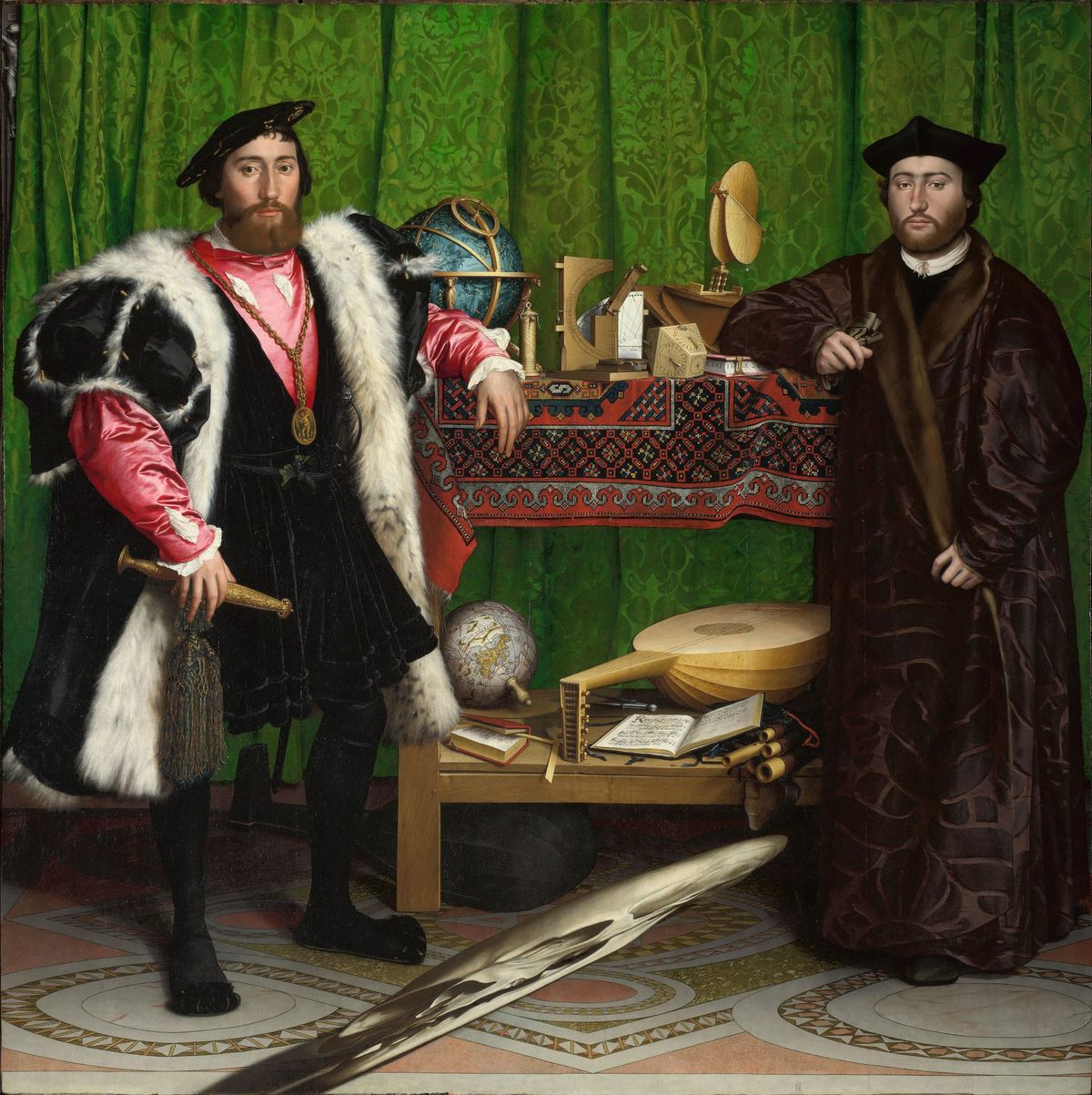
독일 르네상스의 거장 한스 홀바인(Hans Holbein the Younger, c. 1497–1543)이 1533년 영국 런던에서 완성한 유화 대사들(The Ambassadors, 또는 장 드 댕트빌과 조르주 드 셀브의 이중 초상)은 207.0 cm × 209.5 cm 크기의 참나무 패널에 유채로 그린 대표작입니다. 현재 영국 런던의 내셔널 갤러리(The National Gallery, London)에 소장되어 있습니다.
헨리 8세의 궁정에서 마주한 종교 분열과 바니타스의 비밀
1533년 봄 런던은 잉글랜드 국왕 헨리 8세가 왕비 캐서린과의 이혼을 강행하고 앤 불린과의 결혼을 선언하면서 로마 교황청과 파국으로 치닫던 일촉즉발의 공간이었습니다. 프랑스 국왕 프랑수아 1세의 명을 받고 런던에 파견된 젊은 대사 장 드 댕트빌은 거대한 외교적 중압감과 고독에 시달렸고, 절친한 벗이자 프랑스 라보르의 주교였던 조르주 드 셀브가 그를 위로하기 위해 런던을 극비리에 방문했습니다. 댕트빌은 이 짧은 만남과 당대의 위태로운 정세를 영원히 기록하기 위해 궁정 화가 한스 홀바인에게 두 사람의 기념비적인 초상화를 의뢰했습니다.
홀바인은 두 인물 사이에 2단 선반을 배치하고 르네상스 인문주의와 과학의 정수를 상징하는 온갖 진귀한 물건들을 가득 채웠습니다. 윗단에는 천체관측의, 해시계, 천구의 같은 하늘의 지혜를 두고, 아랫단에는 지구의, 수학책, 류트 악기, 마르틴 루터의 독일어 찬송가 악보를 배치했습니다. 특히 류트의 끊어진 줄 하나와 수학책의 나눗셈 페이지는 당시 가톨릭과 개신교로 갈라져 피를 흘리던 유럽의 종교적 불화와 갈등을 날카롭게 은유합니다. 무엇보다 화면 왼쪽 상단 녹색 커튼 뒤에 살며시 숨겨진 은색 십자가는 세속의 어떤 화려한 권력과 지식도 신의 절대적인 섭리 앞에서는 덧없음을 조용히 증언합니다.
왜곡된 해골과 마주하는 무의식 속 시선의 여정과 충격
그림을 마주하는 순간 관람객의 무의식적 시선은 좌우에 당당하게 버티고 선 두 젊은 귀족의 화려한 옷차림으로 가장 먼저 진입합니다. 댕트빌의 풍성한 검은 모피 코트와 번쩍이는 단검, 그리고 드 셀브의 차분한 다마스크 문양 가운은 당대 유럽 최고 지식인들의 세속적 성공과 권위를 실감하게 하며 보는 이에게 강한 시각적 압도감을 선사합니다.
이어 시선은 두 인물 사이에 놓인 2단 선반의 정밀한 정물들로 이동합니다. 완벽한 원근법과 극사실적인 질감으로 묘사된 나침반과 지구의를 훑어가며 감상자는 인간이 성취한 눈부신 르네상스 과학 문명과 지적 자부심에 깊은 경탄을 느끼게 됩니다.
하지만 시선이 바닥으로 내려앉는 순간, 발밑 대리석 바닥 위에 비스듬히 떠 있는 기괴하고 정체불명의 흐릿한 물체와 마주하며 시각적 충돌을 겪습니다. 정면에서는 뼈다귀처럼 길게 늘어져 형태를 알 수 없는 이 형상은, 그림의 오른쪽 대각선 끝으로 걸어가 좁은 각도로 비스듬히 바라보았을 때 비로소 완벽한 인간의 해골로 그 모습을 드러냅니다. 이 교묘한 왜상기법(Anamorphosis)을 통해 관람객은 부와 명예라는 지상의 환상에서 벗어나 언젠가 반드시 죽는다는 메멘토 모리(Memento Mori)의 서늘한 진실을 뼈아프게 직관하게 됩니다.
르네상스 인문주의의 절정이자 광학 예술의 금자탑, 미술계의 평가
미술계는 대사들을 북유럽 르네상스 미술이 도달한 사실주의의 극치이자 과학과 철학, 도상학이 완벽하게 결합된 불멸의 걸작으로 평가합니다.
단순한 인물 묘사를 넘어 16세기 유럽의 종교 분열, 천문학과 지리학의 발전, 그리고 삶과 죽음의 변증법적 관계를 한 폭의 캔버스 안에 백과사전식으로 집대성했기 때문입니다. 특히 정면 시점과 측면 왜곡 시점을 하나의 화면에 공존시킨 홀바인의 파격적인 광학적 실험은, 보는 행위 자체의 한계를 폭로하며 훗날 현대 시각 예술과 철학 이론에 무궁무진한 영감을 준 시각 예술의 영원한 고전으로 칭송받고 있습니다.
The Splendor of Human Knowledge and the Shadow of Mortality, The Ambassadors
Painted in London in the spring of 1533 by the German Renaissance master Hans Holbein the Younger (c. 1497–1543), The Ambassadors (also known as Double Portrait of Jean de Dinteville and Georges de Selve) is an oil and tempera on oak panel measuring 207.0 cm × 209.5 cm (81.5 in × 82.5 in), preserved in the permanent collection of The National Gallery in London, United Kingdom.
Diplomatic Crisis at the Court of Henry VIII and the Hidden Vanitas
In the spring of 1533, London was convulsed by political and religious turmoil as King Henry VIII defied the Papacy to annul his marriage to Catherine of Aragon and crown Anne Boleyn. Sent to London as the French resident ambassador, the young nobleman Jean de Dinteville felt deeply isolated amidst this tense diplomatic intrigue. His close confidant Georges de Selve, the humanist Bishop of Lavaur, traveled across the Channel for a confidential visit to provide counsel. To commemorate their enduring brotherhood and capture the fractured spirit of their era, Dinteville commissioned the renowned court painter Hans Holbein to craft this monumental double portrait.
Holbein arranged a two-tiered wooden chiffonier between the two friends, transforming it into an encyclopedia of Renaissance humanism and the liberal arts. The upper shelf displays exquisite astronomical apparatuses, celestial globes, and sundials representing the heavens, while the lower shelf contains terrestrial instruments, including a globe, a book of arithmetic, a lute, and a translated Lutheran hymnbook. A broken string on the lute and a page open to arithmetic division serve as somber allegories for the religious discord tearing sixteenth-century Christendom apart. Half-concealed behind the sumptuous green damask curtain in the upper left corner, a silver crucifix quietly reminds the viewer that divine authority transcends all secular politics and human pride.
Subconscious Trajectory of the Gaze and the Anamorphic Revelation
The observer's subconscious gaze is immediately arrested by the commanding silhouettes and luxurious attire of the two young emissaries. Dinteville’s voluminous lynx fur coat, lustrous pink satin doublet, and sheathed dagger contrast elegantly with De Selve’s austere, dark damask robe, projecting the formidable worldly power and aristocratic intellectualism of the Renaissance elite.
Visual perception then glides across the two-tiered shelving unit, tracing the immaculate rendered brass dials, navigation tools, and open volumes. The astonishing illusionism and tactile clarity of these scientific objects instill a profound admiration for the zenith of human intellect, discovery, and terrestrial knowledge.
Finally, as the gaze descends toward the intricate mosaic floor modeled on Westminster Abbey, it collides with a strange, distorted diagonal mass hovering across the lower foreground. Indecipherable from a conventional frontal viewpoint, this enigmatic form resolves into a stark human skull only when the viewer steps far to the right and gazes along the surface plane from an acute perspective. Through this brilliant anamorphic conceit, the observer experiences a visceral shock, realizing that behind the illusion of worldly ambition, human achievement, and temporal glory lies the inexorable reality of Memento Mori.
The Synthesis of Humanism and Optical Mastery: Critical Legacy
Art historians celebrate The Ambassadors as one of the most intellectually complex and technically accomplished masterworks in the history of Western painting.
By weaving together portraiture, still life, geopolitical commentary, and metaphysical philosophy, Holbein captured the spirit and anxieties of the early modern world with unmatched sophistication. His dual-perspective construction challenged the boundaries of linear optics, demonstrating that visible reality is merely an illusion waiting to be decoded. Standing as a timeless meditation on mortality and spiritual redemption, this iconic panel remains an indelible benchmark of northern European Renaissance art.
본 컨텐트의 저작권은 팔렛트제주에 있습니다. 허가없는 무단전제를 금지합니다.
Copyright © Palette Jeju. All rights reserved. Unauthorized reproduction or redistribution is strictly prohibited.