세례자 요한 (St. John the Baptist)
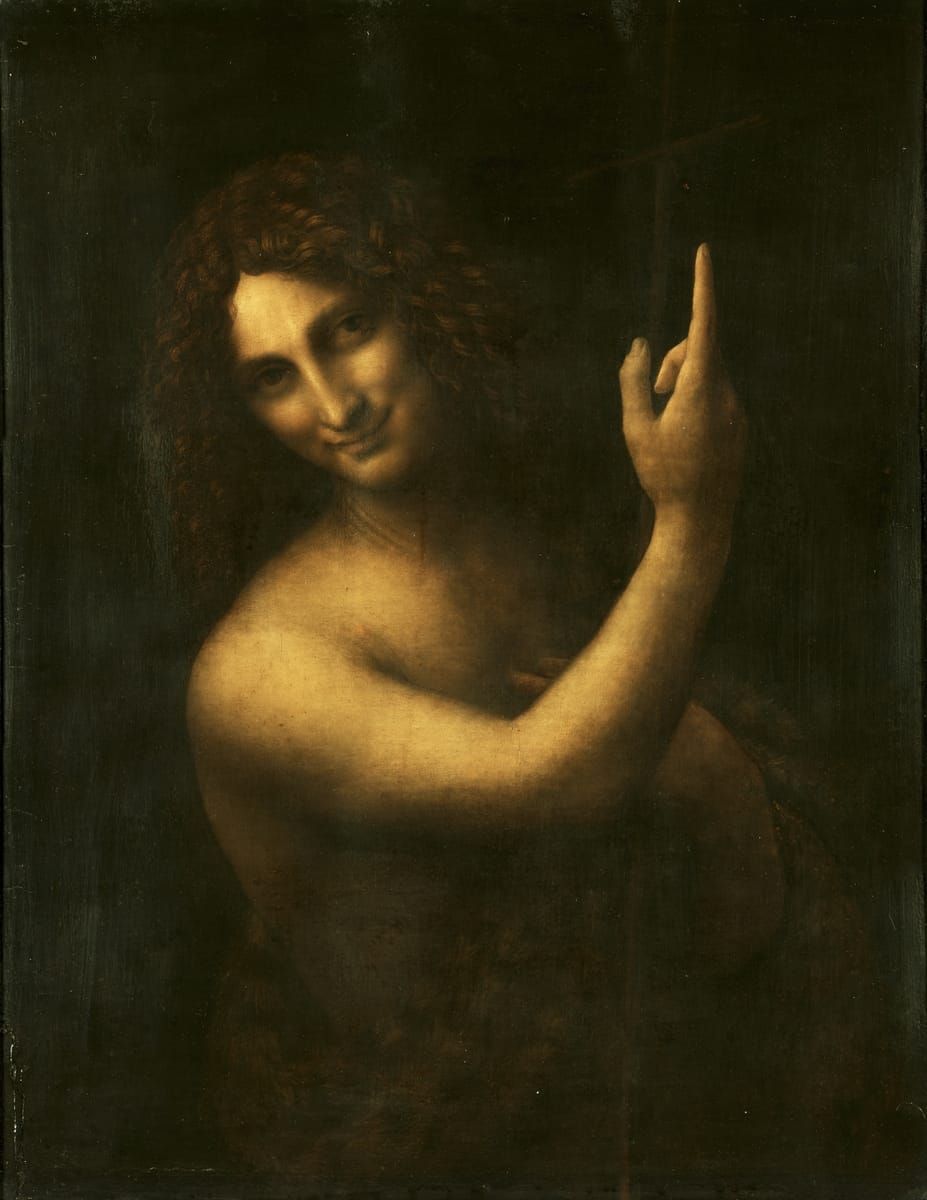
어두운 칠흑 속에서 피어오르는 신비로운 미소와 손짓으로 관람객의 영혼을 흔드는 르네상스 유화 예술의 마지막 유산, <세례 요한 (St. John the Baptist / Saint Jean Baptiste)>입니다. 이 대작은 천재 거장 레오나르도 다 빈치(Leonardo da Vinci, 1452–1519)가 1513–1516년경 완성한 그의 생애 마지막 유화 작품으로, 실제 규격은 세로 69cm, 가로 57cm 크기이며 현재 프랑스 파리의 루브르 박물관(Musée du Louvre, Paris)에 소장되어 있습니다. 화면을 가득 채운 어둠을 뚫고 드러나는 세례 요한의 매혹적이면서도 오묘한 미소와 하늘을 향해 곧게 뻗은 오른손 검지 손가락을 극적인 스푸마토 기법으로 정립해 낸 걸작입니다.
이 화작에서 세례 요한은 기존의 전통적인 종교화 속에 등장하던 야생적인 고행자의 모습이 아닌, 털가죽을 두른 우아하고 양성 구유적인(Androgynous) 청년의 자태로 등장합니다. 왼손으로는 가슴 쪽에 십자가 지팡이를 살짝 끌어안고 있으며, 오른손은 곡선을 그리며 위로 올라가 하늘을 가리킵니다. 이는 장차 오실 구원자 예수 그리스도의 출현과 천국의 존재를 선언하는 도상학적 기호입니다. 레오나르도는 수십 겹의 얇은 유화 물감 층을 겹쳐 올리는 완숙한 스푸마토(Sfumato) 기술을 사용하여 칠흑 같은 어둠 속에서 빛이 스며 나오듯 세례 요한의 미려한 어깨와 얼굴 음영을 완성해 냈습니다.
이 그림에는 거장의 마지막 순간과 얽힌 아련한 역사적 비하인드 스토리와 극찬이 전해집니다. 레오나르도는 프랑스 왕 프란체스코 1세의 초청을 받아 프랑스 앙부아즈의 클로 루세 castle로 떠날 때, 자신의 분신과도 같았던 <모나리자>, <성 안나와 성모자> 그리고 이 <세례 요한> 단 세 점의 유화만을 가지고 갔습니다. 그는 임종 직전까지 작업실에 이 그림을 걸어두고 깊은 명상에 잠기곤 했습니다. 출시 당시 전통적인 세례 요한의 성스러운 이미지를 왜곡했다는 논란도 있었으나, 후대 미술사학자들은 인간과 신성, 빛과 어둠의 경계를 허문 다 빈치 평생의 미학적·철학적 탐구가 응축된 르네상스 명암화의 정점이자 유언과도 같은 최고의 마스터피스로 높이 평가합니다.
이 그림을 들여다보는 감상자의 심리는 오묘하고 감각적인 수직 나선형 시선 동선을 따라 자연스럽게 동화됩니다. 가장 먼저 어둠 속에서 오아시스처럼 빛을 발하며 감상자를 유혹하는 세례 요한의 신비로운 미소와 깊은 눈동자에 시선이 강력하게 매료됩니다. 이어 유연한 목선과 부드럽게 부풀어 오른 오른쪽 어깨 라인을 타고 시선이 올라간 뒤, 하늘을 향해 단호하면서도 우아하게 뻗은 오른손 검지 손가락 끝에 머물게 됩니다. 손가락 끝이 가리키는 허공의 은은한 여백을 지나 왼손이 끌어안고 있는 얇은 십자가 지팡이의 윤곽을 타고 다시 요한의 매혹적인 얼굴 표정으로 동선이 순환합니다. 이러한 포근한 시각적 회귀는 인지적 긴장감을 깨끗이 풀어주며 깊은 내면의 고요와 숭고한 평온을 선사합니다.
This masterpiece, titled St. John the Baptist (Saint Jean Baptiste), was created between 1513 and 1516 by the High Renaissance genius Leonardo da Vinci (1452–1519). Measuring 69 cm in height by 57 cm in width, this celebrated oil on walnut panel is permanently preserved in the Musée du Louvre in Paris, France. Depicting Saint John emerging from an impenetrable dark background with an enigmatic smile and an upward-pointing hand, the painting stands as Leonardo’s final painted masterpiece.
The composition departs dramatically from traditional medieval iconography by presenting the saint as a youthful, radiant, and slightly androgynous figure draped in leopard fur. In his left hand, he gently holds a slender reed cross against his chest, while his right arm arcs gracefully toward the heavens—a symbolic gesture pointing to the coming of Christ and the salvation of mankind. Leonardo achieved an unprecedented mastery of sfumato, layering delicate glazes so seamlessly that the saint’s volumetric contours appear to emerge naturally from the surrounding shadows without visible line work.
Fascinating historical legends surround this testament to Leonardo’s late style. When Leonardo accepted the invitation of King Francis I to relocate to France in 1516, he carried only three precious panel paintings in his saddlebags: the Mona Lisa, The Virgin and Child with Saint Anne, and St. John the Baptist. He kept this panel in his personal studio at Clos Lucé until his death in 1519. Today, modern art historians universally revere the work as the ultimate synthesis of Leonardo's lifelong optical studies, celebrating its revolutionary use of shadow, psychological ambiguity, and transcendent spiritual grace.
Engaging with this captivating painting guides the viewer through an intuitive, spiraling visual journey. The eye is initially mesmerized by the saint’s soft, knowing smile and penetrating gaze radiating from the dark ground. The view glides smoothly along the curved contour of his right arm to rest upon his extended index finger pointing upward. Tracing the faint outline of the reed cross held near his chest, the gaze ascends naturally back to his luminous, enigmatic face, completing a harmonious visual loop that releases mental stress and evokes a profound sense of inner tranquility.
본 리뷰에서 작품을 제외한 컨텐츠의 저작권은 팔렛트제주에 있습니다.
"퍼블릭도메인 고전명화"를 제외한 모든 창작 콘텐츠는 저작권법 제4조 및 제10조에 의거하여 보호됩니다. 무단 도용시 저작권법 제136조(벌칙)에 의거, 당사의 사전 서면 승인 없는 저작권 침해 행위를 금지합니다.